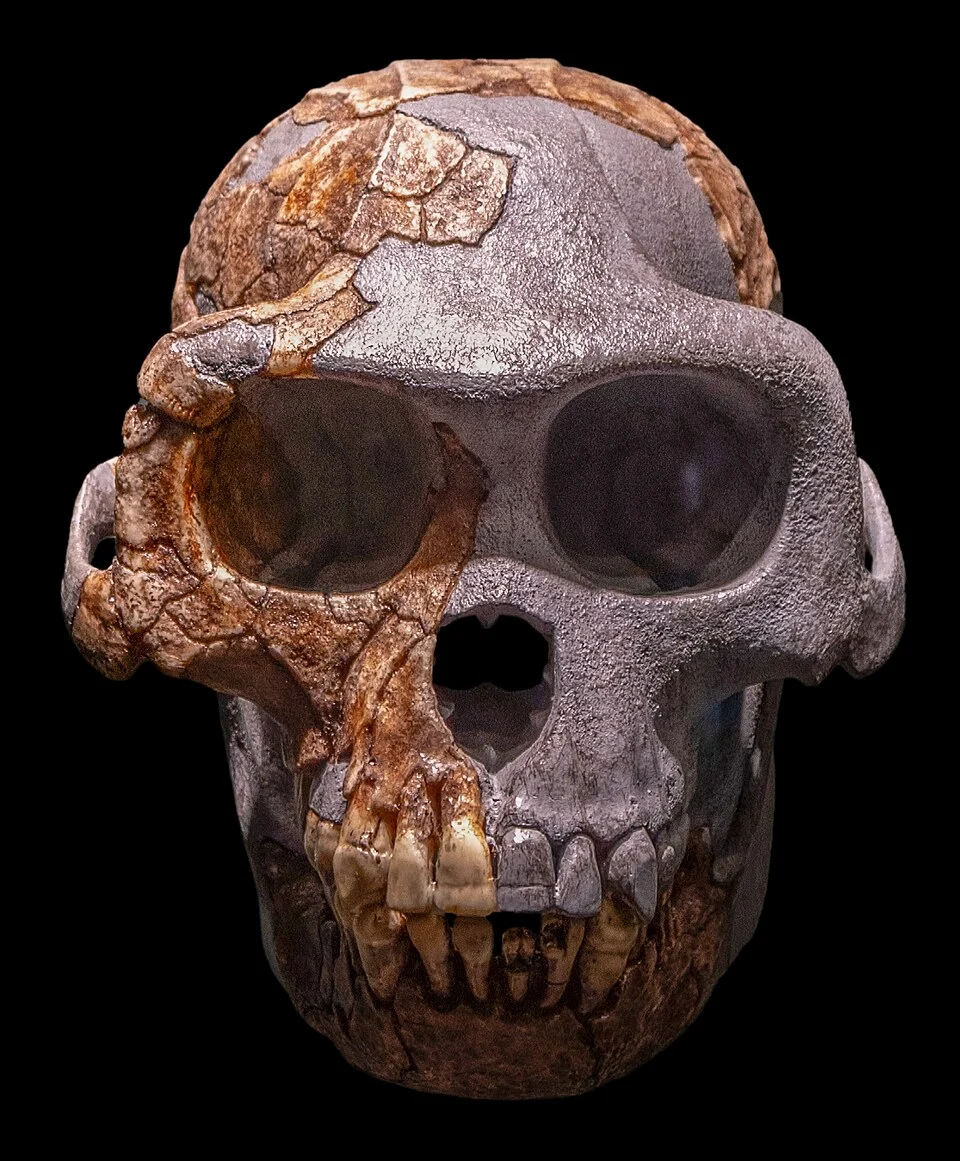
Ardipithecus ramidus
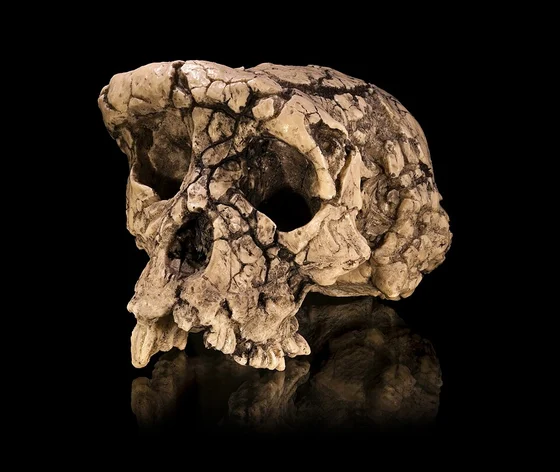
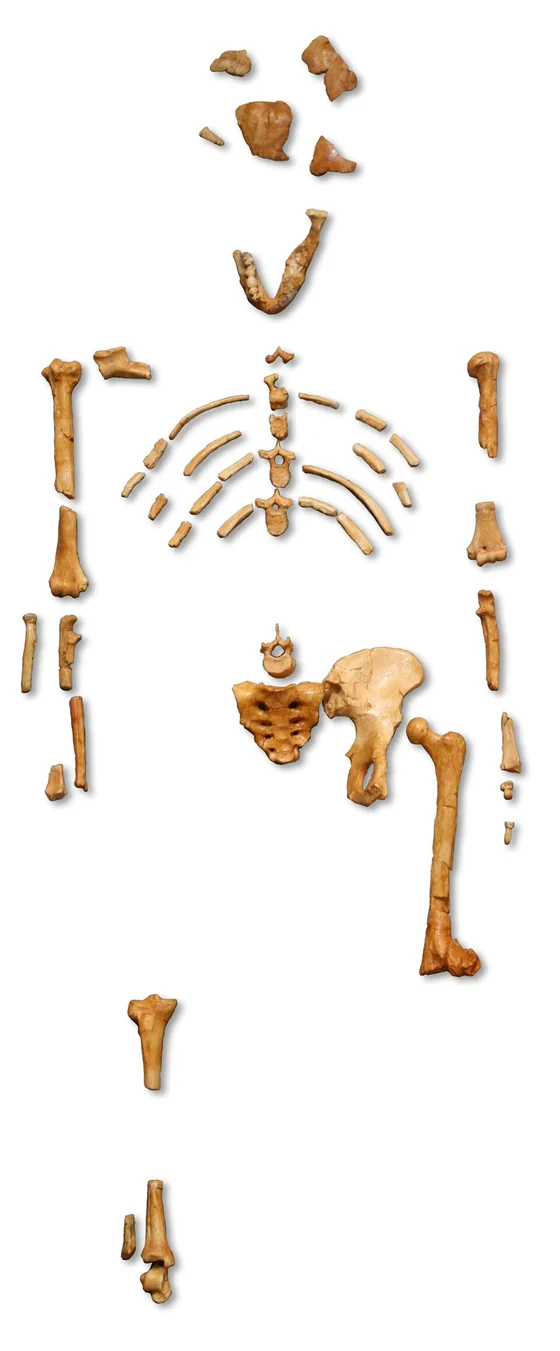
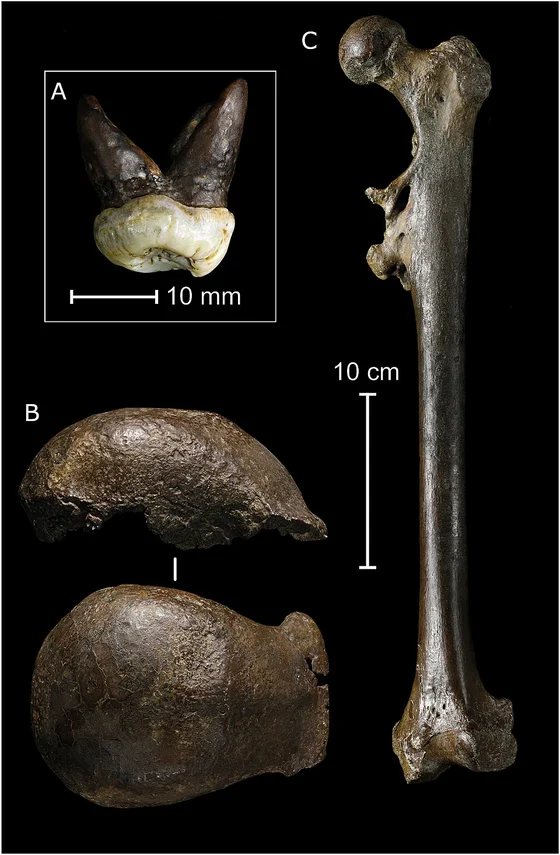
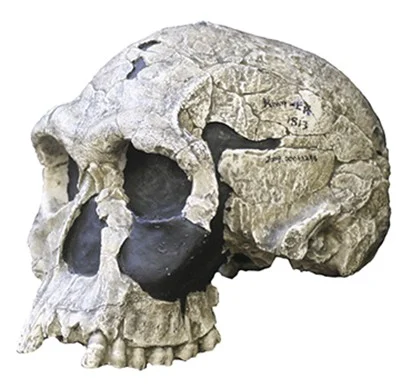
Image associated with the exact linked encyclopedia article; consult credited file description for its interpretation.
Overview
Ardipithecus ramidus is known from Ethiopia, including the partial skeleton nicknamed Ardi. Its anatomical combination differs from both living humans and living chimpanzees, making it useful for testing assumptions about early hominin bodies. The feet, pelvis and hands inform reconstructions of how terrestrial movement and climbing were combined.
Environmental evidence associates the species with wooded settings, complicating a simple story in which upright walking began only after forests vanished. Fossil damage and reconstruction affect interpretation, especially in delicate skeletal regions. The species is therefore an important comparison for the evolution of bipedalism, but it should not be treated as a modern chimpanzee standing upright or as a complete portrait of the last common ancestor shared by humans and other African apes.
The 2009 pelvis and femur study by C. Owen Lovejoy and colleagues interpreted the anatomy as combining upright walking with movement in trees. Its abstract identified a vertically shortened upper hip bone and increased lower-back curvature as contributors to bipedality. The authors argued that these adaptations developed without depending on the specialized climbing and knuckle-walking anatomy of living African apes. This is their functional interpretation, summarized from the public abstract rather than an independent examination of the reconstructed pelvis.
Thomas Cody Prang tested a different aspect of the debate in 2019: the proportions of the foot. He compared six measurements preserved or estimated in the Ardi foot with a broad sample of living primates. Measurements were initially taken on casts and observations subsequently checked against original fossils in Ethiopia. The incomplete fifth metatarsal required an estimated length, and the poorly preserved heel prevented assessment of one important lever arm. These limitations matter because a foot is a working system of joints, bones and soft tissues, while the analysis could measure only selected parts.
After adjusting for size, the Ardi foot grouped most closely with African apes. The combination included relatively short lesser toes and metatarsals, a long big-toe metatarsal and moderately elongated ankle-region bones. Prang interpreted this pattern as compatible with placing the heel on the ground during quadrupedal movement while retaining vertical climbing ability. A modestly elongated midfoot could also improve propulsion during bipedal walking. The result therefore did not reduce Ardi to a modern chimpanzee or deny upright movement; it challenged an exclusively arboreal account of the anatomy from which bipedalism arose.
The study also compared evolutionary models and estimated ancestral foot proportions. Ardipithecus was placed on the starting tree as an early member of the human lineage, rather than having that position established by the foot measurements themselves. The preferred reconstructions supported an African-ape-like ancestral foot, conditional on the comparative data and modelling assumptions. Prang stressed that a heel-down foot posture does not establish knuckle-walking: the latter requires evidence from the hand and wrist. Additional skeletal regions are therefore needed to test how well this foot-based interpretation describes the animal as a whole.
Origins & earliest records
Ardipithecus ramidus was recognised from Ethiopian fossils and formally described in the 1990s. Its best-known material is about 4.4 million years old. The age of those remains records a population in geological time; discovery, naming and later publication of the partial skeleton are separate milestones in human knowledge.
Evidence & interpretation
Teeth, cranial remains and the partial Ardi skeleton support anatomical reconstruction, while associated sediments and organisms constrain habitat. Damaged and incomplete bones require restoration and comparison. Locomotor interpretation therefore combines directly preserved features with functional inference, and the species' exact ancestral relationship to later hominins remains less certain than its existence.
Selected bibliography
Documented works and useful reading. This is not a list of every appearance.
- 01
Ardipithecus ramidus
Selected institutional scientific reading; not a complete bibliography.
- 02
The pelvis and femur of Ardipithecus ramidus: the emergence of upright walking
Complete public abstract read through Europe PMC; full article and supplementary reconstructions not read.
- 03
The African ape-like foot of Ardipithecus ramidus and its implications for the origin of bipedalism
Summary adapted under CC BY4. Complete main Results, Discussion and Methods read, including model construction and fossil measurement limitations; analyses not rerun.
Family, evolution & connections
Selected fossil hominins — a 2015 Bayesian summary
Eight terminals pruned from Figure 1; chimpanzee/gorilla outgroups and other hominins omitted.
Scroll sideways to see all branches. With a keyboard, focus the tree and use the arrow keys.
- Selected hominin terminals
- Remaining sampled terminals
- Selected branches — original node PP 0.25
- Selected branches — original node PP 0.59
- Selected branches — original node PP 0.22
- Selected branches — original node PP 0.59
- Published pair — PP 0.92
- Homo heidelbergensis
Dated Bayesian craniodental analysis: 380 characters, 20 hominins and two outgroups; MrBayes 3.2.3, corrected Mk/gamma model, uncorrelated clock and birth–death prior. Four 10-million-generation runs, 25% burn-in. PP labels retain original nodes after pruning. This historical summary contains weakly supported branches, not settled ancestry. Fossil dating uses scored specimens, not necessarily species first appearances. Missing data and alternative taxonomic groupings matter. Pruning excludes Australopithecus sediba, originally paired with H. habilis, and distinct H. ergaster. No direct ancestor, divergence date or genomic admixture history is inferred.
Selected hominins — Dembo 2016 hypothesis
Nine-tip pruning of Figure 2’s dated Bayesian summary.
Scroll sideways to see all branches. With a keyboard, focus the tree and use the arrow keys.
- Selected hominins
- Ramidus branch
- Afarensis branch
- Habilis branch
- Asian erectus branch — posterior 0.27
- Naledi branch — posterior 0.36
- H. naledi
- Remaining sampled group — posterior 0.94
- Pair — posterior 0.50
- H. heidelbergensis
391 craniodental characters, 24 taxa; corrected Mk/gamma, relaxed clock, birth–death prior; four 20-million-generation runs, 25% burn-in. Original node probabilities are retained, not recomputed. Many branches are weak. Omitted tips include Au. sediba beside H. habilis, H. antecessor beside the sapiens group, and distinct African/Georgian erectus samples. Asian erectus alone maps to the broader profile. Bayes-factor tests did not identify a unique naledi sister. This historical morphology-based tree predates independent naledi dating; no ages or direct ancestors are inferred. It differs from the 2015 matrix and is not merged with it.
Taxonomic classification
A hierarchy of classified groups, not a chain of direct ancestors.
- kingdomAnimalia
- phylumChordata
- classMammalia
- orderPrimates
- familyHominidae
- genusArdipithecus
- speciesArdipithecus ramidus
Encyclopedia background
An additional attributed reference, separate from the editorial profile above.
Read the open encyclopedia overview
Ardipithecus ramidus is a species of australopithecine from the Afar region of Early Pliocene Ethiopia 4.4 million years ago (Ma). The species A. ramidus is the type species for the genus Ardipithecus. There is an older species in this same genus, Ardipithecus kadabba that was discovered more recently.
A. ramidus, unlike modern hominids, has adaptations for both walking on two legs (bipedality) and life in the trees (arboreality), as it has a divergent big toe and evidence of bipedality. This combination of a big toe that would facilitate climbing suggests that Ardipithecus was not as efficient at bipedality as humans or even Australopithecus (a genus that did not have a divergent big toe), nor as good at arboreality as non-human great apes.
The discovery of Ardipithecus, along with Miocene apes, has reworked academic understanding of the chimpanzee–human last common ancestor. Historically, humans were thought to have evolved from a chimpanzee-like ancestor. However, Ardipithecus demonstrates that the last common ancestor had no "close analog among living monkeys or apes" (like modern-day chimpanzees, orangutans or gorillas), but rather represents an intermediate species between Australopithecus immediately (acting as a bridge in many respects to the yet to be found late Miocene African ape) and both humans and modern-day chimpanzees distantly.
In addition to the divergent big toe, another unusual feature of Ardipithecus is the dental anatomy, as it has reduced size and sexual dimorphism of the canines. This reduction in the size of the canines for both males and females suggests that A. ramidus males were less aggressive than those of modern chimps, a feature that is correlated with increased parental care and monogamy in primates.
A. ramidus appears to have inhabited woodland and bushland corridors between savannas, and was a generalized omnivore.
Text from Wikipedia contributors, “Ardipithecus ramidus”. CC BY-SA 4.0. Extracted introduction; formatting changed. Retrieved 5 October 2026. The source article may have changed since retrieval.
References
Sources supporting this profile. Linked pages have their own scope and editorial standards.
- MuseumArdipithecus ramidusResearch access: 2026-10-05
- Primary researchLovejoy and colleagues (2009)Research access: 2026-10-05
- Primary researchThe African ape-like foot of Ardipithecus ramidus and its implications for the origin of bipedalismResearch access: 2026-10-05
Image credits
Reference illustrationArdipithecus ramidus
Image associated with the exact linked encyclopedia article; consult credited file description for its interpretation.