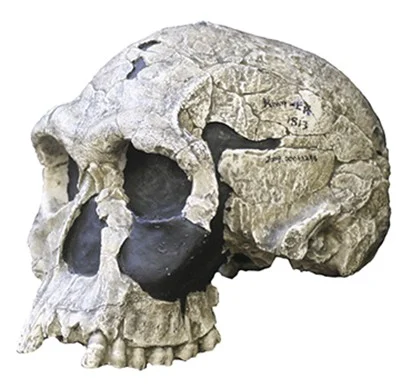
Homo habilis
Image associated with the exact linked encyclopedia article; consult credited file description for its interpretation.
Overview
Homo habilis was named from African fossils that showed differences from previously described australopithecines. Its braincase and teeth informed placement within Homo, while the traditional handy-man name reflected proposed links with stone tools. The species is an important part of debates about what defines the earliest members of our genus.
Tool-making cannot be assigned to one species merely because fossils and artefacts occur near each other. Several hominin lineages coexisted, and earlier tool evidence complicates the idea that habilis introduced technology. Fossils assigned to the species also vary, raising questions about whether all should be grouped together. An entry can explain the conventional taxon while acknowledging that species boundaries and direct ancestry remain active scientific problems.
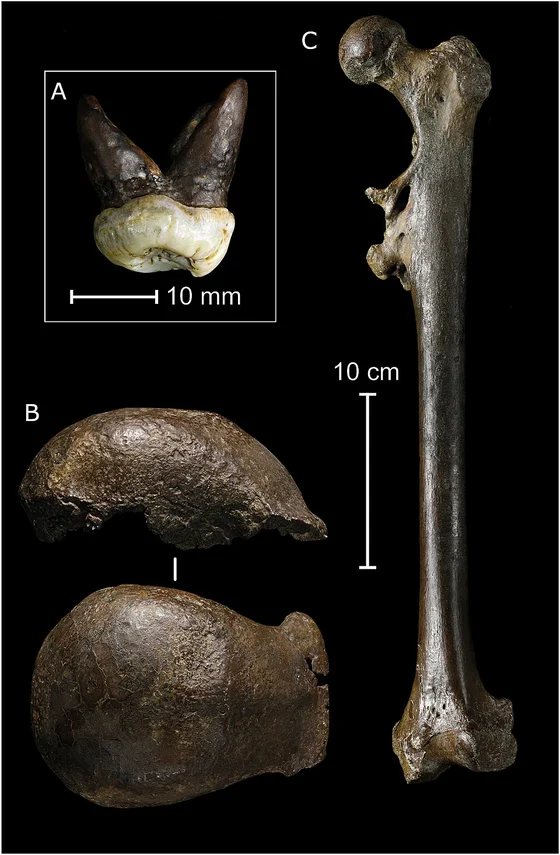
The fragmentary hand associated with Olduvai Hominid 7 illustrates why specimen attribution matters. In a 2010 comparative study, Almécija, Moyà-Solà and Alba examined the terminal thumb phalanx attributed to OH 7 alongside fossil hominins and living primates. Their measurements considered length, shaft and base dimensions, and the width of the terminal expansion supporting the fingertip. The analysis compared overall shape and the robusticity of thumb and middle-finger terminal bones. Measurements came from original specimens, good-quality casts or published data, rather than uniformly from complete original hands.
The OH 7 thumb bone had an unusually broad shaft and terminal expansion. It lacked a distinctive ridge for the long thumb-flexor insertion and some features associated with the separated fingertip-pad regions of modern human thumbs. Its robusticity pattern resembled that of the compared Paranthropus specimen and, in relative thumb-versus-finger breadth, some quadrupedal monkeys. These comparisons concern particular anatomical traits; they do not establish that the fossil individual moved or manipulated objects exactly like a living monkey.
The authors emphasized that assigning the hand to Homo habilis was itself open to question. Its original association with the OH 7 juvenile jaw and skull fragments had been accepted partly because the hand was also immature. Other researchers had suggested a Paranthropus attribution on anatomical grounds. The 2010 paper supported reconsidering that possibility, while acknowledging that more postcranial remains were needed to resolve functional and taxonomic questions. It did not definitively reidentify the entire OH 7 individual or transfer the species name to another genus.
The study also separated the ability to manipulate objects from manufacture of stone tools. Some precision-grip-related features occurred in much older fossil material in its comparison, prompting the authors to propose an early manipulative role predating tool-making. That broader evolutionary explanation remained a hypothesis requiring more complete hands. For Homo habilis, the immediate lesson is narrower: an isolated bone, a disputed anatomical association and a nearby archaeological assemblage provide different kinds of evidence. They cannot be combined into a confident reconstruction of a particular grip or an exclusive claim to technological invention.
Origins & earliest records
Homo habilis was named in 1964 from East African fossils. Known material is generally placed between roughly 2.4 and 1.4 million years ago, with the timeline marker of two million years representing that interval. The name's historical association with tools does not establish either the first technology or the species' precise evolutionary origin.
Evidence & interpretation
Skulls, teeth and fragmentary skeletons support anatomical comparison, while nearby stone tools establish activity by hominins in relevant settings. The exact makers are not always identifiable. Differences among assigned fossils drive taxonomic debate, and brain size alone cannot securely determine behaviour, species boundaries or whether the taxon directly gave rise to later Homo. The 2010 thumb-bone comparison offers specimen-specific morphology and a debated attribution of the OH 7 hand; inferred grip properties do not directly identify archaeological tool-makers.
Selected bibliography
Documented works and useful reading. This is not a list of every appearance.
- 01
Homo habilis
Selected institutional scientific reading; not a complete bibliography.
- 02
Early Origin for Human-Like Precision Grasping: A Comparative Study of Pollical Distal Phalanges in Fossil Hominins
PLOS ONE 5(7):e11727, 22 July 2010; DOI 10.1371/journal.pone.0011727. Complete main Introduction, Results, Discussion, Conclusions and Materials and Methods read, with textual captions; videos, original fossil pixels and statistical reruns not inspected. Original unrestricted Creative Commons Attribution notice; attributed original summary.
Family, evolution & connections
Selected fossil hominins — a 2015 Bayesian summary
Eight terminals pruned from Figure 1; chimpanzee/gorilla outgroups and other hominins omitted.
Scroll sideways to see all branches. With a keyboard, focus the tree and use the arrow keys.
- Selected hominin terminals
- Remaining sampled terminals
- Selected branches — original node PP 0.25
- Selected branches — original node PP 0.59
- Selected branches — original node PP 0.22
- Selected branches — original node PP 0.59
- Published pair — PP 0.92
- Homo heidelbergensis
Dated Bayesian craniodental analysis: 380 characters, 20 hominins and two outgroups; MrBayes 3.2.3, corrected Mk/gamma model, uncorrelated clock and birth–death prior. Four 10-million-generation runs, 25% burn-in. PP labels retain original nodes after pruning. This historical summary contains weakly supported branches, not settled ancestry. Fossil dating uses scored specimens, not necessarily species first appearances. Missing data and alternative taxonomic groupings matter. Pruning excludes Australopithecus sediba, originally paired with H. habilis, and distinct H. ergaster. No direct ancestor, divergence date or genomic admixture history is inferred.
Selected hominins — Dembo 2016 hypothesis
Nine-tip pruning of Figure 2’s dated Bayesian summary.
Scroll sideways to see all branches. With a keyboard, focus the tree and use the arrow keys.
- Selected hominins
- Ramidus branch
- Afarensis branch
- Habilis branch
- Asian erectus branch — posterior 0.27
- Naledi branch — posterior 0.36
- H. naledi
- Remaining sampled group — posterior 0.94
- Pair — posterior 0.50
- H. heidelbergensis
391 craniodental characters, 24 taxa; corrected Mk/gamma, relaxed clock, birth–death prior; four 20-million-generation runs, 25% burn-in. Original node probabilities are retained, not recomputed. Many branches are weak. Omitted tips include Au. sediba beside H. habilis, H. antecessor beside the sapiens group, and distinct African/Georgian erectus samples. Asian erectus alone maps to the broader profile. Bayes-factor tests did not identify a unique naledi sister. This historical morphology-based tree predates independent naledi dating; no ages or direct ancestors are inferred. It differs from the 2015 matrix and is not merged with it.
Taxonomic classification
A hierarchy of classified groups, not a chain of direct ancestors.
Encyclopedia background
An additional attributed reference, separate from the editorial profile above.
Read the open encyclopedia overview
Homo habilis (lit. 'handy man') is an extinct species of archaic human from the Early Pleistocene of East and South Africa about 2.4 million years ago to 1.65 million years ago (mya). It is among the oldest species of archaic humans. Suggestions for pushing back the age to 2.8 Mya were made in 2015 based on the discovery of a jawbone. Upon species description in 1964, H. habilis was highly contested, with many researchers recommending it be synonymised with Australopithecus africanus, the only other early hominin known at the time, but H. habilis received more recognition as time went on and more relevant discoveries were made. By the 1980s, H. habilis was proposed to have been a human ancestor, directly evolving into Homo erectus, which directly led to modern humans. This viewpoint is now debated. Several specimens with insecure species identification were assigned to H. habilis, leading to arguments for splitting, namely into "H. rudolfensis" and "H. gautengensis" of which only the former has received wide support.
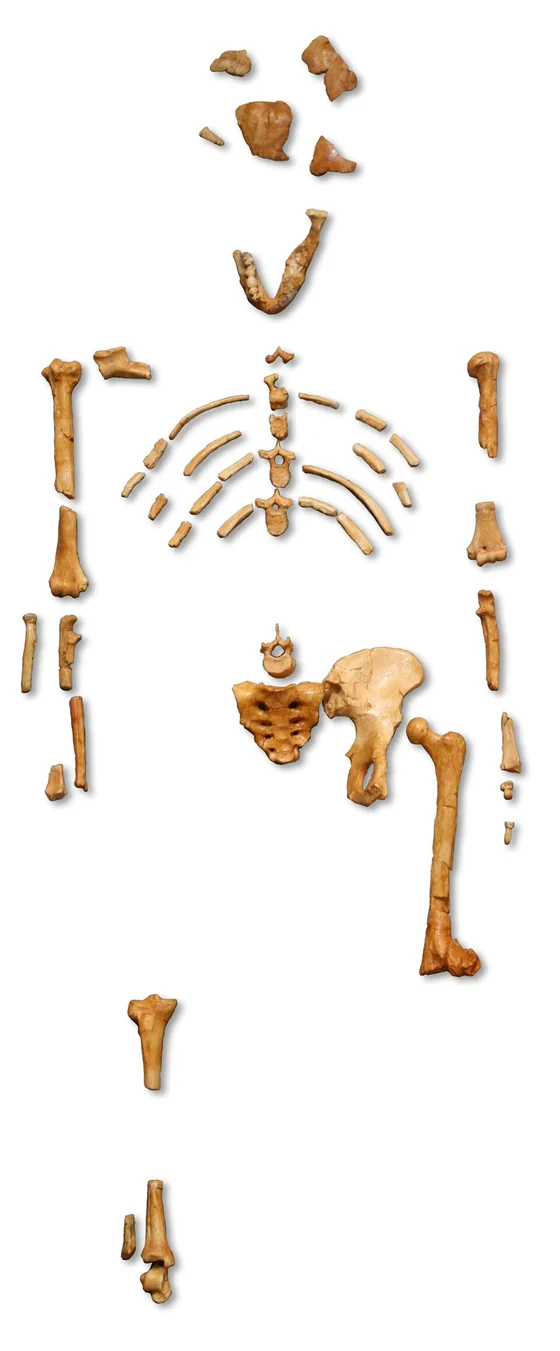
H. habilis brain size generally varied from 500 to 900 cm3 (31–55 cu in). The body proportions of H. habilis are only known from two highly fragmentary skeletons, and is based largely on assuming a similar anatomy to the earlier australopithecines. Because of this, it has also been proposed H. habilis be moved to the genus Australopithecus as Australopithecus habilis. However, the interpretation of H. habilis as a small-statured human with inefficient long-distance travel capabilities has been challenged. The presumed female specimen OH 62 is traditionally interpreted as having been 100–120 cm (3 ft 3 in – 3 ft 11 in) in height and 20–37 kg (44–82 lb) in weight assuming australopithecine-like proportions, but assuming humanlike proportions she would have been about 148 cm (4 ft 10 in) and 35 kg (77 lb). Nonetheless, Homo habilis may have been at least partially arboreal like what is postulated for australopithecines. Early hominins are typically reconstructed as having thick hair and marked sexual dimorphism with males much larger than females, though relative male and female size is not definitively known.
H. habilis manufactured the Oldowan stone tool industry and mainly used tools in butchering. Early Homo, compared to australopithecines, are generally thought to have consumed high quantities of meat and, in the case of H. habilis, scavenged meat. Typically, early hominins are interpreted as having lived in polygynous societies, though this is highly speculative. Assuming H. habilis society was similar to that of modern savanna chimpanzees and baboons, groups may have numbered 70–85 members. This configuration would be advantageous with multiple males to defend against open savanna predators, such as big cats, hyenas and crocodiles. H. habilis coexisted with H. rudolfensis, H. ergaster / H. erectus and Paranthropus boisei.
Text from Wikipedia contributors, “Homo habilis”. CC BY-SA 4.0. Extracted introduction; formatting changed. Retrieved 5 October 2026. The source article may have changed since retrieval.
References
Sources supporting this profile. Linked pages have their own scope and editorial standards.
- MuseumHomo habilisResearch access: 2026-10-05
- ResearchEarly Origin for Human-Like Precision Grasping: A Comparative Study of Pollical Distal Phalanges in Fossil HomininsResearch access: 2026-10-06
Image credits
Reference illustrationHomo habilis
Image associated with the exact linked encyclopedia article; consult credited file description for its interpretation.