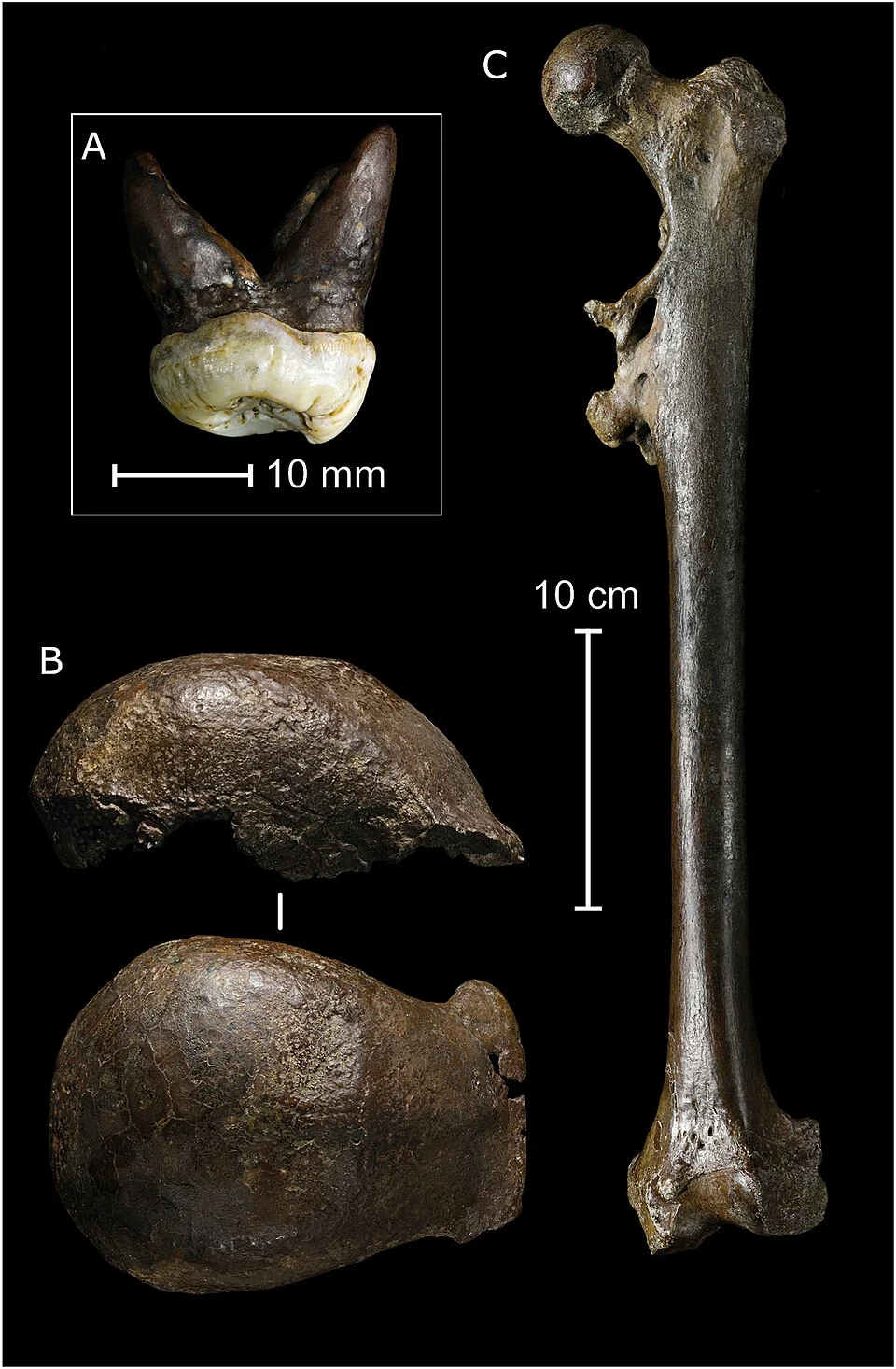
Homo erectus
Image associated with the exact linked encyclopedia article; consult credited file description for its interpretation.
Overview
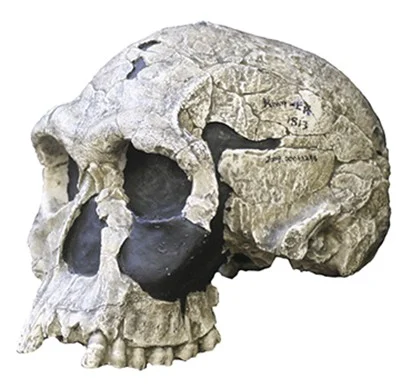
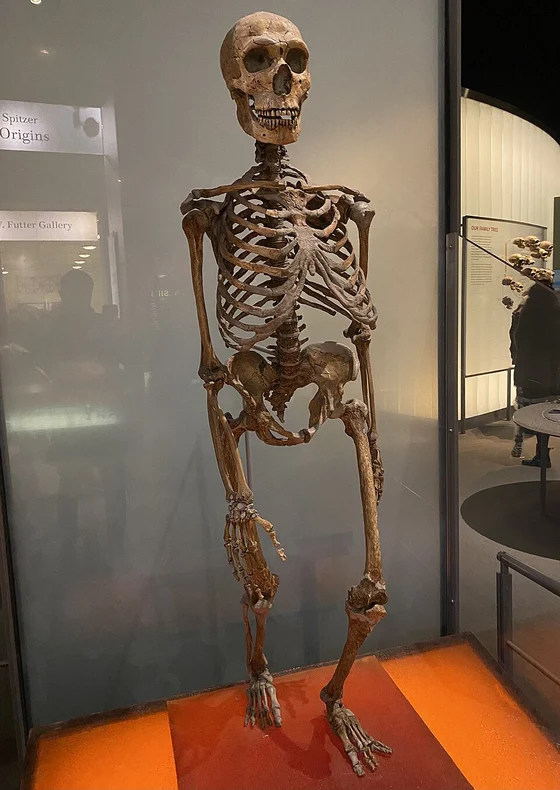
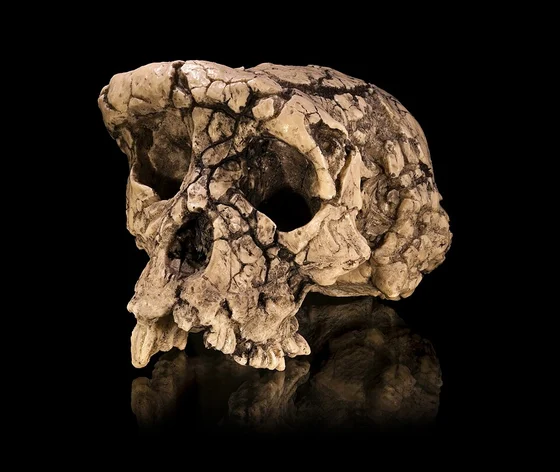
Homo erectus is represented by fossils from Africa and Asia and occupies an important place in the history of human dispersal. Long legs and other body features in well-known specimens show changes from earlier hominins. Skulls retain a characteristic long, low form, with substantial variation across a very broad geographical and temporal record.
Some researchers separate African material as Homo ergaster, while others use a wider erectus classification. That choice changes statements about the taxon's range and duration. Archaeological associations inform discussion of tools, food and possible fire use, but these behaviours are not equally documented at every site. Erectus therefore represents a complex evolutionary and population history rather than one uniform culture spreading unchanged across two continents.
A reconstruction published by Karen Baab and colleagues in 2025 added facial detail to the DAN5/P1 cranium from Gona, Ethiopia, dated to approximately 1.6–1.5 million years ago. Micro-CT scans allowed fragments to be repositioned and missing opposite sides mirrored. The reconstructed face combined features associated with erectus and more ancestral Homo anatomy. The authors favoured population differences within early erectus, while retaining alternatives involving variation, chronology or interbreeding. Attaching the face to the braincase introduced particular uncertainty, tested with an alternative reconstruction. Anatomical resemblance alone did not establish a direct relationship with Homo naledi.
Markus Bastir and colleagues’ 2020 study also challenged an overly uniform body reconstruction. Its public abstract describes a three-dimensional reconstruction of the juvenile Nariokotome skeleton, KNM-WT 15000, alongside an estimated adult rib cage. The reconstructed chest was relatively short, broad and deep compared with the shallower chest of living humans. Long legs therefore need not imply that the entire torso already had modern human proportions. The adult form was estimated from a juvenile fossil, rather than recovered as a complete adult skeleton. This account is limited to the abstract; the full reconstruction procedures were not assessed.
Research published online in 2019 by Yan Rizal and colleagues placed the Ngandong fossil-bearing deposit in Java at approximately 117,000–108,000 years ago. The study combined 52 radiometric age estimates in a model linking regional geology, river terraces and the excavated bone bed. Dating included nonhuman fossils; it was not a direct measurement of the human skullcaps themselves. The inferred interval concerns accumulation during flooding and supported Ngandong as the latest known occurrence in that study. It does not identify the precise moment when every population became extinct. The journal issue appeared in 2020.
Origins & earliest records
Homo erectus was named from Javan discoveries in the nineteenth century. African and Asian fossils extend its recognised history towards the beginning of the Pleistocene, depending on taxonomic choices. The marker near 1.8 million years is representative; scientific discovery, first dispersal and biological origin should not be collapsed into one event.
Evidence & interpretation
Skulls and more complete skeletons establish body and cranial variation, while dated archaeological sites constrain geography and activities. Species boundaries with ergaster and other fossils are debated. Associations with fire or tools require site-specific evidence, and the age of one find cannot establish a single migration route or behaviour shared by every population.
Selected bibliography
Documented works and useful reading. This is not a list of every appearance.
- 01
Homo erectus
Selected institutional scientific reading; not a complete bibliography.
- 02
New reconstruction of DAN5 cranium (Gona, Ethiopia) supports complex emergence of Homo erectus
Focal reconstruction Results, complete main Discussion and Methods read. Brief account; CC BY-NC-ND4 is not an unrestricted reuse grant.
- 03
Rib cage anatomy in Homo erectus suggests a recent evolutionary origin of modern human body shape
Complete public abstract and bibliographic record read; full article not read.
- 04
Last appearance of Homo erectus at Ngandong, Java, 117,000–108,000 years ago
Complete public abstract read. Online publication 18 December 2019; Nature volume577, pages381–385, 2020.
Family, evolution & connections
Selected fossil hominins — a 2015 Bayesian summary
Eight terminals pruned from Figure 1; chimpanzee/gorilla outgroups and other hominins omitted.
Scroll sideways to see all branches. With a keyboard, focus the tree and use the arrow keys.
- Selected hominin terminals
- Remaining sampled terminals
- Selected branches — original node PP 0.25
- Selected branches — original node PP 0.59
- Selected branches — original node PP 0.22
- Selected branches — original node PP 0.59
- Published pair — PP 0.92
- Homo heidelbergensis
Dated Bayesian craniodental analysis: 380 characters, 20 hominins and two outgroups; MrBayes 3.2.3, corrected Mk/gamma model, uncorrelated clock and birth–death prior. Four 10-million-generation runs, 25% burn-in. PP labels retain original nodes after pruning. This historical summary contains weakly supported branches, not settled ancestry. Fossil dating uses scored specimens, not necessarily species first appearances. Missing data and alternative taxonomic groupings matter. Pruning excludes Australopithecus sediba, originally paired with H. habilis, and distinct H. ergaster. No direct ancestor, divergence date or genomic admixture history is inferred.
Selected hominins — Dembo 2016 hypothesis
Nine-tip pruning of Figure 2’s dated Bayesian summary.
Scroll sideways to see all branches. With a keyboard, focus the tree and use the arrow keys.
- Selected hominins
- Ramidus branch
- Afarensis branch
- Habilis branch
- Asian erectus branch — posterior 0.27
- Naledi branch — posterior 0.36
- H. naledi
- Remaining sampled group — posterior 0.94
- Pair — posterior 0.50
- H. heidelbergensis
391 craniodental characters, 24 taxa; corrected Mk/gamma, relaxed clock, birth–death prior; four 20-million-generation runs, 25% burn-in. Original node probabilities are retained, not recomputed. Many branches are weak. Omitted tips include Au. sediba beside H. habilis, H. antecessor beside the sapiens group, and distinct African/Georgian erectus samples. Asian erectus alone maps to the broader profile. Bayes-factor tests did not identify a unique naledi sister. This historical morphology-based tree predates independent naledi dating; no ages or direct ancestors are inferred. It differs from the 2015 matrix and is not merged with it.
Taxonomic classification
A hierarchy of classified groups, not a chain of direct ancestors.
Encyclopedia background
An additional attributed reference, separate from the editorial profile above.
Read the open encyclopedia overview
Homo erectus ( lit. 'upright man') is an extinct species of archaic human from the Pleistocene, spanning nearly 2 million years. It is the first human species to evolve a humanlike body plan and gait, to leave Africa and colonize Asia and Europe, and to wield fire. Some populations of H. erectus were ancestors of later human species, including H. heidelbergensis—the last common ancestor of modern humans, Neanderthals, and Denisovans. As such a widely distributed species both geographically and temporally, H. erectus anatomy varies considerably. Subspecies are sometimes recognized: H. e. erectus, H. e. pekinensis, H. e. soloensis, H. e. ergaster, H. e. georgicus, and H. e. tautavelensis.
The species was first described by Eugène Dubois in 1893 as "Pithecanthropus erectus" using a skullcap, molar, and femur from Java, Indonesia. Further discoveries around East Asia were used to contend that humanity evolved out of Asia. Based on historical race concepts, it was argued that local H. erectus populations evolved directly into local modern human populations (polycentrism) rather than all humanity sharing a single anatomically modern ancestor (monogenism). As the fossil record improved over the mid-to-late 20th century, the "Out of Africa" theory and monogenism became the consensus.
The typical skull has a pronounced brow ridge, a protruding jaw, and large teeth. The bones are much thicker than in modern humans. East Asian populations normally have an even more robust skeleton and larger brain volume—averaging 1,000 cc (61 cu in). Western H. erectus brain volume could be as low as 546 cc (33.3 cu in) in H. e. georgicus. H. erectus probably had a faster apelike growth trajectory, lacking the extended childhood required for language acquisition. Reconstructed adult body dimensions range from 141–167 cm (4 ft 8 in – 5 ft 6 in) in height and about 50 kg (110 lb) in weight.
H. erectus invented the Acheulean tool industry, a major innovation of large, heavy-duty stone tools. These may have been used in butchery, vegetable processing, and woodworking of spears and digging sticks. H. erectus was a major predator of large herbivores on the expanding savannas during the Quaternary glaciation. The species is usually characterized as the first hunter-gatherer and the first to practice sexual division of labor. Fire usage and cave habitation were probably not important aspects of daily life. Similarly, H. erectus may not have often ventured into colder regions or cooked meat. The last known occurrence of H. erectus is 108,000 to 117,000 years ago (H. e. soloensis) in Southeast Asia, until the last savannas in the region gave way to jungle.
Text from Wikipedia contributors, “Homo erectus”. CC BY-SA 4.0. Extracted introduction; formatting changed. Retrieved 5 October 2026. The source article may have changed since retrieval.
References
Sources supporting this profile. Linked pages have their own scope and editorial standards.
- MuseumHomo erectusResearch access: 2026-10-05
- Primary researchBaab and colleagues (2025)Research access: 2026-10-05
- Primary researchBastir and colleagues (2020)Research access: 2026-10-05
- Primary researchRizal and colleagues (2019/2020)Research access: 2026-10-05
Image credits
Reference illustrationHomo erectus
Image associated with the exact linked encyclopedia article; consult credited file description for its interpretation.