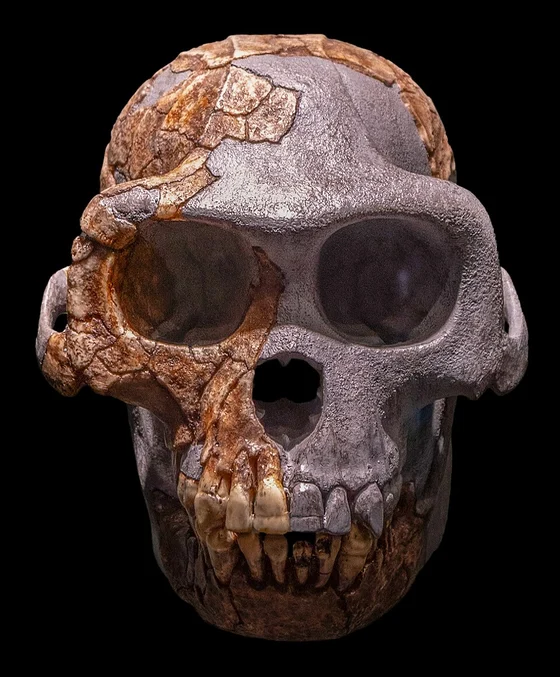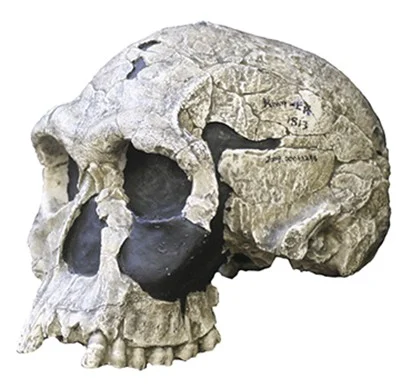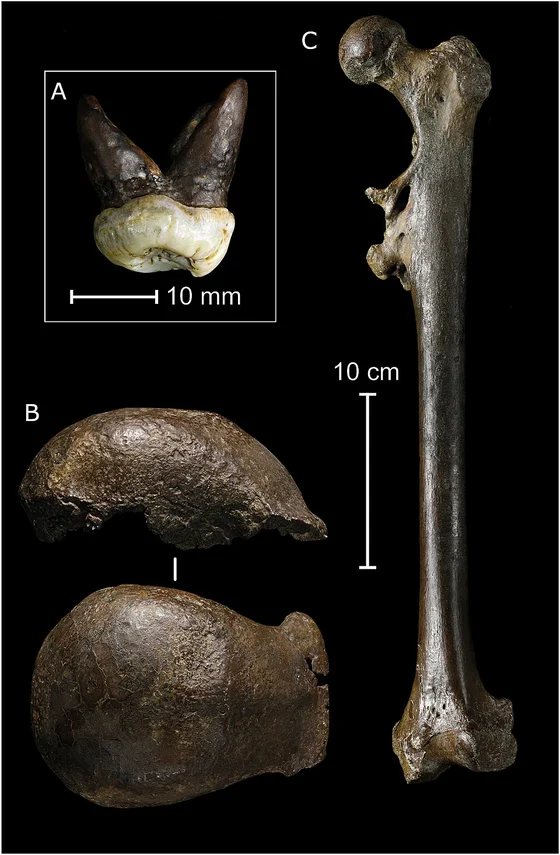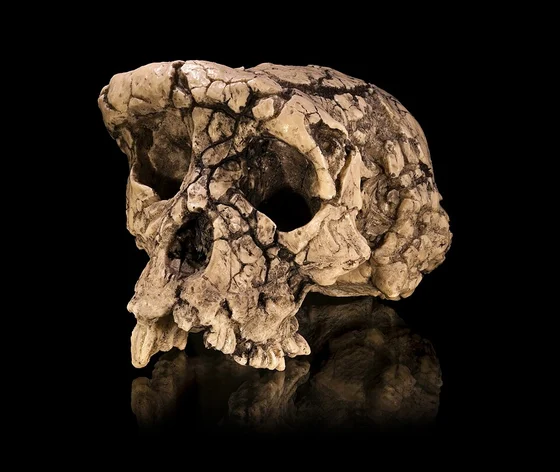
Australopithecus afarensis
Image associated with the exact linked encyclopedia article; consult credited file description for its interpretation.
Overview
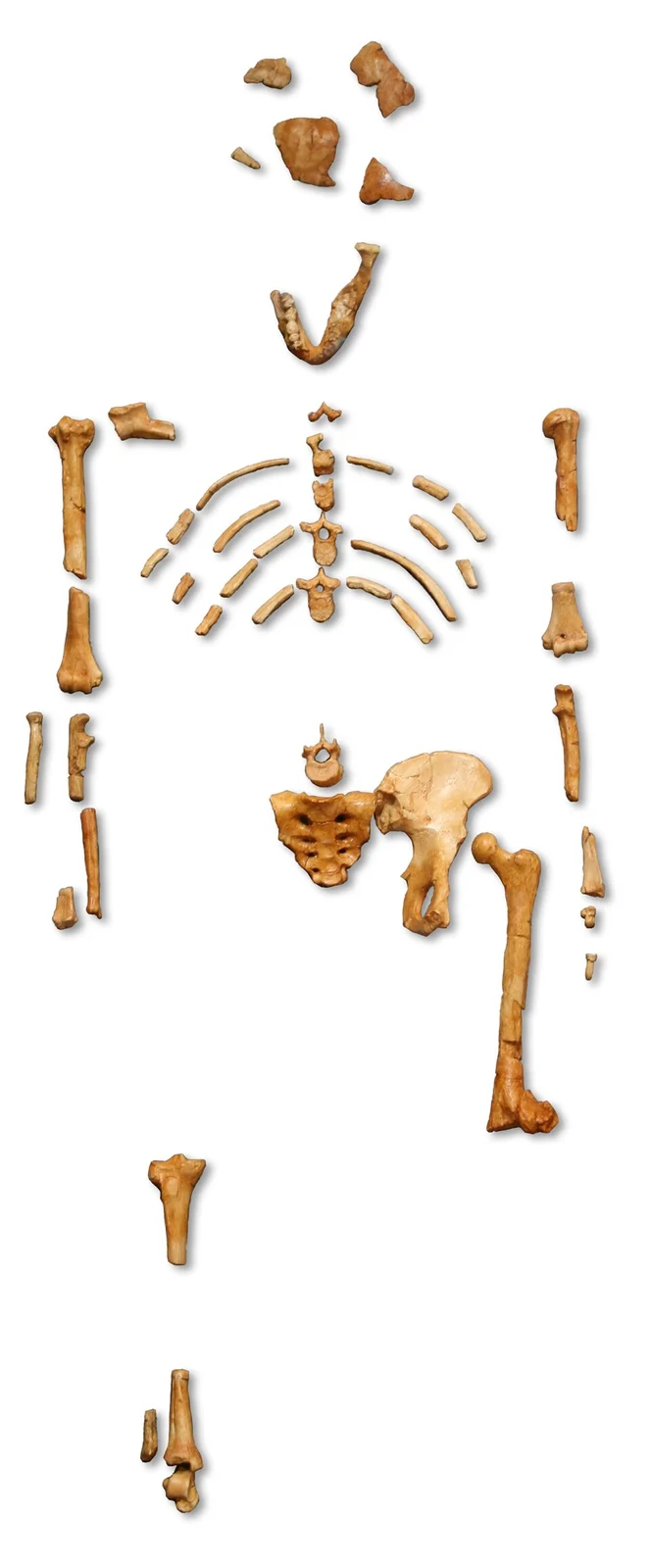
Australopithecus afarensis includes the famous Lucy partial skeleton and other fossils from East Africa. Pelvic, leg and foot anatomy support walking on two legs, while upper-limb features retain signals relevant to climbing. Its relatively small brain demonstrates that substantial brain enlargement was not a prerequisite for habitual bipedal movement.
Fossils from several individuals reveal variation in body size and development. The Laetoli footprints offer an additional behavioural record associated with hominins of the same general interval, although assigning traces to a species requires caution. Afarensis helps reconstruct a branching evolutionary history rather than a ladder from apes to humans. Debates over its precise relationship to later lineages do not diminish the direct evidence that different anatomical changes evolved at different times.
Ruff and colleagues investigated the internal structure of Lucy’s limb bones in 2016, using high-resolution CT scans of the left femur and both humeri of A.L. 288-1. The originals are held in Ethiopia’s National Museum. The team measured reconstructed cross-sections to estimate resistance to bending and twisting, then compared the proportions with modern humans, chimpanzees and other fossils. This approach examines bone geometry shaped by development and loading, rather than measuring an extinct individual’s muscle force directly. Cracks and missing contours required digital repair, and the researchers preferred sections needing less reconstruction where possible.
Lucy’s estimated femoral-to-humeral shaft-strength proportion lay between those of modern humans and chimpanzees, nearer the chimpanzee average. Her upper-arm shaft was particularly strong relative to the size of its elbow joint. The authors interpreted this combination as evidence for substantial upper-limb loading and favoured frequent climbing when considered alongside other anatomy. Other uses of the arms, including obtaining food or defence, were acknowledged as conceivable explanations. The inferred climbing component did not negate terrestrial bipedality: knee-to-elbow proportions and aspects of the femoral neck remained consistent with greater lower-limb loading during upright locomotion.
The study also proposed differences between Lucy’s bipedal gait and that of later Homo, using hip geometry and cortical distribution as biomechanical evidence. Such gait and energetic conclusions are reconstructions, not preserved walking sequences or directly measured metabolic costs. The authors argued that habitual use can remodel long-bone structure, making relative strength informative beyond inherited limb length alone. They nevertheless relied on comparative relationships and reconstructed fossil sections, and did not quantify the exact forces of Lucy’s arboreal movements. The result is an attributed functional interpretation of one associated skeleton and comparative material, rather than a complete schedule of activity for every member of the species.
Origins & earliest records
The species was formally named in 1978 from fossils representing Pliocene East Africa, with known occurrences broadly around 3.9 to 2.9 million years ago. The timeline marker of 3.5 million years is representative. Lucy's discovery and the naming date do not establish the species' first evolutionary appearance or a universal direct ancestry.
Evidence & interpretation
Multiple skeletons, skulls and teeth establish anatomical variation. Limb and pelvic features support bipedalism, while trackways provide independent evidence of movement in the broader setting. Fossil species attribution and interpretations of climbing frequency remain debated. A small brain or retained ancestral feature should not be used to infer an unsupported social or intellectual hierarchy.
Selected bibliography
Documented works and useful reading. This is not a list of every appearance.
- 01
Australopithecus afarensis
Selected institutional scientific reading; not a complete bibliography.
- 02
Limb Bone Structural Proportions and Locomotor Behavior in A.L. 288-1 ("Lucy")
PLOS ONE 11(11): e0166095. Complete structural-derivation Methods and Results, selected locomotor Discussion and complete Conclusions read. CC BY 4.0. Comparative-sample detail, supplementary biomechanical derivations and original CT data not independently examined.
Family, evolution & connections
Selected fossil hominins — a 2015 Bayesian summary
Eight terminals pruned from Figure 1; chimpanzee/gorilla outgroups and other hominins omitted.
Scroll sideways to see all branches. With a keyboard, focus the tree and use the arrow keys.
- Selected hominin terminals
- Remaining sampled terminals
- Selected branches — original node PP 0.25
- Selected branches — original node PP 0.59
- Selected branches — original node PP 0.22
- Selected branches — original node PP 0.59
- Published pair — PP 0.92
- Homo heidelbergensis
Dated Bayesian craniodental analysis: 380 characters, 20 hominins and two outgroups; MrBayes 3.2.3, corrected Mk/gamma model, uncorrelated clock and birth–death prior. Four 10-million-generation runs, 25% burn-in. PP labels retain original nodes after pruning. This historical summary contains weakly supported branches, not settled ancestry. Fossil dating uses scored specimens, not necessarily species first appearances. Missing data and alternative taxonomic groupings matter. Pruning excludes Australopithecus sediba, originally paired with H. habilis, and distinct H. ergaster. No direct ancestor, divergence date or genomic admixture history is inferred.
Selected hominins — Dembo 2016 hypothesis
Nine-tip pruning of Figure 2’s dated Bayesian summary.
Scroll sideways to see all branches. With a keyboard, focus the tree and use the arrow keys.
- Selected hominins
- Ramidus branch
- Afarensis branch
- Habilis branch
- Asian erectus branch — posterior 0.27
- Naledi branch — posterior 0.36
- H. naledi
- Remaining sampled group — posterior 0.94
- Pair — posterior 0.50
- H. heidelbergensis
391 craniodental characters, 24 taxa; corrected Mk/gamma, relaxed clock, birth–death prior; four 20-million-generation runs, 25% burn-in. Original node probabilities are retained, not recomputed. Many branches are weak. Omitted tips include Au. sediba beside H. habilis, H. antecessor beside the sapiens group, and distinct African/Georgian erectus samples. Asian erectus alone maps to the broader profile. Bayes-factor tests did not identify a unique naledi sister. This historical morphology-based tree predates independent naledi dating; no ages or direct ancestors are inferred. It differs from the 2015 matrix and is not merged with it.
Taxonomic classification
A hierarchy of classified groups, not a chain of direct ancestors.
- kingdomAnimalia
- phylumChordata
- classMammalia
- orderPrimates
- familyHominidae
- genusAustralopithecus
- speciesAustralopithecus afarensis
Encyclopedia background
An additional attributed reference, separate from the editorial profile above.
Read the open encyclopedia overview
Australopithecus afarensis is an extinct species of australopithecine which lived from about 3.9–2.9 million years ago (mya) in the Pliocene of East Africa. The first fossils were discovered in the 1930s, but major fossil finds would not take place until the 1970s. From 1972 to 1977, the International Afar Research Expedition—led by anthropologists Maurice Taieb, Donald Johanson and Yves Coppens—unearthed several hundreds of hominin specimens in Hadar, Afar Region, Ethiopia, the most significant being the exceedingly well-preserved skeleton AL 288-1 ("Lucy") and the site AL 333 ("the First Family"). Beginning in 1974, Mary Leakey led an expedition into Laetoli, Tanzania, and notably recovered fossil trackways. In 1978, the species was first described, but this was followed by arguments for splitting the wealth of specimens into different species given the wide range of variation which had been attributed to sexual dimorphism (normal differences between males and females). A. afarensis probably descended from A. anamensis and is hypothesised to have given rise to Homo, though the latter is debated.
A. afarensis had a tall face, a delicate brow ridge, and prognathism (the jaw jutted outwards). The jawbone was quite robust, similar to that of gorillas. The living size of A. afarensis is debated, with arguments for and against marked size differences between males and females. Lucy measured perhaps 105 cm (3 ft 5 in) in height and 25–37 kg (55–82 lb), but she was rather small for her species. In contrast, a presumed male was estimated at 165 cm (5 ft 5 in) and 45 kg (99 lb). A perceived difference in male and female size may simply be sampling bias. The leg bones as well as the Laetoli fossil trackways suggest A. afarensis was a competent biped, though somewhat less efficient at walking and slower at running than humans. The arm and shoulder bones have some similar aspects to those of orangutans and gorillas, which has variously been interpreted as either evidence of partial tree-dwelling (arboreality), or basal traits inherited from the chimpanzee–human last common ancestor with no adaptive functionality.
A. afarensis was probably a generalist omnivore of both C3 forest plants and C4 CAM savanna plants—and perhaps creatures which ate such plants—and was able to exploit a variety of different food sources. Similarly, A. afarensis appears to have inhabited a wide range of habitats with no real preference, inhabiting open grasslands or woodlands, shrublands, and lake- or riverside forests. Potential evidence of stone tool use would indicate meat was also a dietary component. Marked sexual dimorphism in primates typically corresponds to a polygynous society and low dimorphism to monogamy, but the group dynamics of early hominins is difficult to predict with accuracy. Early hominins may have fallen prey to the large carnivores of the time, such as big cats and hyenas.
Text from Wikipedia contributors, “Australopithecus afarensis”. CC BY-SA 4.0. Extracted introduction; formatting changed. Retrieved 5 October 2026. The source article may have changed since retrieval.
References
Sources supporting this profile. Linked pages have their own scope and editorial standards.
- MuseumAustralopithecus afarensisResearch access: 2026-10-05
- ResearchLucy CT-derived limb structural proportionsResearch access: 2026-10-06
Image credits
Reference illustrationAustralopithecus afarensis
Image associated with the exact linked encyclopedia article; consult credited file description for its interpretation.