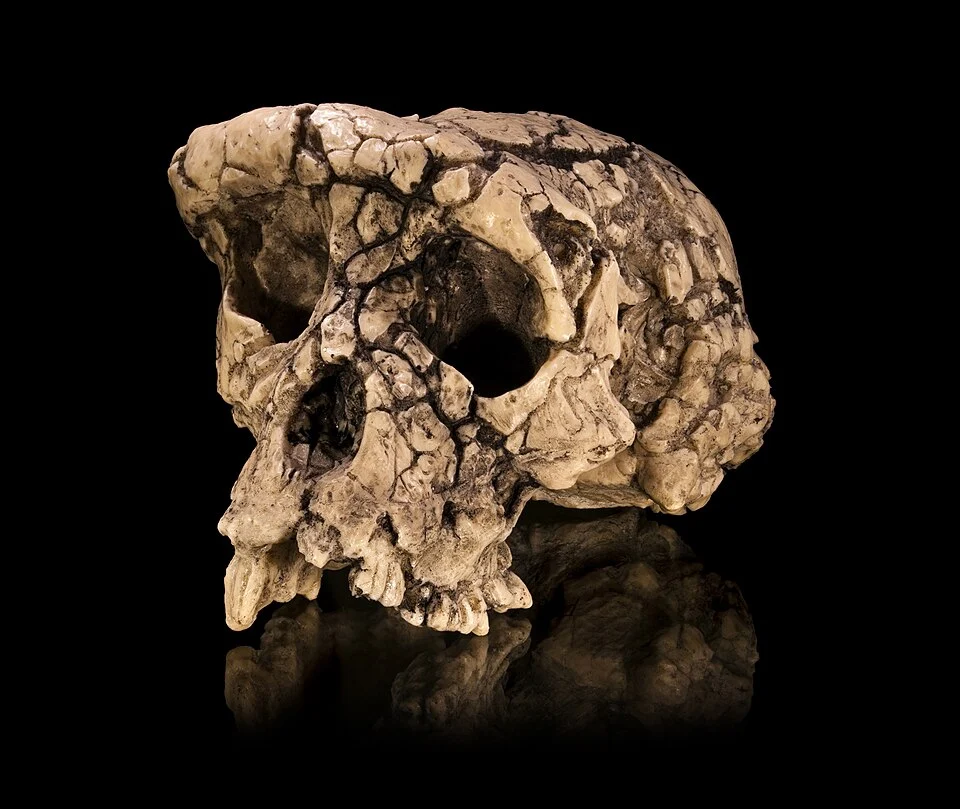
Sahelanthropus tchadensis
Image associated with the exact linked encyclopedia article; consult credited file description for its interpretation.
Overview
Sahelanthropus tchadensis is known from the Toros-Ménalla area of Chad. Its skull combines a small braincase and prominent brow region with features interpreted as relevant to early hominin ancestry. The discovery broadened discussion of where the earliest human relatives lived beyond the better-known East African localities.
Bipedalism was initially inferred largely from cranial anatomy. Later research examined a femur and two ulnae attributed to the same fossil assemblage, interpreting them as evidence for walking on two legs alongside substantial climbing. Attribution and functional interpretation require care, so the evidence should not be converted into a complete modern-human gait. Nor is this species proved to be the last common ancestor of humans and chimpanzees or the earliest hominin beyond dispute.
Scott Williams and colleagues revisited the limb evidence in 2026 using three-dimensional scans of first-generation fossil casts. Their comparisons covered external shape, shaft proportions and particular anatomical features. The overall shapes of the femur and ulna most closely resembled those of chimpanzees, while several details were interpreted as adaptations for bipedal movement. This combination is more informative than assigning the whole skeleton a single label such as human-like or ape-like. The analyses concern incomplete limb bones, not an articulated skeleton preserving the hip, knee and foot together.
One feature was a small projection on the femur, identified on the cast and checked against the original fossil. The researchers interpreted this femoral tubercle as the attachment area for part of the iliofemoral ligament, which helps stabilize an extended hip. They also examined a ridge and roughened area associated with gluteal muscle attachment. Their interpretation concerns the likely arrangement of soft tissues around preserved bone; neither those muscles nor the ligament itself survived. Pelvic features proposed from this reconstruction remain predictions because the relevant pelvis has not been recovered.
The femoral shaft also showed marked twisting. Comparisons with living primates suggested a relationship to the inward inclination of the knee in bipeds. However, both joint ends are missing, and the authors explicitly avoided calculating a knee angle from the weak statistical relationship. Their limb-proportion analysis likewise depended on reconstructions: the ulna combined information from left and right bones, and the association with the femur could represent one individual or several similarly sized individuals. Estimated lengths therefore carry uncertainty beyond ordinary measurement error.
Williams and colleagues supported a mixture of bipedal adaptations and climbing ability. They considered habitual upright movement possible without equating it with the obligate terrestrial walking of later humans. Their proposed chimpanzee-like ancestral body plan is an evolutionary hypothesis, not evidence that living chimpanzees were human ancestors. The damaged ulnae, missing joint surfaces and alternative interpretations of the same fossils remain central to evaluating that proposal.
Origins & earliest records
The fossils were discovered in 2001 and the species described in 2002, while geological estimates place it around seven to six million years ago. Those dates distinguish collection, publication and biological occurrence. The beginning of the hominin lineage and the exact relationships of this species remain separate evolutionary questions.
Evidence & interpretation
Cranial and dental anatomy provides the original evidence, supplemented by postcranial analysis published in 2022. The limb bones support a bipedal-and-climbing interpretation in that study. Sparse remains, specimen attribution and comparative assumptions limit certainty, and older museum statements that only cranial material has been studied should not override newer research.
Selected bibliography
Documented works and useful reading. This is not a list of every appearance.
- 01
Postcranial evidence of late Miocene hominin bipedalism in Chad
Selected institutional scientific reading; not a complete bibliography.
- 02
Earliest evidence of hominin bipedalism in Sahelanthropus tchadensis
Summary adapted under CC BY4. Complete main Results, Discussion and Methods read; supplementary analyses and original specimens not independently assessed.
Family, evolution & connections
Selected fossil hominins — a 2015 Bayesian summary
Eight terminals pruned from Figure 1; chimpanzee/gorilla outgroups and other hominins omitted.
Scroll sideways to see all branches. With a keyboard, focus the tree and use the arrow keys.
- Selected hominin terminals
- Remaining sampled terminals
- Selected branches — original node PP 0.25
- Selected branches — original node PP 0.59
- Selected branches — original node PP 0.22
- Selected branches — original node PP 0.59
- Published pair — PP 0.92
- Homo heidelbergensis
Dated Bayesian craniodental analysis: 380 characters, 20 hominins and two outgroups; MrBayes 3.2.3, corrected Mk/gamma model, uncorrelated clock and birth–death prior. Four 10-million-generation runs, 25% burn-in. PP labels retain original nodes after pruning. This historical summary contains weakly supported branches, not settled ancestry. Fossil dating uses scored specimens, not necessarily species first appearances. Missing data and alternative taxonomic groupings matter. Pruning excludes Australopithecus sediba, originally paired with H. habilis, and distinct H. ergaster. No direct ancestor, divergence date or genomic admixture history is inferred.
Selected hominins — Dembo 2016 hypothesis
Nine-tip pruning of Figure 2’s dated Bayesian summary.
Scroll sideways to see all branches. With a keyboard, focus the tree and use the arrow keys.
- Selected hominins
- Ramidus branch
- Afarensis branch
- Habilis branch
- Asian erectus branch — posterior 0.27
- Naledi branch — posterior 0.36
- H. naledi
- Remaining sampled group — posterior 0.94
- Pair — posterior 0.50
- H. heidelbergensis
391 craniodental characters, 24 taxa; corrected Mk/gamma, relaxed clock, birth–death prior; four 20-million-generation runs, 25% burn-in. Original node probabilities are retained, not recomputed. Many branches are weak. Omitted tips include Au. sediba beside H. habilis, H. antecessor beside the sapiens group, and distinct African/Georgian erectus samples. Asian erectus alone maps to the broader profile. Bayes-factor tests did not identify a unique naledi sister. This historical morphology-based tree predates independent naledi dating; no ages or direct ancestors are inferred. It differs from the 2015 matrix and is not merged with it.
Taxonomic classification
A hierarchy of classified groups, not a chain of direct ancestors.
- kingdomAnimalia
- phylumChordata
- classMammalia
- orderPrimates
- familyHominidae
- genusSahelanthropus
- speciesSahelanthropus tchadensis
Other sampled hominins in Dembo’s 2015 summary
Figure 1 separates Sahelanthropus from the remaining sampled hominin branches. This study-specific placement does not establish direct ancestry; several later branches have low posterior support.
Encyclopedia background
An additional attributed reference, separate from the editorial profile above.
Read the open encyclopedia overview
Sahelanthropus is an extinct genus of hominid dated to about 7 million years ago during the Late Miocene. The type species, Sahelanthropus tchadensis, was first announced in 2002, based mainly on a partial cranium, nicknamed Toumaï, discovered in northern Chad.
The definitive phylogenetic position of Sahelanthropus within the hominids is uncertain. It was initially described as a possible hominin ancestral to both humans and chimpanzees, but subsequent interpretations suggest that it could be an early member of the tribe Gorillini or a stem-hominid outside the hominins. The supposed bipedality based on the postcranial skeleton of Sahelanthropus has also been a subject of debate among paleoanthropologists.
Text from Wikipedia contributors, “Sahelanthropus”. CC BY-SA 4.0. Extracted introduction; formatting changed. Retrieved 5 October 2026. The source article may have changed since retrieval.
References
Sources supporting this profile. Linked pages have their own scope and editorial standards.
- ResearchPostcranial evidence of late Miocene hominin bipedalism in ChadResearch access: 2026-10-05
- MuseumSahelanthropus tchadensisResearch access: 2026-10-05
- Primary researchEarliest evidence of hominin bipedalism in Sahelanthropus tchadensisResearch access: 2026-10-05
Image credits
Reference illustrationSahelanthropus tchadensis
Image associated with the exact linked encyclopedia article; consult credited file description for its interpretation.