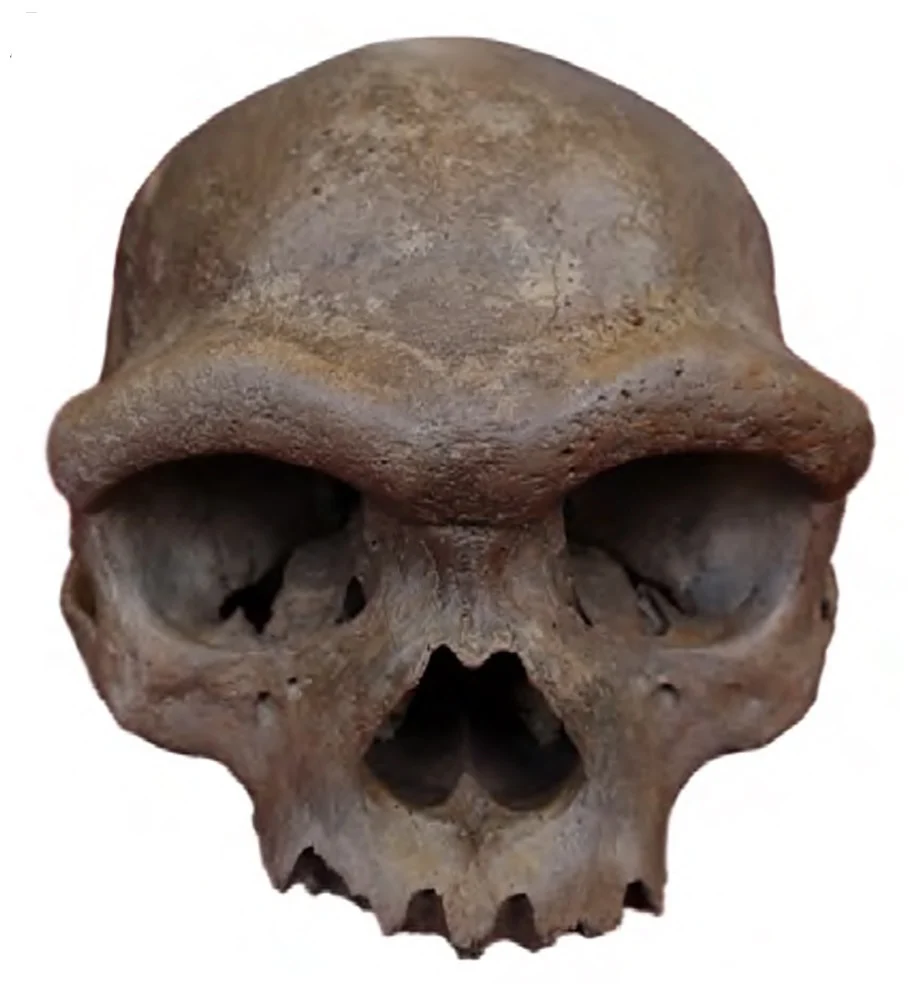
Denisovans
Image associated with the exact linked encyclopedia article; consult credited file description for its interpretation.
Overview
Denisovans first became distinctive in human-evolution research through DNA from remains in Denisova Cave. Their genetic relationships link them closely with Neanderthals, and gene flow left ancestry in some later Homo sapiens populations. The label is useful for a molecularly recognised lineage, while its relationship to proposed formal species names remains debated.
Protein evidence identified the Xiahe mandible outside Siberia, and 2025 molecular studies linked the Harbin cranium with Denisovans. A 2026 study further expanded identified remains in southwest China. These findings provide more anatomy than the older fragment-only portrait, but body proportions and other traits remain poorly constrained. Present-day ancestry traces reveal historical contact; they do not define living peoples as Denisovan races or supply a complete map of past populations.
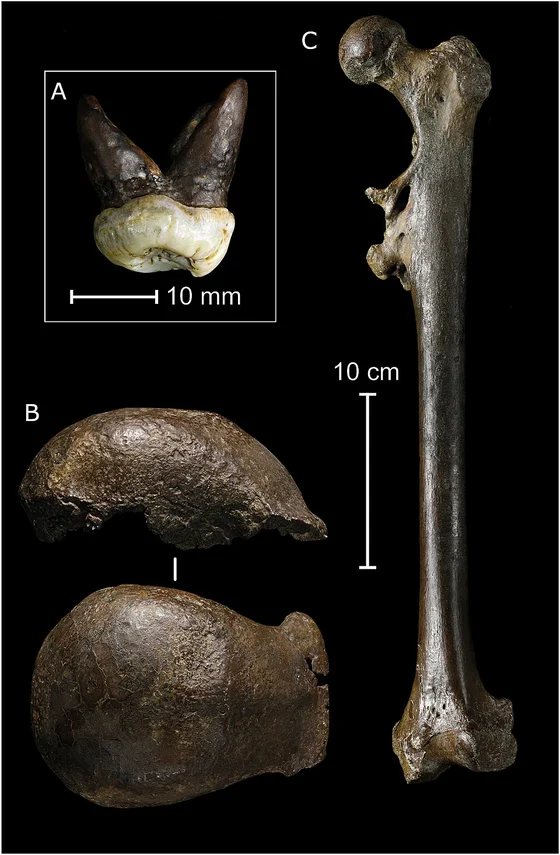
The Xiahe mandible illustrates identification without a recovered genome. Chen and colleagues’ 2019 report analysed ancient proteins from the specimen found at Baishiya Karst Cave on the Tibetan Plateau. Uranium-series dating of carbonate attached to the jaw provided a minimum age of about 160,000 years. The molecular comparison linked the fossil to Denisovans and established evidence beyond Denisova Cave. Protein-based identification, the minimum age of an associated crust and the fossil’s location are separate observations; none supplies a complete history of the population.
For the Harbin cranium, the researchers’ 2025 ProteomeXchange submission documents analyses of two petrous-bone samples. It reports 95 endogenous proteins and a closest relationship to the published high-coverage Denisovan genome in their amino-acid and phylogenetic comparisons. The nearly complete cranium is described there as at least 146,000 years old. This entry uses the author-deposited dataset description, not a new reading of the full accompanying Science paper. The repository’s generic Homo sapiens filing label should not be substituted for the study’s stated affinity.
Rao and colleagues’ 2026 southwest-China study identified five remains molecularly: two parietal fragments, a partial radius and two teeth. Ancient-DNA recovery from the three bones was unsuccessful; proteins instead supported their Denisovan assignment. Their archaeological layers were dated to approximately 167,000–134,000 years ago, while direct uranium-series measurements supplied minimum ages for particular samples. A partial arm bone expands the anatomical evidence but does not establish a complete, uniform Denisovan body form.
Origins & earliest records
The lineage was identified through genetic research published in 2010, distinct from the age of the ancient individuals sampled. The Xiahe mandible is at least about 160,000 years old, while newer finds broaden the record. The timeline marker is a dated fossil example, not the lineage's exact origin or first dispersal.
Evidence & interpretation
Ancient genomes and protein sequences provide molecular identification that can be compared across fossils. Dating methods establish minimum or contextual ages for particular remains. The 2026 study records a broader Asian sample, but sparse postcranial material and competing species proposals limit reconstruction. Genetic similarity alone does not establish every anatomical trait or living cultural identity.
Selected bibliography
Documented works and useful reading. This is not a list of every appearance.
- 01
Ancient proteins identify various Denisovan remains from Southwest China
Selected main sections on molecular identification, assignment and interpretation read. Brief summary only; article uses CC BY-NC-ND 4.0. No figure adaptation or full-body reconstruction.
- 02
A late Middle Pleistocene Denisovan mandible from the Tibetan Plateau
Complete public abstract inspected; full methods and supplementary analyses not newly read.
- 03
The proteome of the late Middle Pleistocene Harbin individual — PXD058447
Complete author-deposited repository description and publication metadata inspected. Dataset DOI 10.6019/PXD058447; accompanying paper DOI 10.1126/science.adu9677 was not fully read.
Family, evolution & connections
Selected hominin population branching
Simplified population topology supported by the nuclear-genome analysis of Reich and colleagues (2010).
Scroll sideways to see all branches. With a keyboard, focus the tree and use the arrow keys.
- Shared ancestral hominin population
- Shared Neanderthal–Denisovan branch
Comparison of ancient Denisovan and Neanderthal nuclear DNA with present-day human genomes. This branching summary omits documented gene flow between populations; it is not a complete evolutionary ladder or a classification of present-day human peoples. Mitochondrial histories differ. No direct ancestral fossil or divergence date is claimed.
Taxonomic classification
A hierarchy of classified groups, not a chain of direct ancestors.
- genusHomo
Neanderthals
The sampled nuclear sequences support shared Denisovan–Neanderthal history distinct from present-day humans. Mitochondrial history differs. The authors explicitly warn that their distance tree cannot faithfully represent the populations’ gene flow; it does not identify direct ancestors.
Encyclopedia background
An additional attributed reference, separate from the editorial profile above.
Read the open encyclopedia overview
The Denisovans or Denisova hominins ( də-NIS-ə-və(nz)) are an extinct species or subspecies of archaic human that ranged across Asia during the Middle to Late Pleistocene, approximately 200,000–32,000 years ago. Most of what is known about Denisovans comes from DNA evidence. While many recent fossils have been found and tentatively identified as Denisovan, the first Denisovans discovered were known from few physical remains. Consequently, no formal species name has been established. However, an analysis of the mitochondrial DNA and endogenous proteins from the Harbin cranium, which had been given the name Homo longi, showed that this skull represents a Denisovan.
In a study published in September 2025, remains from six additional sites in China including the one-million-year-old Yunxian man were proposed to be related to the Homo longi lineage with the genetically confirmed Denisovans. Other authors have included other Denisovan remains, like Penghu 1 and the Xiahe mandible, within the species Homo juluensis.
The first identification of a Denisovan individual occurred in 2010, based on mitochondrial DNA (mtDNA) extracted from a juvenile finger bone excavated from the Siberian Denisova Cave in the Altai Mountains in 2008. Nuclear DNA indicates close affinities with Neanderthals. The cave was also periodically inhabited by Neanderthals. Additional specimens from Denisova Cave were subsequently identified, as were specimens from the Baishiya Karst Cave on the Tibetan Plateau, Tam Ngu Hao 2 Cave in the Annamite Mountains of Laos, the Penghu channel between Taiwan and the mainland, Harbin in Manchuria and Bianfu Cave in Yunnan.
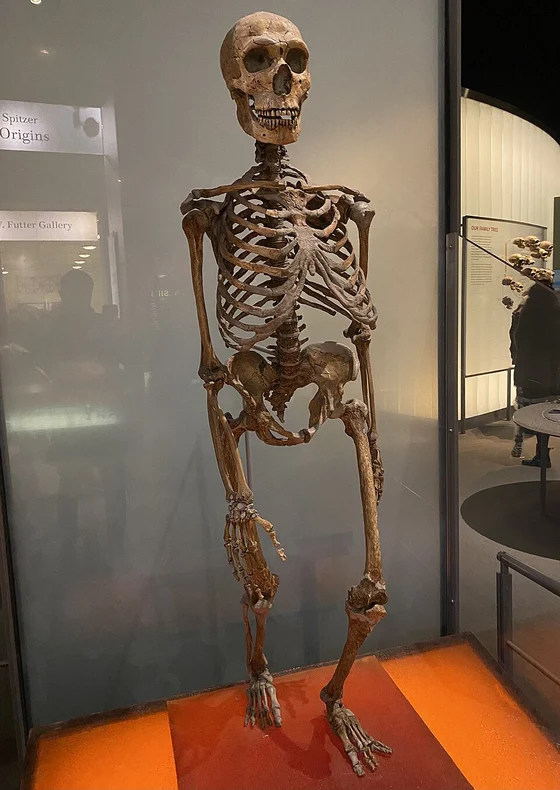
DNA evidence suggests they had dark skin, eyes, and hair, and had a Neanderthal-like build. Based on the Harbin cranium, like other archaic humans, the skull is low and long, with massively developed brow ridges, wide eye sockets, and a large mouth. The two existing Denisovan mandibles show that, like Neanderthals, the Denisovans lacked a chin. Like modern humans and the much earlier Homo antecessor, but unlike Neanderthals, the face is rather flat, but with a larger nose. However, they had larger molars which are reminiscent of Middle to Late Pleistocene archaic humans and australopithecines. The cranial capacity and therefore the brain size of the Denisovans was within the range of modern humans and Neanderthals.
Denisovans interbred with modern humans, with a high percentage (roughly 5%) of Denisovan DNA occurring in Melanesians, Aboriginal Australians, and Filipino Negritos. In contrast, 0.2% derives from Denisovan ancestry in mainland Asians and Native Americans. In a 2018 study, South Asians were found to have levels of Denisovan admixture similar to that seen in East Asians. Another study found that the highest Denisovan ancestry is inferred in Oceanians (~2.0%), while most populations of Native Americans, East Asians, and South Asians have similar amounts (~0.1%). This suggests Denisovan populations were distributed across Asia. Evidence also suggests that there was interbreeding with the Altai Neanderthal population, with about 17% of the Denisovan genome from Denisova Cave deriving from them. A first-generation hybrid nicknamed "Denny" was discovered with a Denisovan father and a Neanderthal mother. Additionally, 4% of the Denisovan genome comes from admixture with Asian Homo erectus (also known as Peking Man) which diverged from Denisovans, Neanderthals and modern humans over one million years ago.
Text from Wikipedia contributors, “Denisovan”. CC BY-SA 4.0. Extracted introduction; formatting changed. Retrieved 5 October 2026. The source article may have changed since retrieval.
References
Sources supporting this profile. Linked pages have their own scope and editorial standards.
- ResearchAncient proteins identify various Denisovan remains from Southwest ChinaResearch access: 2026-10-05
- ResearchA late Middle Pleistocene Denisovan mandible from the Tibetan PlateauResearch access: 2026-10-05
- Primary scientific researchHarbin proteome: author-deposited dataset recordResearch access: 2026-10-05
Image credits
Reference illustrationDenisovans
Image associated with the exact linked encyclopedia article; consult credited file description for its interpretation.