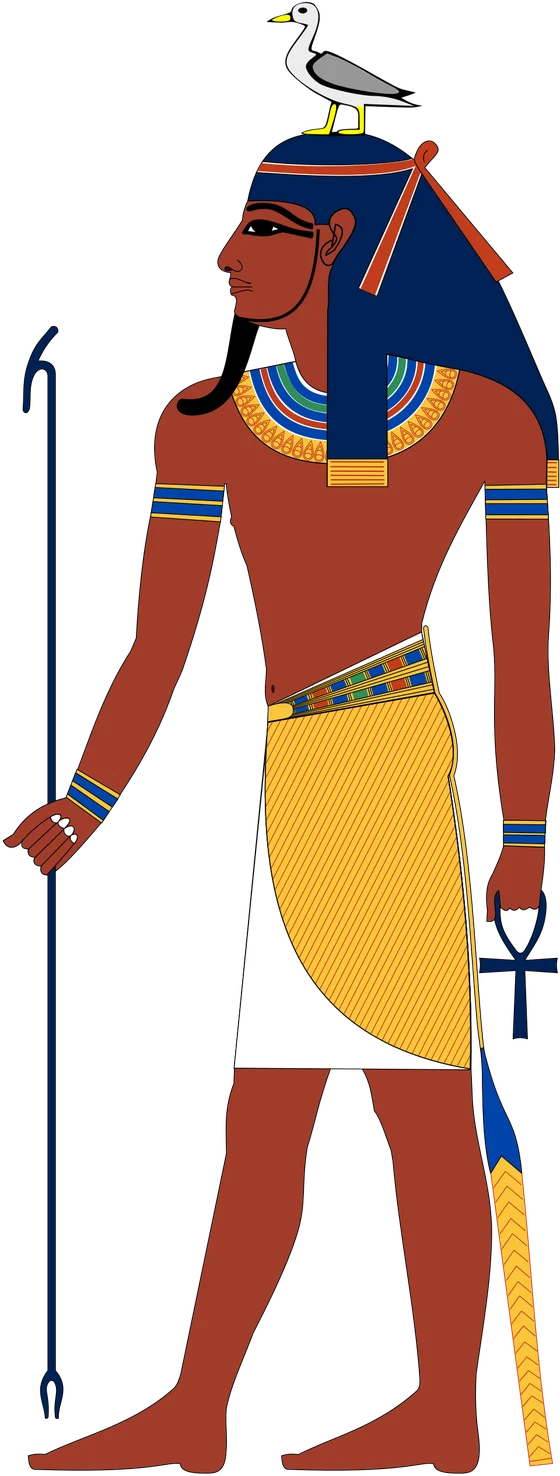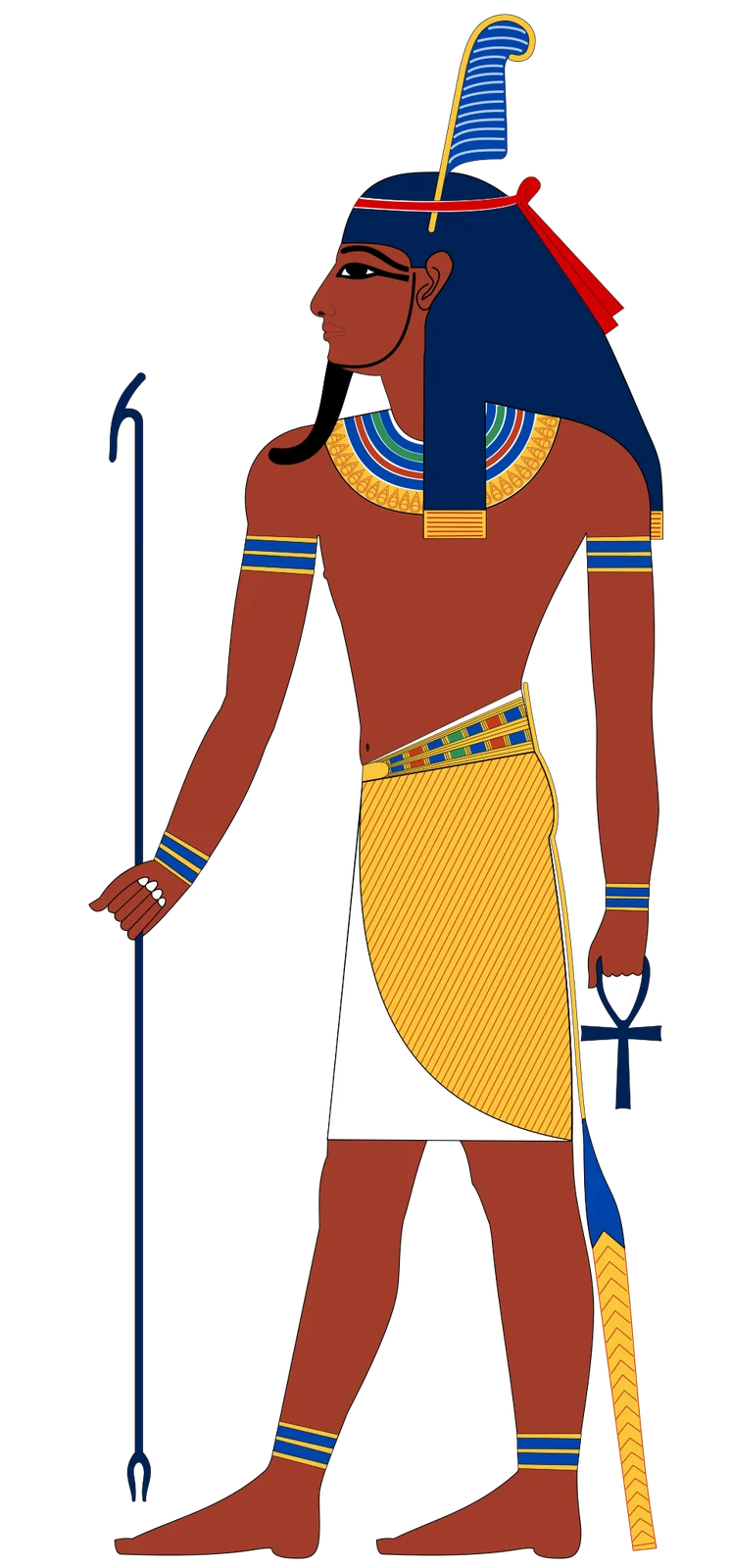
Shu, modern vector interpretation
Modern vector interpretation of Egyptian deity iconography, based on historical representations; not a photograph or an original ancient painting. See the credited file description for shared iconography and artistic liberties.
Overview
Shu is generated with Tefnut in the creation narrative and stands between the earth and the sky in the resulting divine family. In the heavenly-cow episode he supports Nut as Ra withdraws upward. The bodily task makes cosmic separation visible: a divine figure holds apart realms that would otherwise meet. This is a mythic organization of space, not a claim that ancient Egyptians lacked practical knowledge of weather or the physical sky.
The heavenly cow needs bodily support even after Ra has chosen to leave humanity. Shu raises his arms beneath Nut, while divine attendants support her legs. The arrangement makes him an active holder of the upper realm rather than a remote name in a genealogy, and relates his sustaining action to the solar ruler’s ascent.
Origins & earliest records
The selected creation and cow texts are separate witnesses gathered in a 1912 translation. They establish these narrative roles, not a secure date for the first worship of Shu.
Records & interpretation
The selected attestation is Creation and heavenly cow narratives in Budge’s translated collection. It documents a textual or ritual representation; commentary and later classical accounts are labeled where used. It does not establish zoological existence, a first oral telling, or a uniform belief shared by all Egyptians.
In the literature
“set thyself under [my] daughter Nut”
The Legend of the Destruction of Mankind, ChapterI; paragraph beginning “And the Majesty of Ra said, "I decree that supports be…” · E. A. Wallis Budge
Ra orders Shu to support Nut and guard the supports of heaven, establishing the narrated cosmic arrangement.
Selected bibliography
Documented works and useful reading. This is not a list of every appearance.
- 01
Legends of the Gods: The Egyptian Texts
Selected witness: Creation and heavenly cow narratives. Historical translation and commentary; not an exhaustive bibliography.
- 02
Legends of the Gods: The Egyptian Texts, edited with Translations
London,1912; E.A.WallisBudge historical English translations; narrative body distinguished from editorial introduction and footnotes.
Family, evolution & connections
Textual genealogy: Creation A in Budge's Egyptian text translation
Selected divine generations explicitly enumerated in the translated History of Creation A.
Scroll sideways to see all branches. With a keyboard, focus the tree and use the arrow keys.
- Joint parents: Shu and Tefnut
- Joint parents: Geb (Seb/Keb) and Nut
- Heru-khent-an-maati (Blind Horus in this translation)
Follow the translator's named production of Shu and Tefnut, their joint offspring Geb and Nut, and the latter pair's enumerated children. Paired nodes identify two parents; they are not single organisms. A divine genealogy in one translated recension, not biological evolution or a harmonized account of all Egyptian traditions. Creation B differs. The source's Heru-khent-an-maati, glossed Blind Horus, remains an unlinked named node to avoid confusing him with later Horus parentage. Budge's historical translation and commentary are not a modern consensus edition.
Creation B’s different named generation in Budge’s translation
The translated History of Creation B in Budge’s 1912 Legends of the Gods, not his introductory harmonization.
Scroll sideways to see all branches. With a keyboard, focus the tree and use the arrow keys.
Retain the explicit final statement that Shu and Tefnut brought forth Osiris, Heru-khenti-an-maa, Set, Isis and Nephthys. Creation A explicitly inserts Geb and Nut as parents of this group; B’s displayed wording does not, and that difference is preserved. Joint root groups two divine producers, not one organism. The Horus name remains unlinked to avoid conflating distinct Horus parentage. This historical translated recension is not biological evolution or a modern critical edition. The shared leaf set with Creation A is intentional: these are substantively different textual witnesses, not duplicated topology.
Tefnut
Budge’s translated Creation A makes Shu and Tefnut parents of Seb and Nut, who produce the next divine generation. Creation B instead names a different immediate sequence. This connection therefore belongs to the selected A witness, preserving its parentage without reconciling distinct accounts into one universal family.
Osiris
Budge’s translated Creation B says Shu and Tefnut brought forth Osiris in its named divine generation. Creation A instead places Geb and Nut between those generations. This preserves the two recensions rather than silently filling B with A’s intermediate parents.
Set
Budge’s translated Creation B says Shu and Tefnut brought forth Set in its named divine generation. Creation A instead places Geb and Nut between those generations. This preserves the two recensions rather than silently filling B with A’s intermediate parents.
Isis
Budge’s translated Creation B says Shu and Tefnut brought forth Isis in its named divine generation. Creation A instead places Geb and Nut between those generations. This preserves the two recensions rather than silently filling B with A’s intermediate parents.
Nephthys
Budge’s translated Creation B says Shu and Tefnut brought forth Nephthys in its named divine generation. Creation A instead places Geb and Nut between those generations. This preserves the two recensions rather than silently filling B with A’s intermediate parents.
Located primary passages
Specific passages supporting details in this entry, grouped by their published witness.
Legends of the Gods: The Egyptian Texts
London,1912; E.A.WallisBudge historical English translations; narrative body distinguished from editorial introduction and footnotes.
- Ra orders Shu to support Nut and guard the supports of heaven, establishing the narrated cosmic arrangement.
Budge’s historical translation of a particular ancient text; uncertain readings, lacunae and variant names retained. Mythic healing claims are narrative content, not medical instructions.
References
Sources supporting this profile. Linked pages have their own scope and editorial standards.
- Primary-text translation and historical commentaryLegends of the Gods — Creation and heavenly cow narrativesResearch access: 2026-10-05
Image credits
Thematic illustrationShu, modern vector interpretation
Modern vector interpretation of Egyptian deity iconography, based on historical representations; not a photograph or an original ancient painting. See the credited file description for shared iconography and artistic liberties.