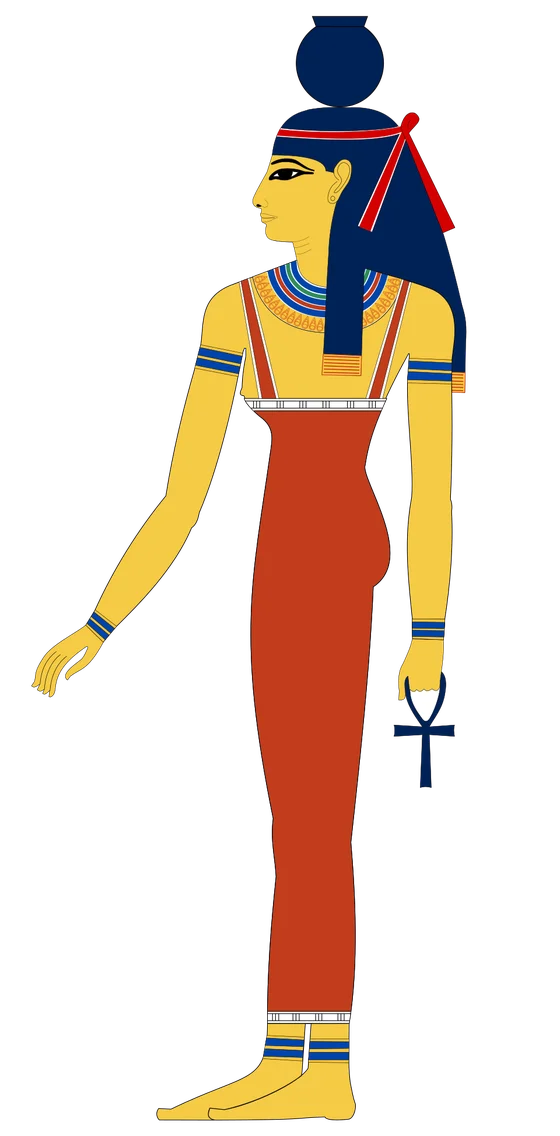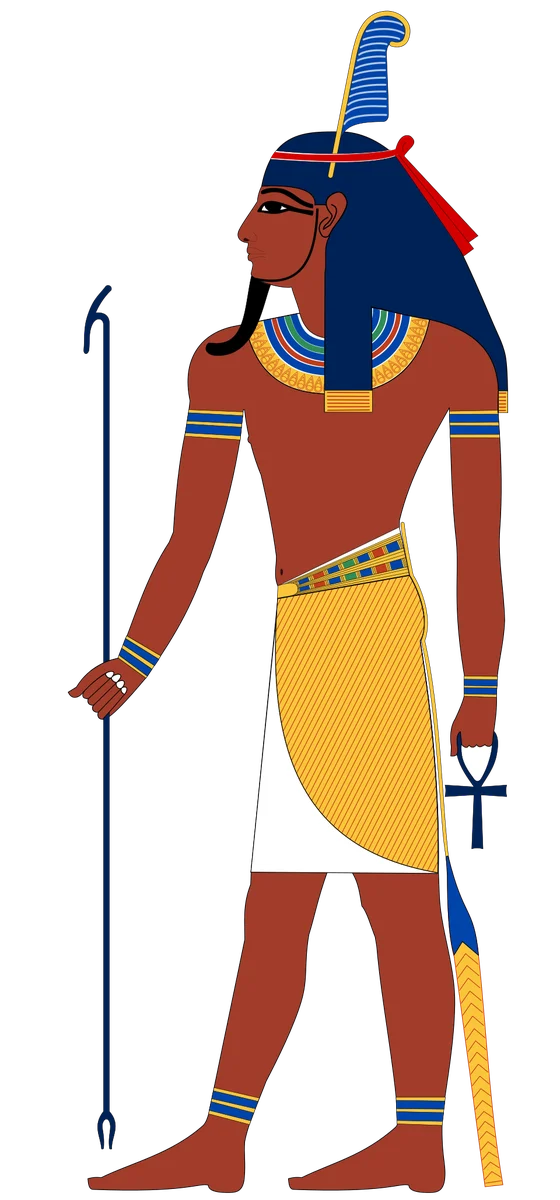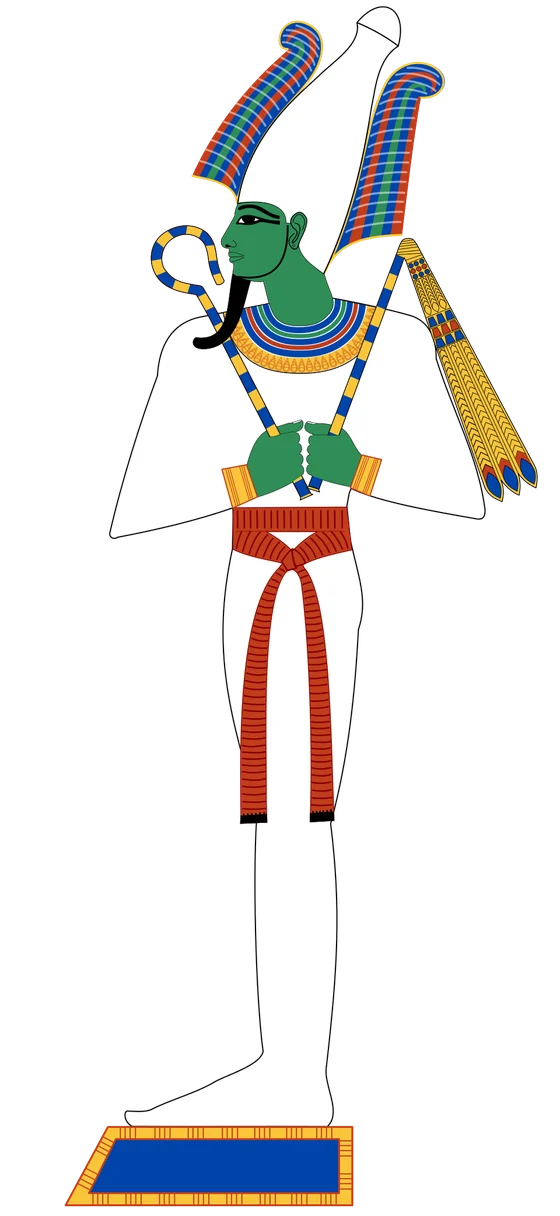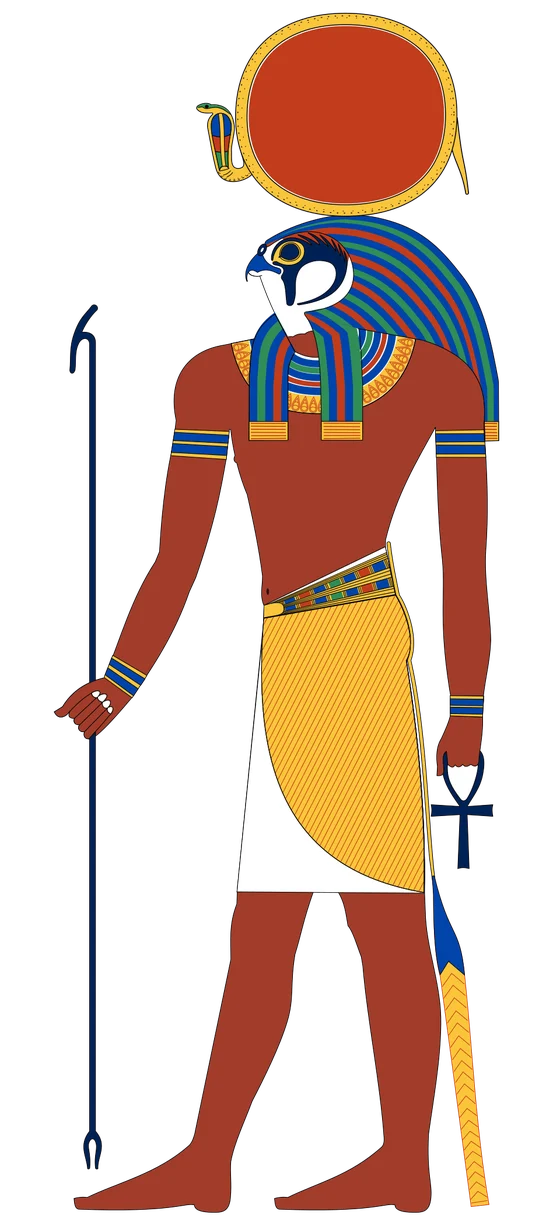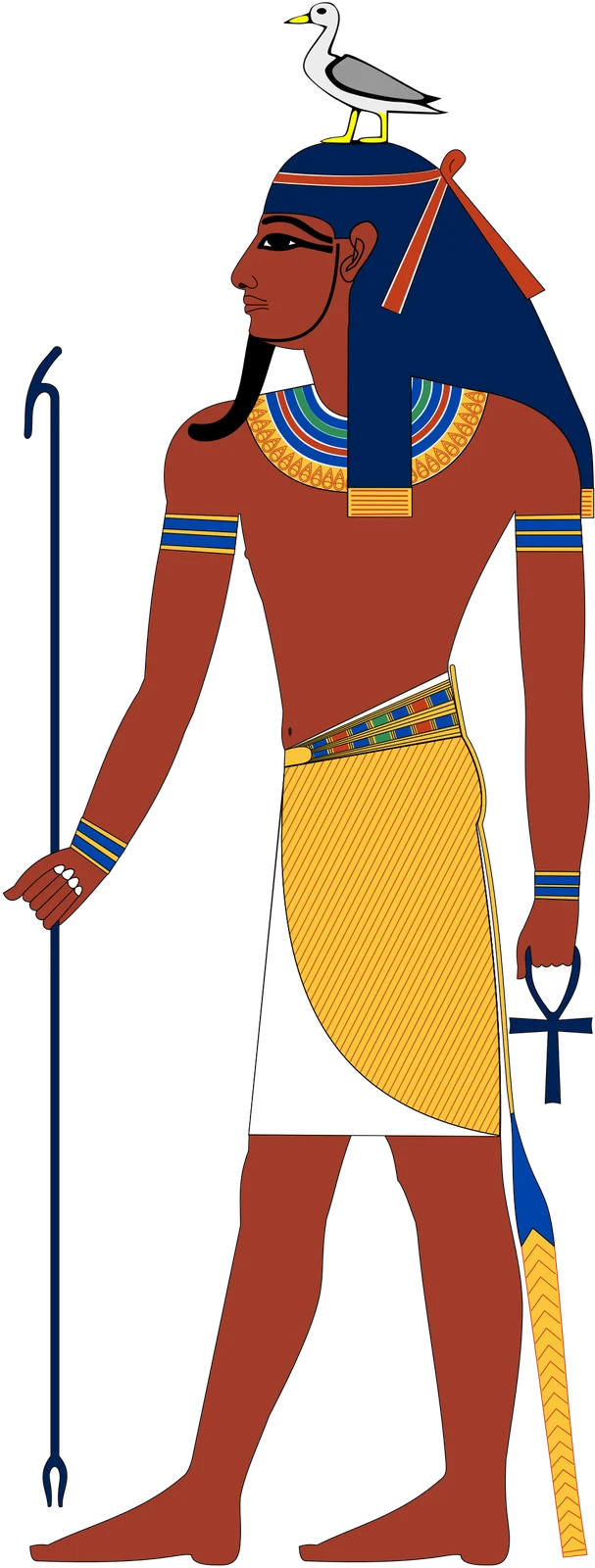
Geb, modern vector interpretation
Modern vector interpretation of Egyptian deity iconography, based on historical representations; not a photograph or an original ancient painting. See the credited file description for shared iconography and artistic liberties.
Overview
The selected account calls the earth god Keb. His union with Nut produces a further divine generation including Osiris, Isis, Set and Nephthys. Their separation establishes the vertical order of earth and sky. The relationship is genealogical and cosmic within the story; it should not be confused with a biological ancestry tree or used to impose one uniform family arrangement on every Egyptian temple tradition.
Keb’s embrace of Nut precedes the separation of earth and sky, while their offspring carry the narrative forward into divine rule and rivalry. The account makes the landscape a person capable of kinship: earth is both a realm beneath the sky and a parent whose children become central actors in later episodes.
Origins & earliest records
Geb and Keb are variant transliterations here, so they form one profile. The source is an ancient creation text in a dated modern translation.
Records & interpretation
The selected attestation is Creation narrative, Keb in Budge’s translated collection. It documents a textual or ritual representation; commentary and later classical accounts are labeled where used. It does not establish zoological existence, a first oral telling, or a uniform belief shared by all Egyptians.
In the literature
“Shu and Tefnut brought forth [Seb and] Nut”
History of Creation—A; paragraph beginning “"When there fell on them their moment[FN#54] through plant-like clouds, I…” · E. A. Wallis Budge
Creation versionA gives Seb and Nut as offspring of Shu and Tefnut and parents of the next divine generation; the restored Seb wording is bracketed.
Selected bibliography
Documented works and useful reading. This is not a list of every appearance.
- 01
Legends of the Gods: The Egyptian Texts
Selected witness: Creation narrative, Keb. Historical translation and commentary; not an exhaustive bibliography.
- 02
Legends of the Gods: The Egyptian Texts, edited with Translations
London,1912; historical English text edited by E.A.WallisBudge. Ancient narrative/ritual translation, separate from modern introduction and footnotes.
Family, evolution & connections
Textual genealogy: Creation A in Budge's Egyptian text translation
Selected divine generations explicitly enumerated in the translated History of Creation A.
Scroll sideways to see all branches. With a keyboard, focus the tree and use the arrow keys.
- Joint parents: Shu and Tefnut
- Joint parents: Geb (Seb/Keb) and Nut
- Heru-khent-an-maati (Blind Horus in this translation)
Follow the translator's named production of Shu and Tefnut, their joint offspring Geb and Nut, and the latter pair's enumerated children. Paired nodes identify two parents; they are not single organisms. A divine genealogy in one translated recension, not biological evolution or a harmonized account of all Egyptian traditions. Creation B differs. The source's Heru-khent-an-maati, glossed Blind Horus, remains an unlinked named node to avoid confusing him with later Horus parentage. Budge's historical translation and commentary are not a modern consensus edition.
Osiris
In History of Creation A, Geb and Nut bring forth Osiris and four other named gods. This records Osiris as an offspring of that joint pair in the selected recension; Nut remains equally part of the relationship even though the directed edge begins at Geb. Creation B differs, so the two texts are not harmonized here.
Located primary passages
Specific passages supporting details in this entry, grouped by their published witness.
Legends of the Gods: The Egyptian Texts
London,1912; historical English text edited by E.A.WallisBudge. Ancient narrative/ritual translation, separate from modern introduction and footnotes.
- Creation versionA gives Seb and Nut as offspring of Shu and Tefnut and parents of the next divine generation; the restored Seb wording is bracketed.
Specific ancient textual version in a historical English witness; names Uatchet/Nekhebet/Seb/Nu are historical renderings, not separate beings. Plutarch’s version and bracketed restorations must not be universalized. Ritual speech is literary evidence, not an instruction to perform healing or protective practices.
Encyclopedia background
An additional attributed reference, separate from the editorial profile above.
Read the open encyclopedia overview
Geb (Ancient Egyptian: gbb, Egyptological pronunciation: Gebeb), also known as Ceb, , was the Egyptian god of the Earth and a mythological member of the Ennead of Heliopolis. He could also be considered a father of snakes. It was believed in ancient Egypt that Geb's laughter generated earthquakes and that he allowed crops to grow.
Text from Wikipedia contributors, “Geb”. CC BY-SA 4.0. Extracted introduction; formatting changed. Retrieved 5 October 2026. The source article may have changed since retrieval.
References
Sources supporting this profile. Linked pages have their own scope and editorial standards.
- Primary-text translation and historical commentaryLegends of the Gods — Creation narrative, KebResearch access: 2026-10-05
Image credits
Thematic illustrationGeb, modern vector interpretation
Modern vector interpretation of Egyptian deity iconography, based on historical representations; not a photograph or an original ancient painting. See the credited file description for shared iconography and artistic liberties.