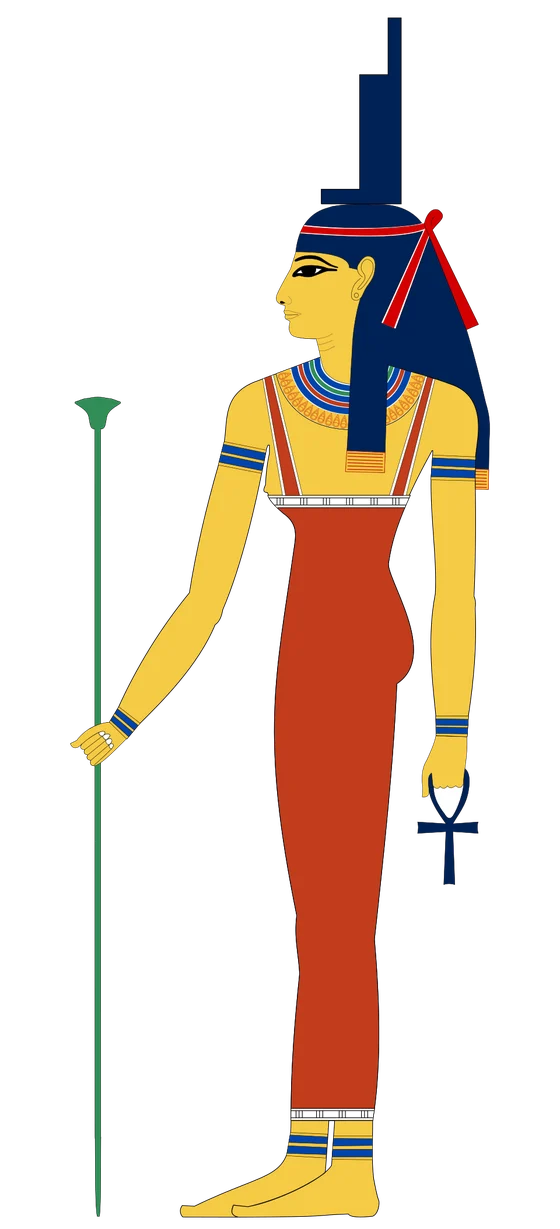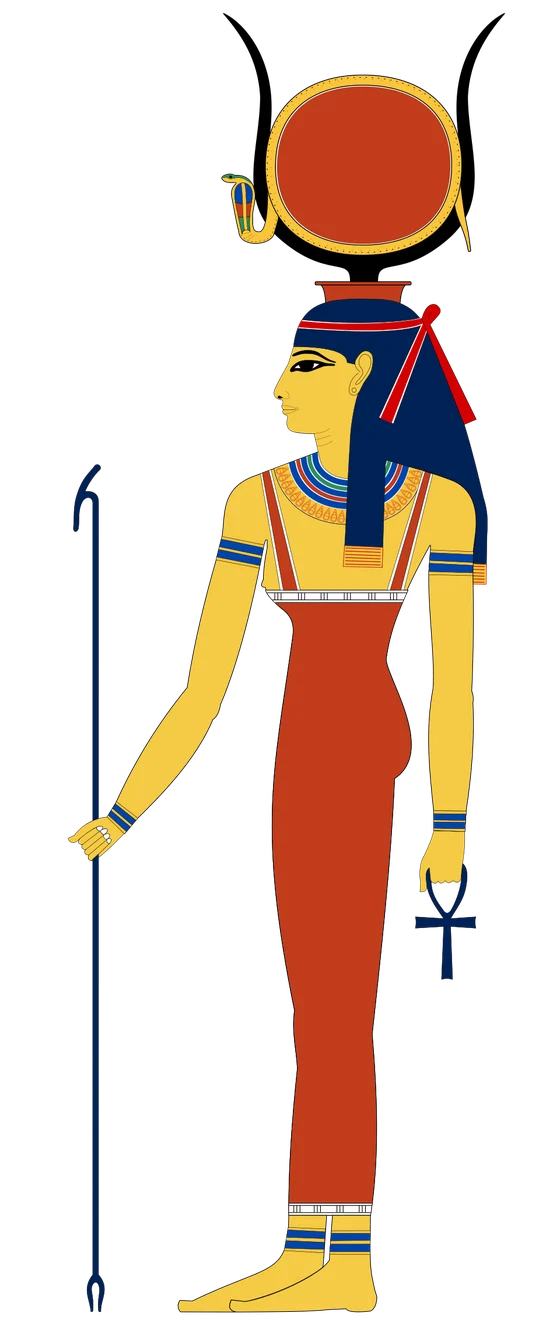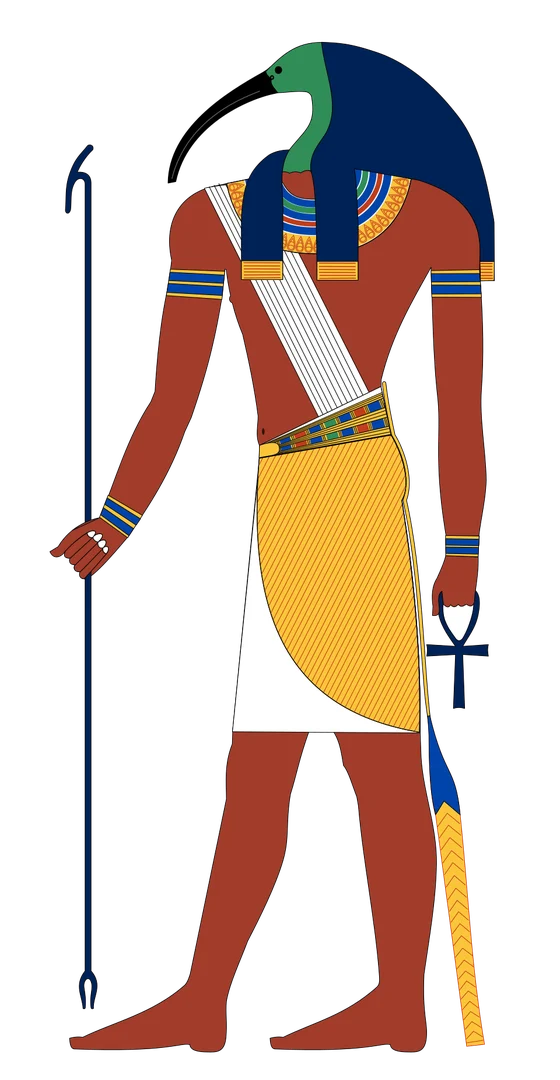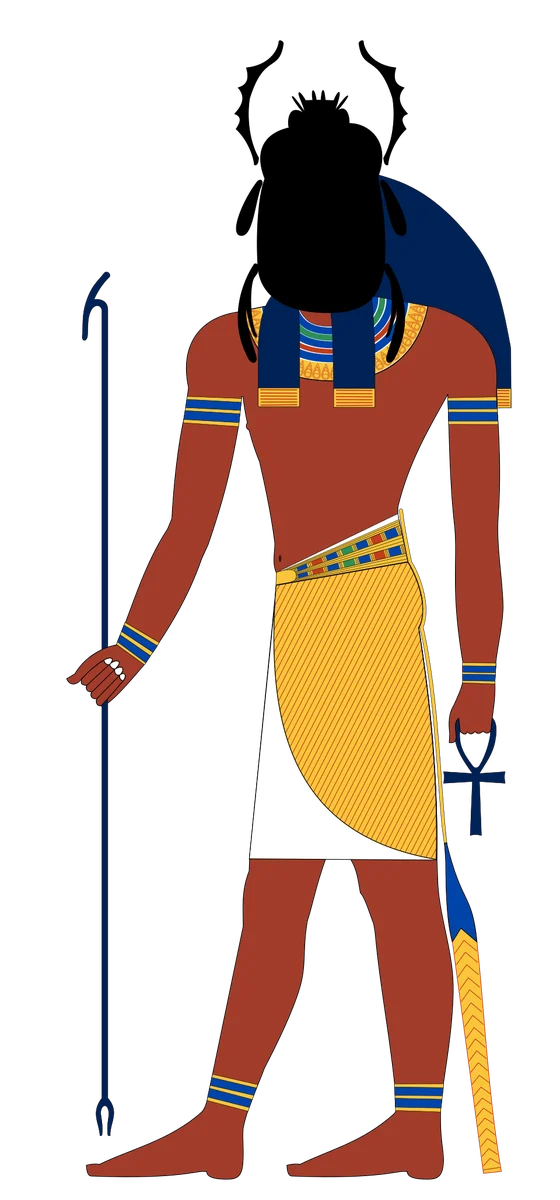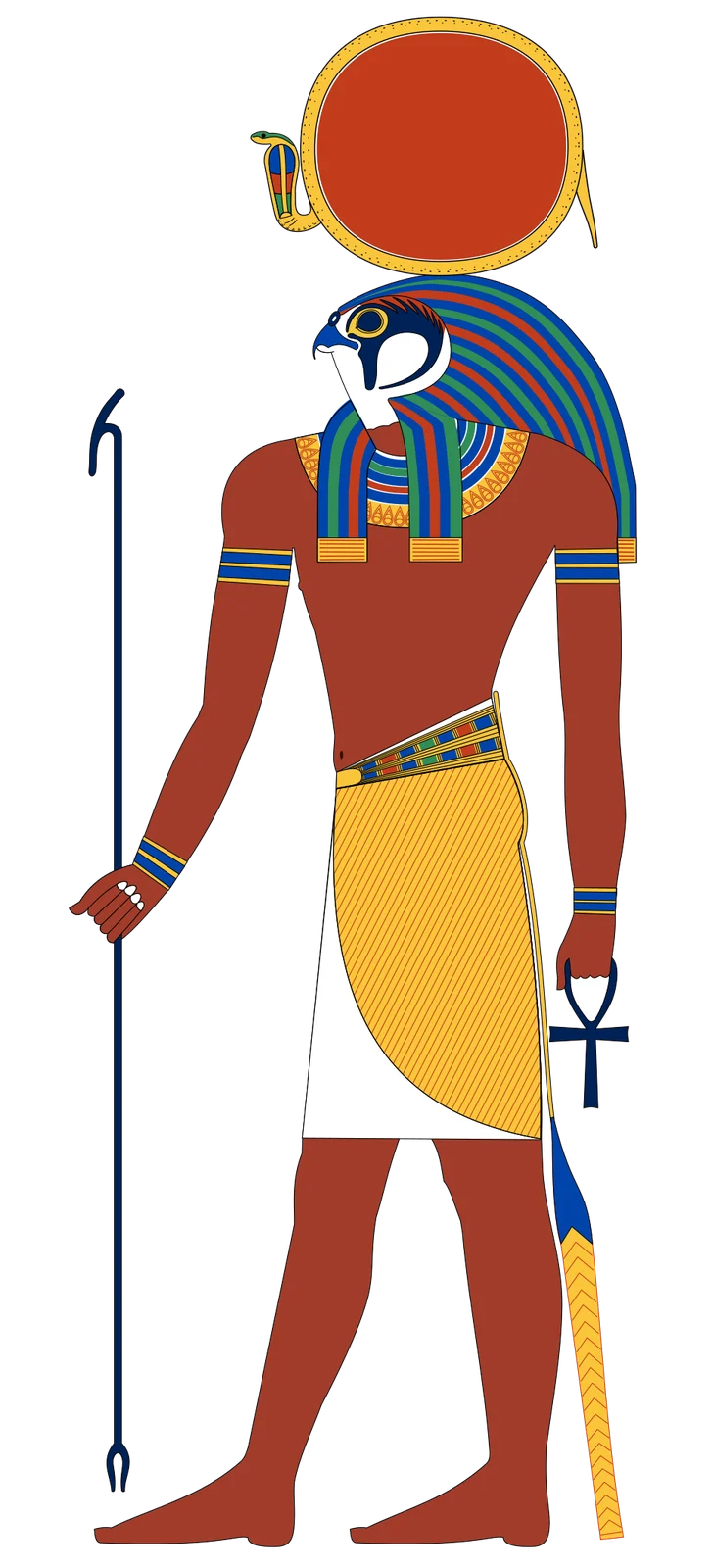
Ra-Horakhty, the combined form of Ra and Horus, modern vector illustration
Modern vector interpretation of Egyptian deity iconography, based on historical representations; not a photograph or an original ancient painting. See the credited file description for shared iconography and artistic liberties. This image specifically depicts the combined Ra-Horakhty form.
Overview
The destruction narrative opens with Ra as an ageing sovereign whose bones are compared to silver, limbs to gold and hair to lapis lazuli. People complain about him, and he secretly summons his Eye, the elemental gods and divine ancestors to consider a response. He will not begin the punishment before hearing their counsel. The Eye acts in Hathor’s form and kills the rebels, but Ra later decides to preserve the remaining people from her appetite. He has intoxicating drink spread across the place of slaughter, and the returning goddess drinks and ceases attacking. His authority therefore includes a reversal of his own destructive command.
Weary of continued existence among humans, Ra withdraws on the back of Nut after she assumes the form of a cow. The narrative connects his commands with heavenly fields and stars, and Shu is appointed to support the elevated goddess. The serpent episode gives the solar ruler another vulnerability. Isis fashions a new serpent from material associated with his aged body, and it bites him on his daily route. He cannot identify the unfamiliar attacker. He offers an account of his creative power and his forms as Khepera in the morning, Ra at noon and Temu in the evening, but these declarations do not satisfy Isis’s demand for the hidden name. He finally permits that name to pass from his body into hers, enabling her restorative words.
The two episodes do not require one permanent animal body. Ra travels in a solar boat in the serpent text and rides the distinct cow-shaped Nut in the withdrawal account. A separately catalogued British Museum gold figure, EA 38005, represents a solar being with a falcon head, human limbs, kilt and a large disk and cobra above the head. That object provides a concrete visual form alongside the narrative’s metallic and mineral comparisons. It is neither Nut’s cow shape nor the body of Isis’s hostile serpent. The selected textual episodes portray solar sovereignty through creation, counsel, fatigue, harmful force and an exchange of protected knowledge.
Origins & earliest records
The collection translates several distinct Egyptian witnesses rather than one continuous biography; its serpent episode is associated with a Turin papyrus.
Records & interpretation
Budge’s historical translation: The Legend of the Destruction of Mankind, chapter I; The Legend of Ra and Isis, full translated episode and notes 66–74. The previously verified British Museum catalogue EA 38005 independently supports the gold figure’s represented falcon-headed form; full catalogue access was blocked.
In the literature
“I am the Being who openeth his eyes and the light cometh”
The Legend of Ra and Isis; paragraph beginning “The Chapter of the divine (or, mighty) god, who created himself,…” · E. A. Wallis Budge
Ra describes his cosmic power but remains poisoned until Isis obtains his concealed name and commands the poison to leave.
Selected bibliography
Documented works and useful reading. This is not a list of every appearance.
- 01
Legends of the Gods: The Egyptian Texts
The Legend of the Destruction of Mankind, chapter I; The Legend of Ra and Isis, full translated episode and notes 66–74.
- 02
Legends of the Gods: The Egyptian Texts, edited with Translations
London,1912; E.A.WallisBudge historical English translations; narrative body distinguished from editorial introduction and footnotes.
Family & connections
A source-supported family tree or inspiration record has not yet been compiled for this profile. Related reading below indicates a connection in subject matter, not a proven lineage or creative influence.
Located primary passages
Specific passages supporting details in this entry, grouped by their published witness.
Legends of the Gods: The Egyptian Texts
London,1912; E.A.WallisBudge historical English translations; narrative body distinguished from editorial introduction and footnotes.
- Ra describes his cosmic power but remains poisoned until Isis obtains his concealed name and commands the poison to leave.
Budge’s historical translation of a particular ancient text; uncertain readings, lacunae and variant names retained. Mythic healing claims are narrative content, not medical instructions.
Encyclopedia background
An additional attributed reference, separate from the editorial profile above.
Read the open encyclopedia overview
Ra (; Ancient Egyptian: 𓂋𓂝𓇳, romanized: rꜥ; also transliterated rꜥw, pronounced [ˈɾiːʕuw] ; cuneiform: 𒊑𒀀 ri-a or 𒊑𒅀ri-ia; Phoenician: 𐤓𐤏, romanized: rʿ) or Re (Coptic: ⲣⲏ, romanized: Rē) was the ancient Egyptian deity of the Sun. By the Fifth Dynasty, in the 25th and 24th centuries BC, Ra had become one of the most important gods in ancient Egyptian religion, identified primarily with the noon-day Sun. Ra ruled in all parts of the created world: the sky, the Earth, and the Duat (underworld). He was believed to have ruled as the second pharaoh of Ancient Egypt, succeeding Ptah. He was the god of the Sun, order, kings and the sky.
Ra was portrayed as a falcon and shared characteristics with the sky-god Horus. At times, the two deities were merged as Ra-Horakhty, "Ra, who is Horus of the Two Horizons". When the god Amun rose to prominence during Egypt's New Kingdom, he was fused with Ra as Amun-Ra.
The cult of the Mnevis bull, an embodiment of Ra, had its center in Heliopolis and there was a formal burial ground for the sacrificed bulls north of the city.
All forms of life were believed to have been created by Ra. In some accounts, humans were created from Ra's tears and sweat, hence the Egyptians called themselves the "Cattle of Ra". In the myth of the Celestial Cow, it is recounted how humankind plotted against Ra and how he sent his eye as the goddess Sekhmet to punish them.
Text from Wikipedia contributors, “Ra”. CC BY-SA 4.0. Extracted introduction; formatting changed. Retrieved 5 October 2026. The source article may have changed since retrieval.
References
Sources supporting this profile. Linked pages have their own scope and editorial standards.
- Primary-text translation and historical commentaryLegends of the Gods — Creation; destruction of mankind; snake-biteResearch access: 2026-10-05
- Museum object catalogueBritish Museum — gold solar figure EA 38005Research access: 2026-10-05
Image credits
Thematic illustrationRa-Horakhty, the combined form of Ra and Horus, modern vector illustration
Modern vector interpretation of Egyptian deity iconography, based on historical representations; not a photograph or an original ancient painting. See the credited file description for shared iconography and artistic liberties. This image specifically depicts the combined Ra-Horakhty form.