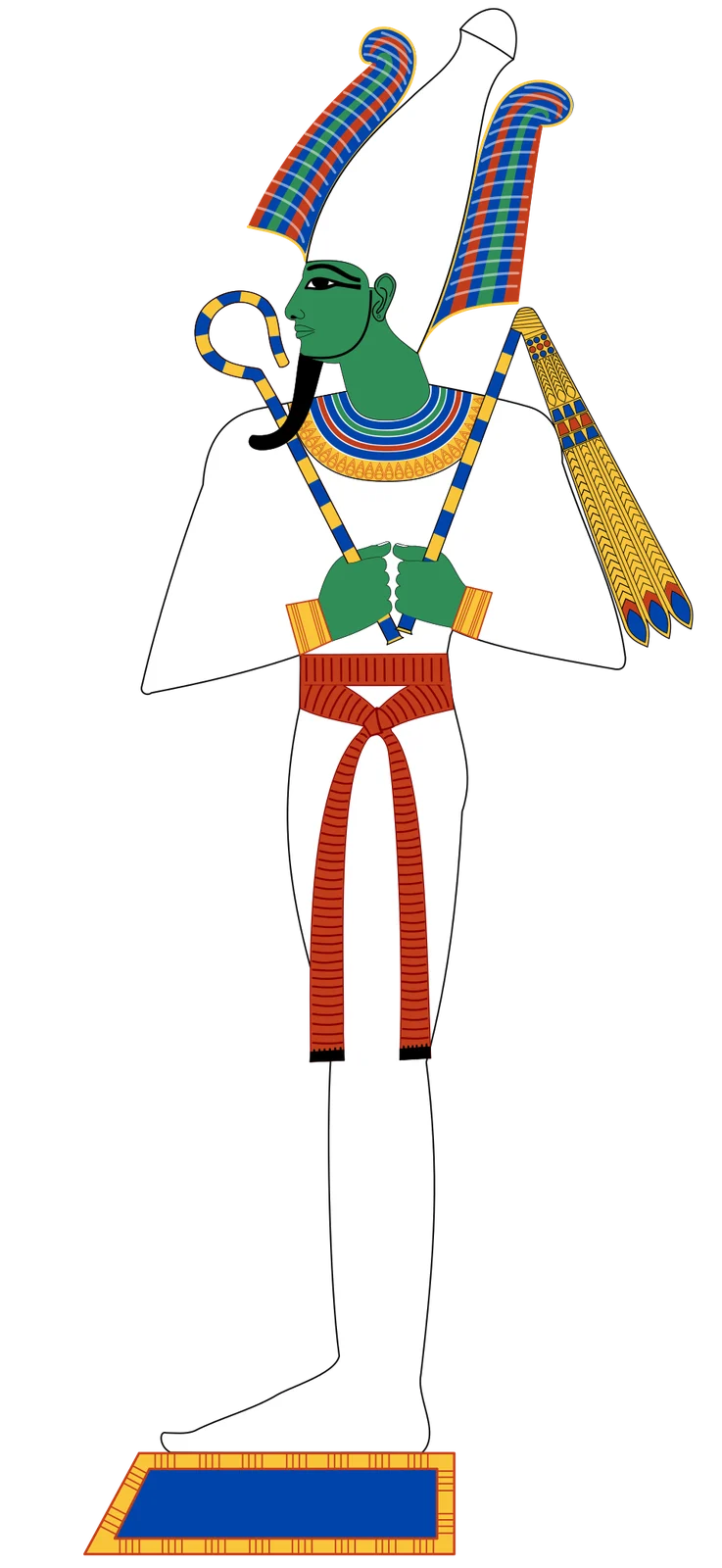
Osiris
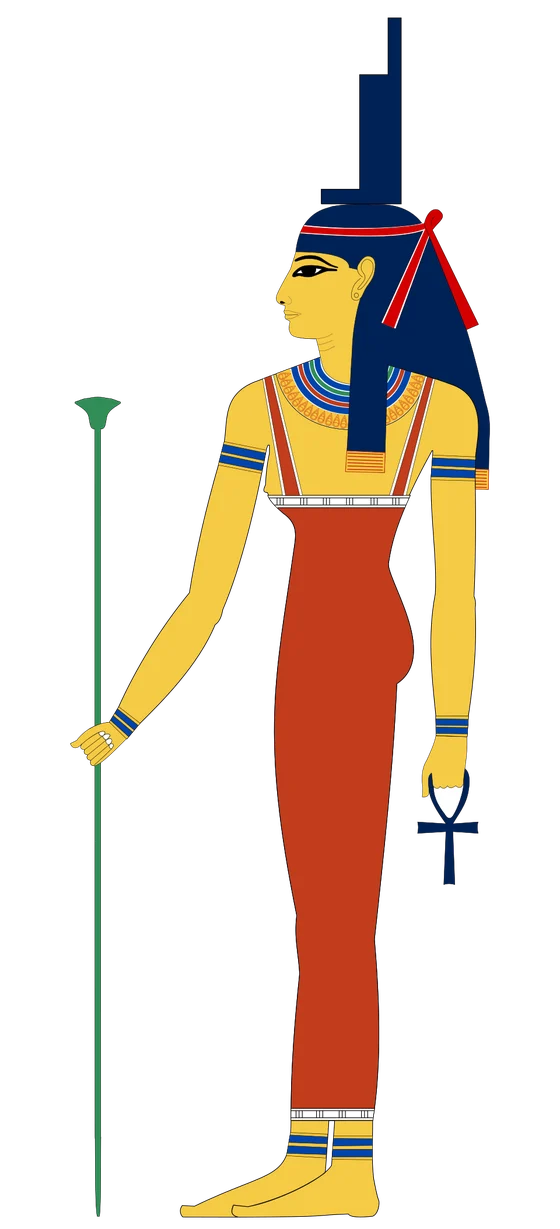
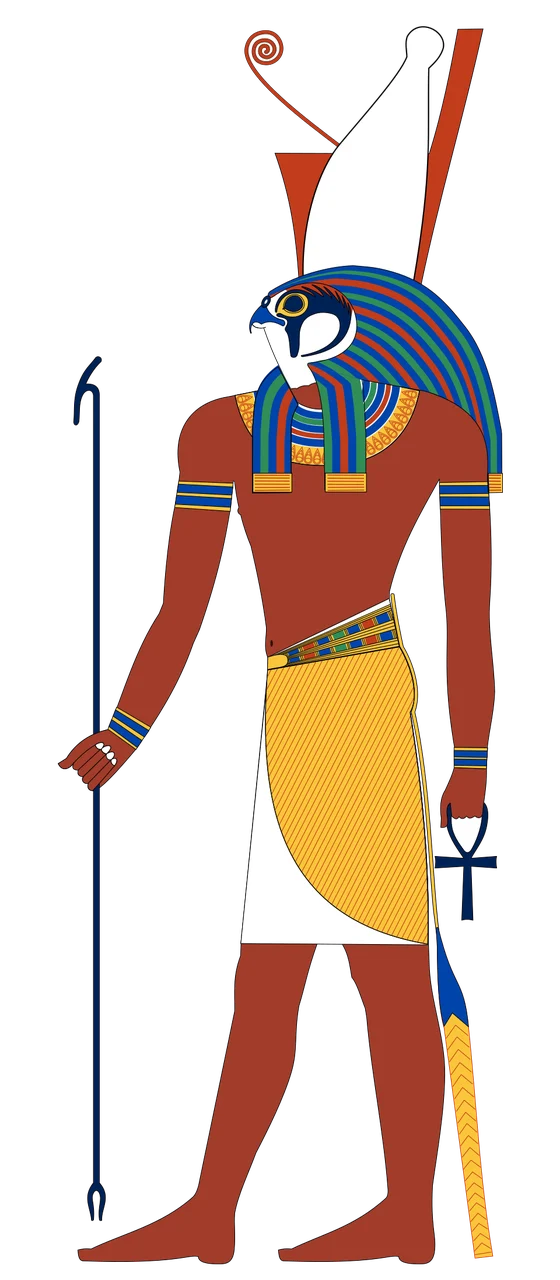
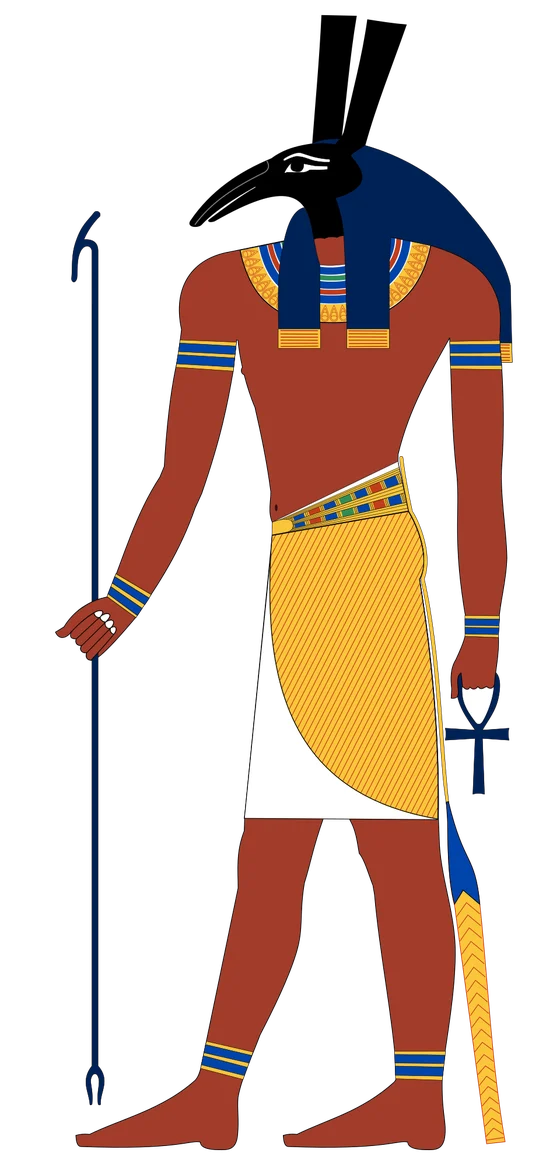
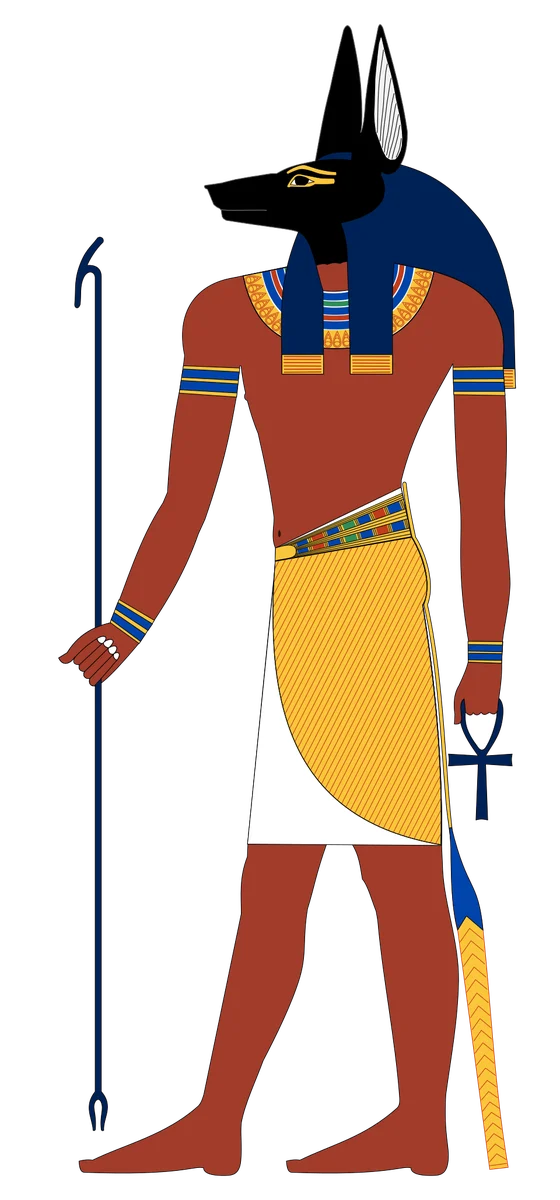
Modern vector interpretation of Egyptian deity iconography, based on historical representations; not a photograph or an original ancient painting. See the credited file description for shared iconography and artistic liberties.
Overview
The translated Hymn to Osiris addresses him through a series of local sanctuaries and royal titles: lord of eternity, ruler at Abydos, a hidden soul and a power praised in both lands. It attributes waters, winds, plants, cattle, birds, fish and other creatures to his beneficent rule. Stars obey him, heavenly gates open and divine offerings appear. These are the hymn’s expansive acts of praise, rather than incidents all arranged into a chronological biography. Its concrete visual language includes two light-giving plumes and a White Crown reaching towards the stars, while its account of his domain extends into the other world.
Isis’s search and restoration introduce the vulnerable body beneath that praise. She flies in grief until finding her brother, uses her wings and powerful speech to assist him and raises the helpless members of the one whose heart has ceased. The text describes her drawing his essence to produce an heir. Horus then grows strong in secret and comes before the divine assembly as Osiris’s flesh and bone. The gods recognise the rightful succession, and the hymn celebrates the son’s place on the ancestral throne. Osiris’s continuing authority thus depends on actions by sister, son and assembled deities as well as his own exalted titles.
Budge’s volume places this Egyptian hymn beside further resurrection representations and a separately identified account drawn from Plutarch. The classical narrative of murder and search is a different witness from the hymn’s compressed praise and succession scene. The collection’s illustrations also distinguish the procreation of Horus from the resurrection of Osiris, allowing those representations to be located separately. This profile follows the selected hymn’s actual movements: cosmic and local sovereignty, the helpless dead body, Isis’s restorative assistance and the heir’s recognition. It does not collapse those successive roles into a single undifferentiated description of a death god.
Origins & earliest records
The source mixes Egyptian translated texts with classical interpretation, explicitly separated in its chapters. Local versions and changes in cult practice require additional witnesses.
Records & interpretation
Budge’s historical translation: Hymn to Osiris and a Legend of the Origin of Horus, complete translated hymn and notes 119–149; separate classical account identified in the volume’s contents.
In the literature
“Osiris, Lord of eternity, King of the gods,”
A Hymn to Osiris and a Legend of the Origin of Horus; paragraph beginning “Homage to thee, Osiris, Lord of eternity, King of the gods,…” · E. A. Wallis Budge
The hymn addresses Osiris as lord of eternity, a manifold named and transforming ruler whose presence is associated with named sanctuaries.
Selected bibliography
Documented works and useful reading. This is not a list of every appearance.
- 01
Legends of the Gods: The Egyptian Texts
Hymn to Osiris and a Legend of the Origin of Horus, complete translated hymn and notes 119–149; separate classical account identified in the volume’s contents.
- 02
Legends of the Gods: The Egyptian Texts, edited with Translations
London,1912; historical English text edited by E.A.WallisBudge. Ancient narrative/ritual translation, separate from modern introduction and footnotes.
Family, evolution & connections
Textual genealogy: Creation A in Budge's Egyptian text translation
Selected divine generations explicitly enumerated in the translated History of Creation A.
Scroll sideways to see all branches. With a keyboard, focus the tree and use the arrow keys.
- Joint parents: Shu and Tefnut
- Joint parents: Geb (Seb/Keb) and Nut
- Heru-khent-an-maati (Blind Horus in this translation)
Follow the translator's named production of Shu and Tefnut, their joint offspring Geb and Nut, and the latter pair's enumerated children. Paired nodes identify two parents; they are not single organisms. A divine genealogy in one translated recension, not biological evolution or a harmonized account of all Egyptian traditions. Creation B differs. The source's Heru-khent-an-maati, glossed Blind Horus, remains an unlinked named node to avoid confusing him with later Horus parentage. Budge's historical translation and commentary are not a modern consensus edition.
Creation B’s different named generation in Budge’s translation
The translated History of Creation B in Budge’s 1912 Legends of the Gods, not his introductory harmonization.
Scroll sideways to see all branches. With a keyboard, focus the tree and use the arrow keys.
Retain the explicit final statement that Shu and Tefnut brought forth Osiris, Heru-khenti-an-maa, Set, Isis and Nephthys. Creation A explicitly inserts Geb and Nut as parents of this group; B’s displayed wording does not, and that difference is preserved. Joint root groups two divine producers, not one organism. The Horus name remains unlinked to avoid conflating distinct Horus parentage. This historical translated recension is not biological evolution or a modern critical edition. The shared leaf set with Creation A is intentional: these are substantively different textual witnesses, not duplicated topology.
Located primary passages
Specific passages supporting details in this entry, grouped by their published witness.
Legends of the Gods: The Egyptian Texts
London,1912; historical English text edited by E.A.WallisBudge. Ancient narrative/ritual translation, separate from modern introduction and footnotes.
- The hymn addresses Osiris as lord of eternity, a manifold named and transforming ruler whose presence is associated with named sanctuaries.
Specific ancient textual version in a historical English witness; names Uatchet/Nekhebet/Seb/Nu are historical renderings, not separate beings. Plutarch’s version and bracketed restorations must not be universalized. Ritual speech is literary evidence, not an instruction to perform healing or protective practices.
Encyclopedia background
An additional attributed reference, separate from the editorial profile above.
Read the open encyclopedia overview
Osiris (, from Egyptian wsjr) was the god of fertility, agriculture, the afterlife, the dead, resurrection, life, and vegetation in ancient Egyptian religion. He was classically depicted with a pharaoh's beard, partially mummy-wrapped at the legs, wearing a distinctive atef crown and holding a symbolic crook and flail. He was one of the first to be associated with the mummy wrap. When his brother Set cut him to pieces after killing him, Osiris's sister-wife, Isis, with her sister Nephthys, searched Egypt to find each part of him. She collected all but one – Osiris's genitalia. She then wrapped his body up, enabling him to return to life. Osiris was widely worshipped until the decline of ancient Egyptian religion.
Osiris was at times considered the eldest son of the earth god Geb and the sky goddess Nut, as well as brother and husband of Isis, and brother of Set, Nephthys, and Horus the Elder, with Horus the Younger being considered his posthumously begotten son. Through syncretism with Iah, he was also a god of the Moon.
Osiris was the lord of the dead and the underworld, the "Lord of Silence" and Khenti-Amentiu, meaning "Foremost of the Westerners". In the Old Kingdom (2686–2181 BC) the pharaoh was considered a son of the sun god Ra who, after his death, ascended to join Ra in the sky. After the spread of the Osiris cult, however, the kings of Egypt were associated with Osiris in death – as Osiris rose from the dead, they would unite with him and inherit eternal life through imitative magic. Through the hope of new life after death, Osiris began to be associated with the cycles in nature, in particular the sprouting of vegetation and annual flooding of the Nile River, as well as the heliacal rising of Orion and Sirius at the start of the new year. He became the sovereign that granted all life, "He Who is Permanently Benign and Youthful".
The first evidence of the worship of Osiris is from the middle of the Fifth Dynasty of Egypt (25th century BCE), though it is likely he was worshipped much earlier; the Khenti-Amentiu epithet dates to at least the First Dynasty, and was used as a pharaonic title. Most information available on the Osiris myth is derived from allusions in the Pyramid Texts at the end of the Fifth Dynasty, later New Kingdom source documents such as the Shabaka Stone and "The Contendings of Horus and Seth", and much later, in the narratives of Greek authors including Plutarch and Diodorus Siculus.
Text from Wikipedia contributors, “Osiris”. CC BY-SA 4.0. Extracted introduction; formatting changed. Retrieved 5 October 2026. The source article may have changed since retrieval.
References
Sources supporting this profile. Linked pages have their own scope and editorial standards.
- Primary-text translation and historical commentaryLegends of the Gods — Origin of Horus; resurrection material; classical Isis and Osiris accountResearch access: 2026-10-05
Image credits
Thematic illustrationOsiris
Modern vector interpretation of Egyptian deity iconography, based on historical representations; not a photograph or an original ancient painting. See the credited file description for shared iconography and artistic liberties.