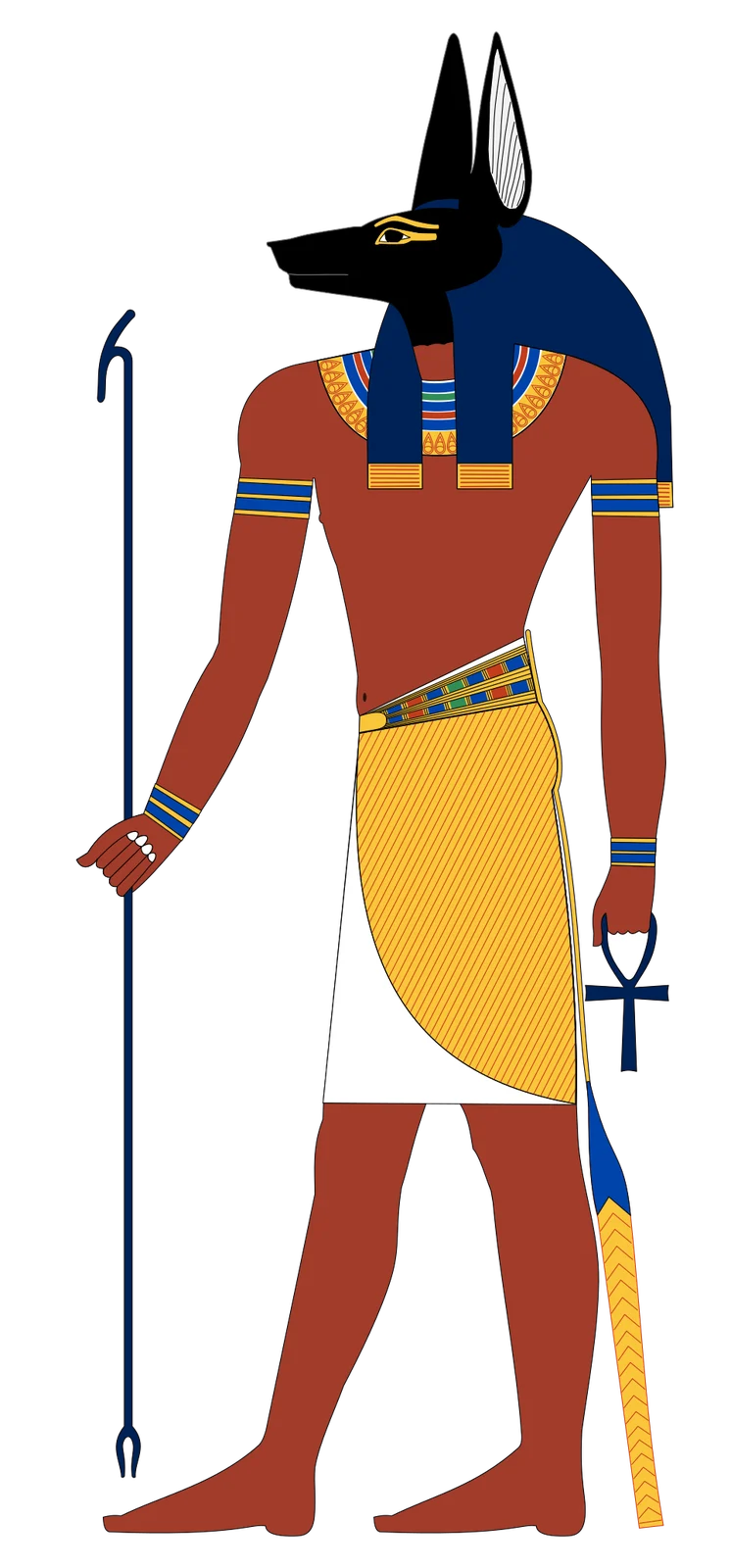
Anubis
Modern vector interpretation of Egyptian deity iconography, based on historical representations; not a photograph or an original ancient painting. See the credited file description for shared iconography and artistic liberties.
Overview
Budge identifies Anpu with Anubis in discussing the divine family and includes him in the classical narrative surrounding Isis and Osiris. The source’s treatment follows kinship and assistance rather than a natural-history account of a jackal. This short profile does not supply an unsupported complete history of embalming or judgment iconography. Those familiar associations require separate material witnesses if they are to be described in detail.
Museo Egizio’s description of amulet Cat. 1022 explicitly identifies Anubis as jackal-headed and responsible for protecting the mummified body. The same catalogue distinguishes Thoth’s recording task before Osiris. That division provides a concrete funerary role and animal representation, supplementing the kinship material without attributing every judgment action to Anubis.
Origins & earliest records
Anpu and Anubis are one entity. Some genealogical details in the edition occur in commentary or classical interpretation rather than in the selected creation text itself.
Records & interpretation
The selected attestation is Creation commentary; classical Isis and Osiris account in Budge’s translated collection. It documents a textual or ritual representation; commentary and later classical accounts are labeled where used. It does not establish zoological existence, a first oral telling, or a uniform belief shared by all Egyptians. A separate museum object/catalogue supports the represented animal form and visual details; this is material/iconographic evidence, not an observation of a living supernatural organism.
In the literature
“it became her constant guard and attendant”
Plutarch: History of Isis and Osiris, sectionXIV; paragraph beginning “XIV. The first who had knowledge of the accident which had…” · English translation printed in Budge1912; specific Plutarch translator uncredited in this section
In Plutarch’s narrative Isis finds and raises the exposed child of Osiris and Nephthys; he becomes Anubis, her guardian.
Selected bibliography
Documented works and useful reading. This is not a list of every appearance.
- 01
Legends of the Gods: The Egyptian Texts
Selected witness: Creation commentary; classical Isis and Osiris account. Historical translation and commentary; not an exhaustive bibliography.
- 02
Legends of the Gods: The Egyptian Texts, edited with Translations
London,1912; historical English text edited by E.A.WallisBudge. Greek literary witness from Plutarch, distinct from the Egyptian-language narratives.
Family & connections
A source-supported family tree or inspiration record has not yet been compiled for this profile. Related reading below indicates a connection in subject matter, not a proven lineage or creative influence.
Located primary passages
Specific passages supporting details in this entry, grouped by their published witness.
Legends of the Gods: The Egyptian Texts
London,1912; historical English text edited by E.A.WallisBudge. Greek literary witness from Plutarch, distinct from the Egyptian-language narratives.
- In Plutarch’s narrative Isis finds and raises the exposed child of Osiris and Nephthys; he becomes Anubis, her guardian.
Specific ancient textual version in a historical English witness; names Uatchet/Nekhebet/Seb/Nu are historical renderings, not separate beings. Plutarch’s version and bracketed restorations must not be universalized. Ritual speech is literary evidence, not an instruction to perform healing or protective practices.
Encyclopedia background
An additional attributed reference, separate from the editorial profile above.
Read the open encyclopedia overview
Anubis ( ; Ancient Greek: Ἄνουβις), also known as Inpu, Inpw, Jnpw, or Anpu in Ancient Egyptian (Coptic: ⲁⲛⲟⲩⲡ, romanized: Anoup), is the god of funerary rites, protector of graves, and guide to the underworld in ancient Egyptian religion, usually depicted as a canine or a man with a canine head.
Like many ancient Egyptian deities, Anubis assumed different roles in various contexts. Depicted as a protector of graves as early as the First Dynasty (c. 3100 – c. 2890 BC), Anubis was also an embalmer. By the Middle Kingdom (c. 2055–1650 BC) he was replaced by Osiris in his role as lord of the underworld. One of his prominent roles was as a god who ushered souls into the afterlife. He attended the weighing scale during the "Weighing of the Heart", in which it was determined whether a soul would be allowed to enter the realm of the dead. Anubis is one of the most frequently depicted and mentioned gods in the Egyptian pantheon; however, few major myths involved him.
Anubis was depicted in black, a color that symbolized regeneration, life, the soil of the Nile River, and the discoloration of the corpse after embalming. Anubis is associated with Wepwawet, another Egyptian god portrayed with a dog's head or in canine form, but with grey or white fur. Historians assume that the two figures were eventually combined. Anubis's female counterpart is Anput. His daughter is the serpent goddess Kebechet.
Text from Wikipedia contributors, “Anubis”. CC BY-SA 4.0. Extracted introduction; formatting changed. Retrieved 5 October 2026. The source article may have changed since retrieval.
References
Sources supporting this profile. Linked pages have their own scope and editorial standards.
- Primary-text translation and historical commentaryLegends of the Gods — Creation commentary; classical Isis and Osiris accountResearch access: 2026-10-05
- Museum object catalogueMuseo Egizio — amulet Cat. 1022Research access: 2026-10-05
Image credits
Thematic illustrationAnubis
Modern vector interpretation of Egyptian deity iconography, based on historical representations; not a photograph or an original ancient painting. See the credited file description for shared iconography and artistic liberties.