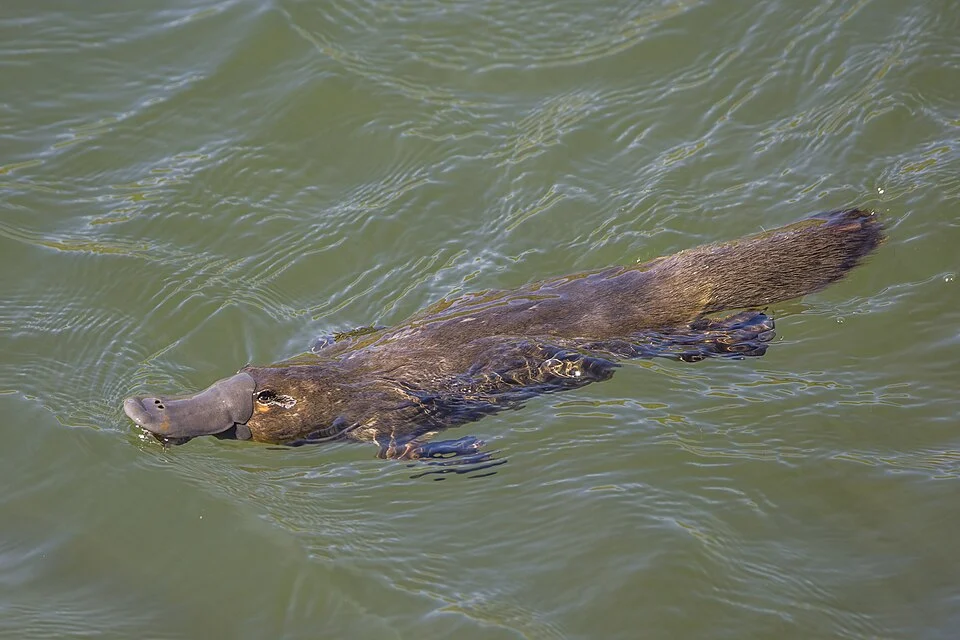
Platypus
Image associated with the exact linked encyclopedia article; consult credited file description for its interpretation.
Overview
The platypus combines dense fur, webbed feet and a sensitive bill with egg-laying reproduction. It is a monotreme mammal, rather than a mixture of bird and mammal assembled from unrelated parts. Living populations inhabit freshwater systems of eastern Australia and Tasmania, where they forage for aquatic food.
Fossil relatives show that the broader platypus lineage once had different anatomy and a wider distribution. This history should be separated from the age and range of the living species. Modern study uses observations, collections and imaging to investigate reproduction, feeding and variation. The animal's distinctive features illustrate one surviving branch of mammalian diversity; they do not make it an unchanged primitive ancestor or justify treating its physiology as a collection of biological exceptions.
Yang Zhou and colleagues published an improved platypus genome together with a short-beaked echidna genome in 2021. Skeletal muscle and liver from the male platypus Pmale09 supplied several sequencing and mapping datasets, with additional liver material from Pmale08. The curated platypus assembly assigned 98 percent of its sequence to 21 autosomes and five X and five Y chromosomes. Its 20,742 predicted protein-coding genes included genes and exons missed or fragmented in the older reference. The echidna assembly was less continuous, and some of its chromosome assignments used the platypus reference, an important qualification when comparing the two resources.
The male platypus sex chromosomes form a chain during meiosis, but the inferred history of that system is more complicated than a conventional single X-Y pair. Comparisons of corresponding chromosome regions suggested an ancestral ring that later opened as some regions diverged. That ring is reconstructed from modern homologies rather than observed in an ancestral animal. The researchers also identified AMH as a putative sex-determining gene, not an experimentally established master switch. Measurements of chromosome contacts in liver and fluorescent tests in fibroblasts supplied separate evidence for interactions among modern sex chromosomes; proposed roles of those interactions in ancient rearrangements remained interpretations.
Other comparisons addressed diet, senses and reproduction. Both sampled monotremes lacked several genes associated with tooth and stomach functions. The platypus had fewer annotated olfactory-receptor genes than the echidna but more vomeronasal type-1 receptor genes; the authors linked these differences with contrasting sensory lives, while specific receptor functions remained qualified. Both genomes lacked haptoglobin and the usual mammalian CD163A partner, suggesting a different system for clearing free hemoglobin without identifying its complete mechanism. They retained milk-related genes alongside the reproductive features of egg-laying mammals. Extra casein copies had unknown functions, illustrating how a genome can reveal a distinctive feature before its physiological role is established.
Origins & earliest records
The living platypus was scientifically investigated through specimens and observations, while its lineage is known from older fossils with different features. Monotreme divergence estimates concern a broader branch and must not be presented as the age of Ornithorhynchus anatinus itself. This profile therefore leaves the species' exact evolutionary origin undated.
Evidence & interpretation
Living observations, museum specimens and imaging reveal anatomy and reproduction. Fossil jaws, teeth and skulls document extinct relatives, but rare remains leave gaps in their relationships and distribution. Comparisons between living and extinct forms support evolutionary change rather than an assertion that the modern platypus has remained identical throughout its lineage's history.
Selected bibliography
Documented works and useful reading. This is not a list of every appearance.
- 01
Platypus
Selected institutional scientific reading; not a complete bibliography.
- 02
Platypus and echidna genomes reveal mammalian biology and evolution
Nature 592:756-762, DOI10.1038/s41586-020-03039-0. Main narrative and selected sample, assembly and chromosome-anchoring Methods. CC BY 4.0.
Family, evolution & connections
Monotremes and selected therian mammals
Mammalian subtree of the seven-species phylogenomic reconstruction in Zhou and colleagues (2021), Extended Data Figure 2a.
Scroll sideways to see all branches. With a keyboard, focus the tree and use the arrow keys.
Fourfold-degenerate sites from 7,946 one-to-one orthologues; non-mammalian outgroups omitted here. Only sampled representative species are displayed. A short-beaked echidna represents the sampled echidna genome, not all echidna diversity. Internal nodes denote shared ancestry, not living species transforming into one another. No dates or branch lengths are shown.
Seven sampled species in the 2021 monotreme genome study
All seven representative species in Extended Data Figure 2a; broader mammalian diversity is not sampled.
Scroll sideways to see all branches. With a keyboard, focus the tree and use the arrow keys.
RAxML tree from concatenated fourfold-degenerate sites of 7,946 one-to-one orthologues; chicken and green lizard specified as outgroups. The figure combines a phylogenetic backbone with calibrated times and gene-family counts. This rendering transfers only branching, omitting dates, expansion/contraction counts and chromosome reconstruction. Representatives are sister lineages, not direct ancestors; it does not display relationships among human peoples.
Taxonomic classification
A hierarchy of classified groups, not a chain of direct ancestors.
- kingdomAnimalia
- phylumChordata
- classMammalia
- orderMonotremata
- familyOrnithorhynchidae
- genusOrnithorhynchus
- speciesOrnithorhynchus anatinus
Short-beaked echidna
The comparative genome study samples platypus and short-beaked echidna on a shared monotreme branch, separate from sampled therian mammals. This is evidence for common ancestry, not for platypuses descending from living echidnas. Its selected species tree does not describe the relationships among every living echidna species.
Short-beaked echidna (Zhou 2021 sampled tree)
The concatenated nuclear-site tree pairs platypus and short-beaked echidna. Both are sampled living lineages; neither is shown as the other’s ancestor.
Located primary passages
Specific passages supporting details in this entry, grouped by their published witness.
Platypus and echidna genomes reveal mammalian biology and evolution
Nature592,756–762; online6January2021, issue29April2021; DOI10.1038/s41586-020-03039-0
- The authors compare an improved male platypus assembly with a less continuous echidna assembly. They assign98% of the curated platypus sequence to21 autosomes and five pairs of sex chromosomes, and propose an ancestral ring behind the latter complex. Comparative gene changes support distinct sensory and reproductive histories; several functional explanations remain hypotheses, including putative sex determination and monotreme-specific haemoglobin clearance.
Assembly-based inference is not a directly observed ancestral chromosome configuration. Echidna anchoring partly uses the platypus reference; AMH sex-determining role is putative. Extended datasets and full methods not reviewed.
Encyclopedia background
An additional attributed reference, separate from the editorial profile above.
Read the open encyclopedia overview
The platypus (Ornithorhynchus anatinus), sometimes referred to as the duck-billed platypus, is a semiaquatic, egg-laying mammal endemic to eastern Australia, including Tasmania. The platypus is the sole living representative of the family Ornithorhynchidae and genus Ornithorhynchus, though a number of related species appear in the fossil record. Together with the four species of echidna, it is one of the five extant species of monotremes, mammals that lay eggs instead of giving birth to live young. Like other monotremes, the platypus has a sense of electrolocation, which it uses to detect prey in water while its eyes, ears and nostrils are closed. It is one of the few species of venomous mammals, as the male platypus has a spur on each hind foot that delivers an extremely painful venom.
The unusual appearance of this egg-laying, duck-billed, beaver-tailed mammal at first baffled European naturalists. In 1799, the first scientists to examine a preserved platypus body judged it a fake made of several animals sewn together. The unique features of the platypus make it important in the study of evolutionary biology, and a recognisable and iconic symbol of Australia. It is culturally significant to several Aboriginal peoples, who also used to hunt it for food, and has appeared on stamps and currency.
The platypus was hunted for its fur, but since 1912 it has been a legally protected species in all states where it is found. Captive breeding programs have had slight success, and it is vulnerable to pollution, bycatching and climate change. It is classified as a near-threatened species by the IUCN, but a November 2020 report has recommended that it be upgraded to threatened species under the federal EPBC Act, due to habitat destruction and declining numbers in all states.
Text from Wikipedia contributors, “Platypus”. CC BY-SA 4.0. Extracted introduction; formatting changed. Retrieved 5 October 2026. The source article may have changed since retrieval.
References
Sources supporting this profile. Linked pages have their own scope and editorial standards.
- MuseumPlatypusResearch access: 2026-10-05
- ResearchZhou and colleagues 2021, CC BY 4.0Research access: 2026-10-05
Image credits
Reference illustrationPlatypus
Image associated with the exact linked encyclopedia article; consult credited file description for its interpretation.