Dimetrodon
Image associated with the exact linked encyclopedia article; consult credited file description for its interpretation.
Overview
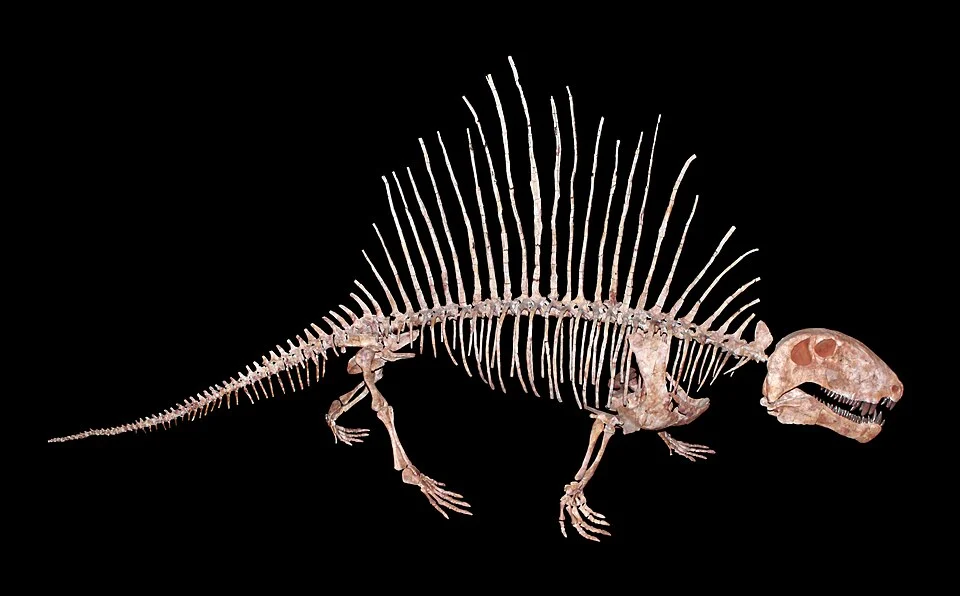
Dimetrodon had a prominent sail supported by elongated vertebral spines and a skull with differently sized teeth. It is frequently grouped with dinosaurs in popular imagery, but its ancestry lies among synapsids, on the mammalian side of the amniote family tree. It lived before the rise of dinosaurs and was not itself a mammal.
The sail's function has been interpreted in terms of temperature regulation, display and other possibilities. Its existence is directly supported by bones, whereas its appearance and use require reconstruction. Different Dimetrodon species varied in size and anatomy. The genus helps demonstrate how evolutionary relationships can disagree with superficial resemblance: a sprawling, reptile-looking animal can still be more closely related to living mammals than to living reptiles.
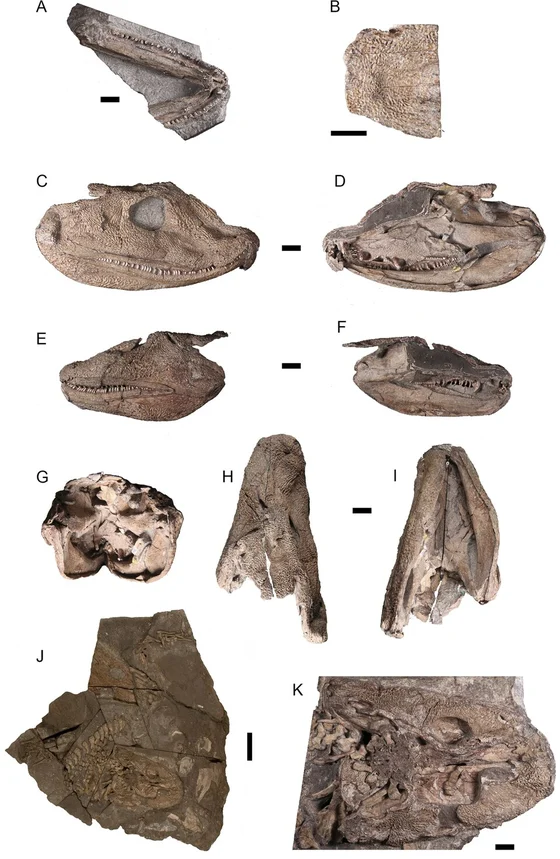
Brink and Reisz’s 2014 study distinguished enamel-only ornament from serrations with dentine cores. Species assignments were tentative; their analysis inferred independent dental developments among synapsids.
A 2010 comparison by Adam Huttenlocker and colleagues examined spine tissues in Dimetrodon and Sphenacodon. Its public abstract reports muscle-attachment evidence near the spine base, becoming reduced farther upward. The outer bone was not more richly vascularized distally than proximally, although surface vascular grooves occurred. This supports reconstructing different soft-tissue surroundings along a spine; it does not establish a single sail function. The authors left thermoregulatory capacity uncertain. Their inferred short Sphenacodon crest also cautions against giving every related animal the same silhouette. This account follows the abstract; the full paper was not assessed.
Origins & earliest records
Dimetrodon fossils are known from Permian deposits, especially in North America, with additional evidence from Europe. The marker near 290 million years represents part of its history rather than its exact origin. Naming individual species and recovering type specimens are scientific events distinct from the divergence of the synapsid lineage.
Evidence & interpretation
Skulls, teeth, vertebrae and limbs establish its anatomy and synapsid identity. The single temporal opening is informative in comparative classification. Sail function is less directly recoverable than skeletal structure, and behaviour should remain qualified. Species differences also mean that one mounted skeleton cannot represent the proportions of every Dimetrodon.
Selected bibliography
Documented works and useful reading. This is not a list of every appearance.
- 01
Dimetrodon
Selected institutional scientific reading; not a complete bibliography.
- 02
Hidden dental diversity in the oldest terrestrial apex predator Dimetrodon
Selected primary anatomical research.
- 03
Comparative anatomy and osteohistology of hyperelongate neural spines in the sphenacodontids Sphenacodon and Dimetrodon (Amniota: Synapsida)
Complete public abstract and bibliographic record read; full article not read.
Family, evolution & connections
Sampled Dimetrodon and relatives — Brink and Reisz 2014
Nine Figure 6 terminals, retaining its collapsed Therapsida label and three tentative Dimetrodon assignments.
Scroll sideways to see all branches. With a keyboard, focus the tree and use the arrow keys.
- Sampled Sphenacodontia
- Haptodus garnettensis
- Remaining sampled lineages
- Cutleria
- Sphenacodontoidea
- Therapsida (Alrausuchus representative)
- Sphenacodontidae
- Secodontosaurus
- Remaining sampled sphenacodontids
- Sphenacodon / Ctenospondylus pair
- Sphenacodon
- Ctenospondylus
- cf. Dimetrodon milleri
- cf. D. limbatus / cf. D. grandis pair
- cf. Dimetrodon limbatus
- cf. Dimetrodon grandis
Branch-and-bound parsimony in PAUP, with 122 unordered, unweighted morphological characters; 72 were informative. Branching follows Figure 6. This is a limited dental-focused sample, not all synapsids. Pie charts reconstruct tooth-character states; they are not branch support. No confidence values or dates are represented. The sampled Dimetrodon identifications require further taxonomic work. Fossil tips and ghost lineages are not demonstrated ancestors.
Taxonomic classification
A hierarchy of classified groups, not a chain of direct ancestors.
- kingdomAnimalia
- phylumChordata
- familySphenacodontidae
- genusDimetrodon
Homo sapiens
The museum places Dimetrodon among the synapsid relatives of mammals, a lineage that also ultimately includes humans. This supports a broad evolutionary connection, not a claim that this named fossil species directly became people. A tree should show branching descent and major groups, while keeping Dimetrodon's age and anatomy distinct from later mammals.
Encyclopedia background
An additional attributed reference, separate from the editorial profile above.
Read the open encyclopedia overview
Dimetrodon ( or ; lit. 'two measures of teeth') is an extinct genus of sphenacodontid synapsid that lived during the Cisuralian to early Guadalupian epoch of the Permian period, around 294.1–271 million years ago. With most species measuring 1.7–4.6 m (5.6–15.1 ft) long and weighing 28–250 kg (62–551 lb), the most prominent feature of Dimetrodon is the large neural spine sail on its back formed by elongated spines extending from the vertebrae. It was an obligate quadruped (it could walk only on four legs) and had a tall, curved skull with large teeth of different sizes set along the jaws. Most fossils have been found in the Southwestern United States, the majority of these coming from a geological deposit called the Red Beds of Texas and Oklahoma. More recently, its fossils have also been found in Germany and over a dozen species have been named since the genus was first erected in 1878.
Dimetrodon is often mistaken for a dinosaur or portrayed as a contemporary of dinosaurs in popular culture, but it became extinct by the middle Permian, some 40 million years before the appearance of dinosaurs. Although reptile-like in appearance and physiology, Dimetrodon is much more closely related to mammals, as it belongs to the closest sister family to therapsids, the latter of which contains the direct ancestor of mammals. Dimetrodon is traditionally assigned to the paraphyletic group "pelycosaurs", a term now considered obsolete and replaced by terms such as "primitive synapsids" or "basal synapsids"; the name "mammal-like reptiles" is also traditionally used for non-mammalian synapsids due to some of the features shared with modern mammals such as tooth specialization and endothermy, but that term is now also defunct. The Dimetrodon skull has a single opening (temporal fenestra) behind each eye, a feature shared among all synapsids, unlike the skulls of reptiles and birds, both of which belong to the clade Sauropsida, which had diverged from the synapsids by the Late Carboniferous.
Dimetrodon was probably one of the apex predators of the Cisuralian ecosystems, feeding on fish and tetrapods, including reptiles and amphibians. Smaller Dimetrodon species may have had different ecological roles. The sail of Dimetrodon may have been used to stabilize its spine or to heat and cool its body as a form of thermoregulation. Some recent studies argue that the sail would have been ineffective at removing heat from the body, due to large species being discovered with small sails and small species being discovered with large sails, essentially ruling out heat regulation as its main purpose. The sail was most likely used in courtship display, including threatening away rivals or showing off to potential mates.
Text from Wikipedia contributors, “Dimetrodon”. CC BY-SA 4.0. Extracted introduction; formatting changed. Retrieved 5 October 2026. The source article may have changed since retrieval.
References
Sources supporting this profile. Linked pages have their own scope and editorial standards.
- MuseumDimetrodonResearch access: 2026-10-05
- Primary researchBrink and Reisz (2014)Research access: 2026-10-05
- Primary researchHuttenlocker and colleagues (2010): comparative spine histologyResearch access: 2026-10-05
Image credits
Reference illustrationDimetrodon
Image associated with the exact linked encyclopedia article; consult credited file description for its interpretation.