Lystrosaurus
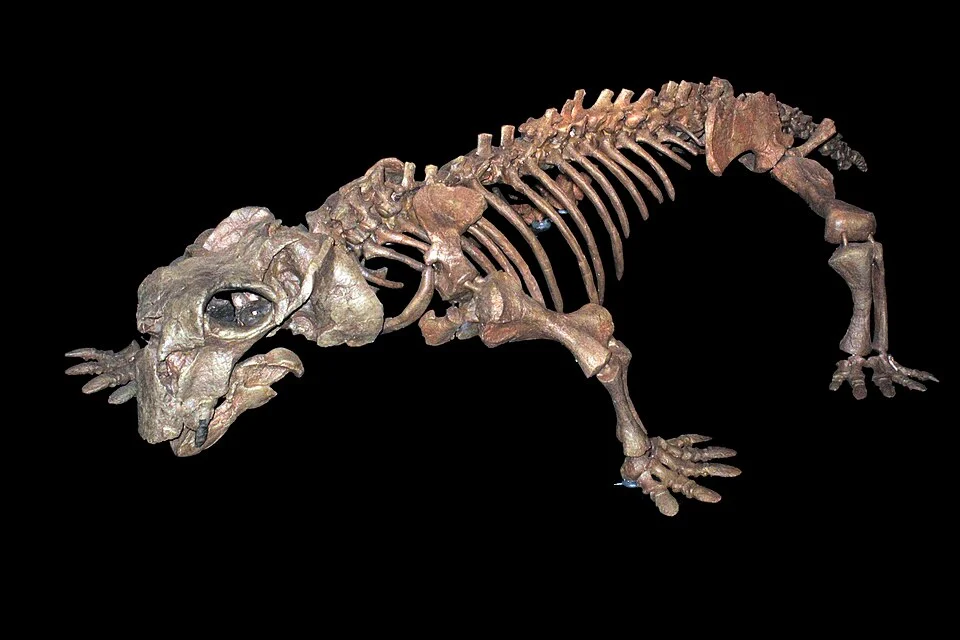
Image associated with the exact linked encyclopedia article; consult credited file description for its interpretation.
Overview
Lystrosaurus had a sturdy body, a beaked mouth and a pair of tusks in many familiar reconstructions. As a dicynodont, it belonged to an extinct branch of non-mammalian synapsids. Fossils from widely separated regions record its distribution across parts of the ancient supercontinent, providing evidence relevant to both biological history and changing geography.
Its survival through the end-Permian crisis made the genus important for studying ecological recovery. Bone growth records suggest that life histories changed under harsh conditions, with some post-extinction populations experiencing shorter lives. Such findings are hypotheses grounded in sampled bones rather than direct observations of reproduction. Success after an extinction was contingent on particular environments; it should not be interpreted as a universal formula for surviving all future crises.
Whitney and Sidor's 2020 study asks a different life-history question: whether high-latitude Lystrosaurus experienced recurrent metabolic slowdowns. They sectioned six Antarctic tusks and four South African tusks, comparing dentine growth in polar and non-polar material. Antarctica was warmer in the Early Triassic than today, yet long seasonal changes in daylight remained important. The tusks provide a growth record rather than a preserved sleeping animal. The authors deliberately avoided assigning each fine line a fixed daily or yearly duration because dentine deposition intervals are insufficiently calibrated across non-mammalian vertebrates.
Ordinary incremental spacing was not significantly different between the two sampled groups. Antarctic tusks nevertheless had thicker stress lines and shorter intervals between stressful episodes, compared with the more continuous growth in the South African sample. These contrasts persisted when the authors removed outliers, although individuals varied substantially. They interpreted closely spaced groups of stress marks as consistent with torpor: a temporary reduction in metabolic activity, potentially resembling hibernation. This is a physiological interpretation of tissue patterns. It does not establish that every growth interruption was torpor, nor does it directly measure body temperature, energy use, sleep duration or the exact season of an episode.
The experiment's scale matters. Hundreds of measured intervals came from ten tusks, not hundreds of independent animals. Fragmentary material suitable for destructive sampling constrained the comparison, and comparable baseline growth could only partly control for age, species and individual differences. The authors regard the result as preliminary and call for wider testing of seasonal responses. They connect physiological flexibility with possible persistence in polar environments after the end-Permian extinction, rather than identifying one demonstrated cause of the genus' survival everywhere. Their Antarctic-refugium discussion also distinguishes a temperate ancient polar ecosystem from today's ice-covered continent. A broadly distributed genus can contain populations with different responses to environmental stress.
Origins & earliest records
Lystrosaurus occurs in rocks spanning the Late Permian and Early Triassic, around the major extinction near 252 million years ago. Different species and populations had different histories. First description and modern study date scientific recognition, while fossil occurrences constrain distribution and survival rather than revealing an exact evolutionary starting point.
Evidence & interpretation
Abundant skeletons establish dicynodont anatomy and geographic occurrence. Bone microstructure allows estimates of growth and age, informing hypotheses about altered life histories after extinction. Sample composition and species differences matter, so suggested early reproduction or short lifespan cannot be assumed to apply identically across every Lystrosaurus population.
Selected bibliography
Documented works and useful reading. This is not a list of every appearance.
- 01
How to Beat Extinction: Live Fast, Die Young
Selected institutional scientific reading; not a complete bibliography.
- 02
Evidence of torpor in the tusks of Lystrosaurus from the Early Triassic of Antarctica
Communications Biology 3, 471; complete main Introduction, Results, Discussion, Methods and main captions read. Six Antarctic and four South African tusks.
Family, evolution & connections
Sampled lystrosaurids — Kammerer et al. 2013
Six Figure 9 terminals: five Lystrosaurus species and Eupytchognathus bathyrhynchus; remaining dicynodonts omitted.
Scroll sideways to see all branches. With a keyboard, focus the tree and use the arrow keys.
- Selected lystrosaurid branch
- Eupytchognathus bathyrhynchus
- Lystrosaurus murrayi
- Remaining sampled species
- Lystrosaurus declivis
- Curvatus and remaining pair
- Lystrosaurus curvatus
- L. maccaigi / L. hedini pair
- Lystrosaurus maccaigi
- Lystrosaurus hedini
TNT parsimony using 174 characters: 153 discrete and 21 additive continuous characters. Two search strategies returned the same tree. These branches are a historical morphological hypothesis. The authors describe unstable dicynodontoid rooting and problematic Lystrosaurus relationships, whose inferred divergence order conflicts with fossil appearances. No support values or chronology are represented. Non-anomodont outgroup branching is intentionally excluded; the authors warn that it reflects character sampling rather than reliable broader therapsid relationships.
Taxonomic classification
A hierarchy of classified groups, not a chain of direct ancestors.
- kingdomAnimalia
- phylumChordata
- familyLystrosauridae
- genusLystrosaurus
Eupytchognathus bathyrhynchus
Kammerer and colleagues place Eupytchognathus beside five sampled Lystrosaurus species. Their discussion warns that lystrosaurid relationships and broader rooting remain problematic; this is not an ancestor claim.
Encyclopedia background
An additional attributed reference, separate from the editorial profile above.
Read the open encyclopedia overview
Lystrosaurus (; 'shovel lizard'; from Ancient Greek λίστρον lístron 'tool for leveling or smoothing, shovel, spade, hoe') is an extinct genus of herbivorous dicynodont therapsids from the late Permian and Early Triassic epochs (around 248 million years ago). It had a widespread distribution across Pangaea, with fossils having been found in what is now Antarctica, India, China, Mongolia, European Russia, South Africa, and possibly Australia and Mozambique. Four to six species are currently recognized, but from the 1930s to 1970s the number of species was thought to be much higher.
As a dicynodont, Lystrosaurus had only two teeth (a pair of tusk-like canines), and is thought to have had a horny beak that was used for biting off pieces of vegetation. It was a heavily built, herbivorous animal. The structure of its shoulders and hip joints suggests that it moved with a semi-sprawling gait. Its forelimbs were even more robust than its hindlimbs, and it is thought to have been a powerful digger that nested in burrows.
Lystrosaurus survived the Permian-Triassic extinction event (Earth's most severe) 252 million years ago and thrived in the immediate aftermath; its fossils are, by far, the most common terrestrial vertebrate fossils in Early Triassic beds around the world, such as in the Lystrosaurus Assemblage Zone in South Africa. Researchers have offered various hypotheses for why it survived the extinction event and thrived in the early Triassic.
Text from Wikipedia contributors, “Lystrosaurus”. CC BY-SA 4.0. Extracted introduction; formatting changed. Retrieved 5 October 2026. The source article may have changed since retrieval.
References
Sources supporting this profile. Linked pages have their own scope and editorial standards.
- MuseumHow to Beat Extinction: Live Fast, Die YoungResearch access: 2026-10-05
- ResearchWhitney and Sidor 2020 — Lystrosaurus tusk growthResearch access: 2026-10-05
Image credits
Reference illustrationLystrosaurus
Image associated with the exact linked encyclopedia article; consult credited file description for its interpretation.