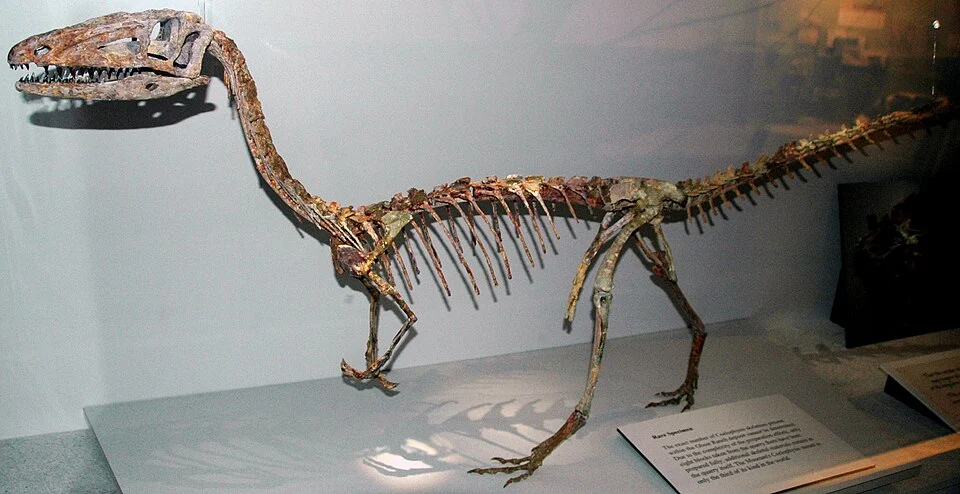
Coelophysis
Image associated with the exact linked encyclopedia article; consult credited file description for its interpretation.
Overview
Coelophysis had a slender body, hollow limb bones and a long balancing tail. Sharp teeth and grasping claws suit a meat-eating interpretation, while its two-legged anatomy indicates an agile animal. It lived in ecosystems where dinosaurs did not automatically occupy every dominant predatory role; other reptile lineages also played important parts.
Large fossil assemblages make the genus useful for anatomical and ecological study, but numerous bones in one deposit do not prove a permanent social group. Older claims of cannibalism relied on small bones thought to lie within an adult's rib cage. Re-examination identified different animals in important examples. This makes Coelophysis a useful reminder that even a dramatic behavioural story must be tested against the identity and position of the actual fossils.
A 2022 study by Barta, Griffin and Norell examined growth in the Ghost Ranch Coelophysis bauri bonebed using bone microstructure. The researchers sampled tibiae from 22 individuals, including attached fibulae where present, and additional material from two individuals. A distally sampled tibia and a specimen with an unusual bony callus were excluded from quantitative comparisons. Thin sections revealed growth interruptions and changes in tissue deposition. Counts of these marks served as age proxies, while tibial circumference and measured or estimated femur length represented body size. They were not direct records of birth dates or complete lifetime growth.
Growth marks and size showed an overall positive relationship, but size explained relatively little of the variation in the age proxy. Scores based on muscle scars and bone fusion also corresponded poorly with both size and growth-mark count. Many sampled animals lacked the closely spaced outer growth marks associated with skeletal maturity. Some showed reduced vascularity or a shift toward more slowly deposited bone, and a sectioned femur preserved an external fundamental system. The findings therefore distinguish continued growth, slowed growth and mature tissue rather than sorting all specimens into age classes using their length alone.
The authors used raw preserved growth-mark counts instead of reconstructing missing marks, because crushing, discontinuous marks and limited end-stage samples made reconstruction unreliable. They considered variable maturation and environmental stress as alternative or interacting explanations for slowed growth. A distribution dominated by low growth-mark counts was consistent with a catastrophic assemblage, but did not establish a single detailed cause of death. This population provides evidence for variable developmental trajectories; it does not prove that every early dinosaur grew identically or that all bonebed occupants belonged to a permanent herd. Their proposed connection between flexible growth and survival through unstable environments remained a broader evolutionary hypothesis.
Origins & earliest records
Coelophysis is associated with Late Triassic dinosaur faunas, particularly in North America. The representative timeline marker is approximate and does not encompass every historically assigned specimen. Scientific naming and the excavation of major assemblages are research milestones, whereas evolutionary origin must be inferred from relationships and older fossil occurrences.
Evidence & interpretation
Numerous skeletons reveal theropod anatomy and variation. Teeth and claws support carnivory, while assemblage structure informs possible mortality events. Famous supposed cannibalism evidence has been reassessed, with some internal bones belonging to other reptiles. Behavioural conclusions require anatomical identification and geological context rather than the visual impression of crowded remains.
Selected bibliography
Documented works and useful reading. This is not a list of every appearance.
- 01
Coelophysis
Selected institutional scientific reading; not a complete bibliography.
- 02
Osteohistology of a Triassic dinosaur population reveals highly variable growth trajectories typified early dinosaur ontogeny
Scientific Reports. Complete Results and Methods, first three Discussion sections and their captions read; broader evolutionary discussion and supplementary data not independently examined. CC BY4.0.
Family, evolution & connections
Sampled neotheropods in Zahner and Brinkmann’s example analysis (2019)
The 13-tip Neotheropoda subtree of Figure 2; Eoraptor, Eodromaeus and Tawa outgroups omitted.
Scroll sideways to see all branches. With a keyboard, focus the tree and use the arrow keys.
- Neotheropoda — Bremer 7; bootstrap 92%
- Coelophysoidea — Bremer 2; bootstrap not shown above 50%
- Segisaurus halli
- Remaining sampled coelophysoids — Bremer 1
- “Syntarsus” kayentakatae (source label)
- Panguraptor and Coelophysis pair — Bremer 1
- Panguraptor lufengensis
- Coelophysis pair — Bremer 2; bootstrap 80%
- Coelophysis rhodesiensis (source label)
- Zupaysaurus and averostran-line sample — Bremer 2; bootstrap not shown above 50%
- Zupaysaurus rougieri
- Notatesseraeraptor and remaining sample — Bremer 6; bootstrap 64%
- Notatesseraeraptor frickensis
- Dilophosaurus and remaining sample — Bremer 5; bootstrap 69%
- Dilophosaurus wetherilli
- Cryolophosaurus and Averostra — Bremer 1; bootstrap 60%
- Cryolophosaurus ellioti
- Averostra in this analysis — Bremer 5; bootstrap 74%
- Piatnitzkysaurus floresi
- Remaining sampled averostrans — Bremer 1
- Eustreptospondylus oxoniensis
- Ceratosaurus / Allosaurus pair — Bremer 1
- Ceratosaurus nasicornis
Single most-parsimonious tree from the authors’ 40%-completeness dataset, with Herrerasaurus replaced by Eodromaeus, plus Segisaurus and four averostrans. The analysis uses 155 cranial and 130 postcranial characters; length 547, consistency index 0.5210 and retention index 0.5379. One explicitly chosen example from several taxon-sampling analyses, not a pooled consensus. Including averostrans breaks the reduced analysis’s Dilophosauridae; adding Sinraptor can instead join Dilophosaurus and Cryolophosaurus. Removing Notatesseraeraptor produces 12 equally parsimonious trees and poor resolution. Coelophysoid relationships are weak. Bootstrap labels appear only where the figure reports values above 50%; absence is not zero support. Time-scaled geometry is omitted, and no fossil tip is labelled a direct ancestor. Historical names are preserved.
Taxonomic classification
A hierarchy of classified groups, not a chain of direct ancestors.
- cladeDinosauria
- cladeSaurischia
- cladeTheropoda
- cladeNeotheropoda
- superfamilyCoelophysoidea
- familyCoelophysidae
- genusCoelophysis
Coelophysis rhodesiensis in the 2019 example
Figure 2 pairs C. bauri and the historically labelled C. rhodesiensis, with Bremer support 2 and bootstrap 80%. The source labels are preserved without deciding current generic synonymy or making either fossil a direct ancestor.
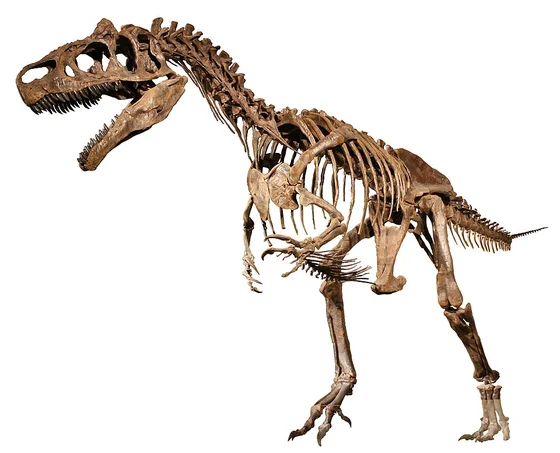
Allosaurus
In this sampling-sensitive example, Coelophysis belongs to the coelophysoid branch while Allosaurus belongs to Averostra on the other neotheropod branch. The common Neotheropoda node has Bremer support 7 and bootstrap 92%; the two genera are not immediate sisters or an ancestor–descendant pair.
Encyclopedia background
An additional attributed reference, separate from the editorial profile above.
Read the open encyclopedia overview
Coelophysis is an extinct genus of coelophysid theropod dinosaurs that lived approximately 215 to 201.4 million years ago during the late Triassic period from the middle Norian to Rhaetian age in what is now the southwestern United States. Megapnosaurus was once considered to be a species within this genus, but this interpretation has been challenged and the genus Megapnosaurus is now considered valid.
Coelophysis was a small, slenderly built, ground-dwelling, bipedal carnivore that could grow up to 3 m (9.8 ft) long. It is one of the earliest known dinosaur genera. Scattered material representing similar animals has been found worldwide in some Late Triassic and Early Jurassic formations.
The type species C. bauri, originally placed in the genus Coelurus by Edward Drinker Cope in 1887, was described by the latter in 1889. The names Longosaurus and Rioarribasaurus are synonymous with Coelophysis. Coelophysis is one of the most specimen-rich dinosaur genera.
Text from Wikipedia contributors, “Coelophysis”. CC BY-SA 4.0. Extracted introduction; formatting changed. Retrieved 5 October 2026. The source article may have changed since retrieval.
References
Sources supporting this profile. Linked pages have their own scope and editorial standards.
- MuseumCoelophysisResearch access: 2026-10-05
- ResearchGhost Ranch population growth and maturity studyResearch access: 2026-10-06
Image credits
Reference illustrationCoelophysis
Image associated with the exact linked encyclopedia article; consult credited file description for its interpretation.