Stegosaurus
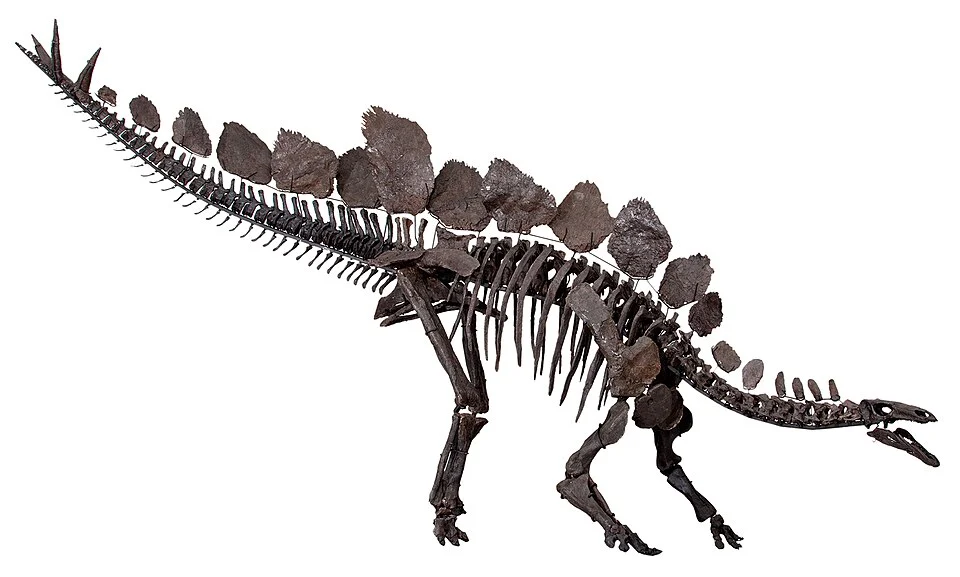
Image associated with the exact linked encyclopedia article; consult credited file description for its interpretation.
Overview
Stegosaurus had a small head relative to its body, weight-bearing limbs and a distinctive arrangement of bony plates in the skin of its back. The plates were separate from the vertebrae, which helps explain why their positions were difficult to reconstruct from disarticulated fossils. Its tail carried spikes that could plausibly serve in defence.
The genus lived alongside large predatory theropods and other herbivores in Late Jurassic ecosystems. Plate function has been discussed in relation to display, recognition and heat exchange, with no need to assume only one role. Well-preserved specimens allow increasingly precise estimates of anatomy and proportions. The animal's small skull does not provide a simple measure of behaviour or an excuse to repeat outdated claims about a second brain.
A particularly informative individual is NHMUK PV R36730, the skeleton displayed as Sophie at London's Natural History Museum. Maidment, Brassey and Barrett's 2015 study describes its postcranial bones and identifies it as Stegosaurus stenops. It was found at Red Canyon Ranch near Shell, Wyoming, in 2003 and excavated in 2004. Although substantially complete, it lacks parts including the hands and much of the tail base; some vertebrae were originally present but too poorly preserved to recover. Its mounted skeleton therefore combines original anatomy with reconstructed missing elements.
Eighteen plates and four tail spines were recovered. A gap near the proximal tail suggests one additional lost plate, giving an inferred original total of nineteen. Their largely associated positions provide unusually strong evidence for sequence, but the researchers could not establish which plates leaned left or right in life. The plates differ markedly along the body: small rounded anterior elements give way to larger, asymmetric plates with grooves and finely divided margins. The tail spines retain expanded attachment regions and pointed shafts. No throat ossicles were recovered, although other specimens preserve them; loss during fossilisation and biological variation remain alternatives.
At approximately 5.5–6 metres long, Sophie had not completed skeletal growth. Visible vertebral sutures, limb-joint features and earlier histological observations support a young-adult interpretation. That interpretation does not establish the individual's sex: the feminine nickname is not anatomical evidence, and absence of medullary bone cannot distinguish a male from a female that was not producing eggs. The largely articulated body, freshwater bivalves and fine sediments suggest rapid burial in standing water, possibly a pond or oxbow lake. These are environmental interpretations rather than an observed death scene. The precise cause of death is unknown, with no clear bite marks or major skeletal injuries reported. Nearby radiometric evidence and regional correlation provide geological context rather than a direct date measured from Sophie's bones.
Origins & earliest records
Stegosaurus was named by Othniel Charles Marsh in 1877 from fossils representing Late Jurassic life. A marker near 150 million years sits within that geological context. The scientific description and later correction of plate arrangement are historical research events, not direct measurements of the lineage's evolutionary origin.
Evidence & interpretation
Skeletons preserve limbs, plates and tail spikes, while unusually complete specimens help reconstruct their arrangement. Defensive use of the tail and proposed plate functions depend on anatomy and comparative evidence. Fossilisation can move skin-associated plates away from the body, so individual mounts involve informed decisions rather than simple reassembly of an untouched carcass.
Selected bibliography
Documented works and useful reading. This is not a list of every appearance.
- 01
Stegosaurus
Selected institutional scientific reading; not a complete bibliography.
- 02
The Postcranial Skeleton of an Exceptionally Complete Individual of the Plated Dinosaur Stegosaurus stenops (Dinosauria: Thyreophora) from the Upper Jurassic Morrison Formation of Wyoming, U.S.A.
Discovery, Geological Setting, Systematic Palaeontology/material, complete dermal-armour description and Ontogeny, Sex and Death; DOI 10.1371/journal.pone.0138352. Selected sections of a detailed anatomical study.
Family, evolution & connections
Seven sampled stegosaurs in Maidment (2010)
Crownward seven-tip subtree of Figure 1a; excluded basal tips include an unresolved polytomy.
Scroll sideways to see all branches. With a keyboard, focus the tree and use the arrow keys.
- Selected subtree (weighted decay 4)
- Kentrosaurus
- Remaining sampled subtree (bootstrap 50 / weighted decay 4)
- Loricatosaurus
- Sister groups (weighted decay 26)
- Stegosaurus armatus
- Pair (bootstrap 61 / weighted decay 5)
- Stegosaurus homheni (source spelling)
- Stegosaurus mjosi
- Dacentrurinae (bootstrap 89 / weighted decay 106)
- Dacentrurus
- Miragaia
Strict component consensus of 41 morphological most-parsimonious trees, length 3739; gap weighting to 26 and 5,000 bootstrap replicates. Historical labels are retained, including then-assigned Stegosaurus species; this is not current nomenclature consensus. Decay indices are weighted: 26 corresponds to ordinary index 1, and values below 26 depend on continuous characters only. No direct ancestors or branch dates are implied. Figure 1b is a different reduced consensus, not mixed here.
Taxonomic classification
A hierarchy of classified groups, not a chain of direct ancestors.
- kingdomAnimalia
- phylumChordata
- familyStegosauridae
- genusStegosaurus
Encyclopedia background
An additional attributed reference, separate from the editorial profile above.
Read the open encyclopedia overview
Stegosaurus (; lit. 'roof-lizard') is a genus of extinct herbivorous four-legged armored dinosaurs from the Late Jurassic, characterized by the distinctive kite-shaped upright plates along their backs and spikes on their tails. Fossils of the genus have been found in the western United States and in Portugal, where they are found in Kimmeridgian- to Tithonian-aged strata, dating to between 155 and 145 million years ago. Of the species that have been classified in the upper Morrison Formation of the western US, only three are universally recognized: S. stenops, S. ungulatus and S. sulcatus. The remains of over 80 individual animals of this genus have been found. Stegosaurus would have lived alongside dinosaurs such as Apatosaurus, Diplodocus, Camarasaurus and Allosaurus, the latter of which may have preyed on it.
They were large, heavily built, herbivorous quadrupeds with rounded backs, short fore limbs, long hind limbs, and tails held high in the air. Due to their distinctive combination of broad, upright plates and tail tipped with spikes, Stegosaurus is one of the most recognizable kinds of dinosaurs. The function of this array of plates and spikes has been the subject of much speculation among scientists. Today, it is generally agreed that their spiked tails were most likely used for defense against predators, while their plates may have been used primarily for display, and secondarily for thermoregulatory functions. Stegosaurus had a relatively low brain-to-body mass ratio. It had a short neck and a small head, meaning it most likely ate low-lying bushes and shrubs. One species, Stegosaurus ungulatus, is one of the largest known of all the stegosaurians, with the largest known specimens measuring about 9 metres (30 ft) long and weighing over 6.9 metric tons (7.6 short tons).
Stegosaurus remains were first identified during the "Bone Wars" by Othniel Charles Marsh at Dinosaur Ridge National Landmark. The first known skeletons were fragmentary and the bones were scattered, and it would be many years before the true appearance of these animals, including their posture and plate arrangement, became well understood. Despite its popularity in books and film, mounted skeletons of Stegosaurus did not become a staple of major natural history museums until the mid-20th century, and many museums have had to assemble composite displays from several different specimens due to a lack of complete skeletons. Stegosaurus is one of the better-known dinosaurs and has been featured in film, on postal stamps, and in many other types of media.
Text from Wikipedia contributors, “Stegosaurus”. CC BY-SA 4.0. Extracted introduction; formatting changed. Retrieved 5 October 2026. The source article may have changed since retrieval.
References
Sources supporting this profile. Linked pages have their own scope and editorial standards.
- MuseumStegosaurusResearch access: 2026-10-05
- ResearchThe Postcranial Skeleton of an Exceptionally Complete Individual of the Plated Dinosaur Stegosaurus stenops (Dinosauria: Thyreophora) from the Upper Jurassic Morrison Formation of Wyoming, U.S.A.Research access: 2026-10-05
Image credits
Reference illustrationStegosaurus
Image associated with the exact linked encyclopedia article; consult credited file description for its interpretation.