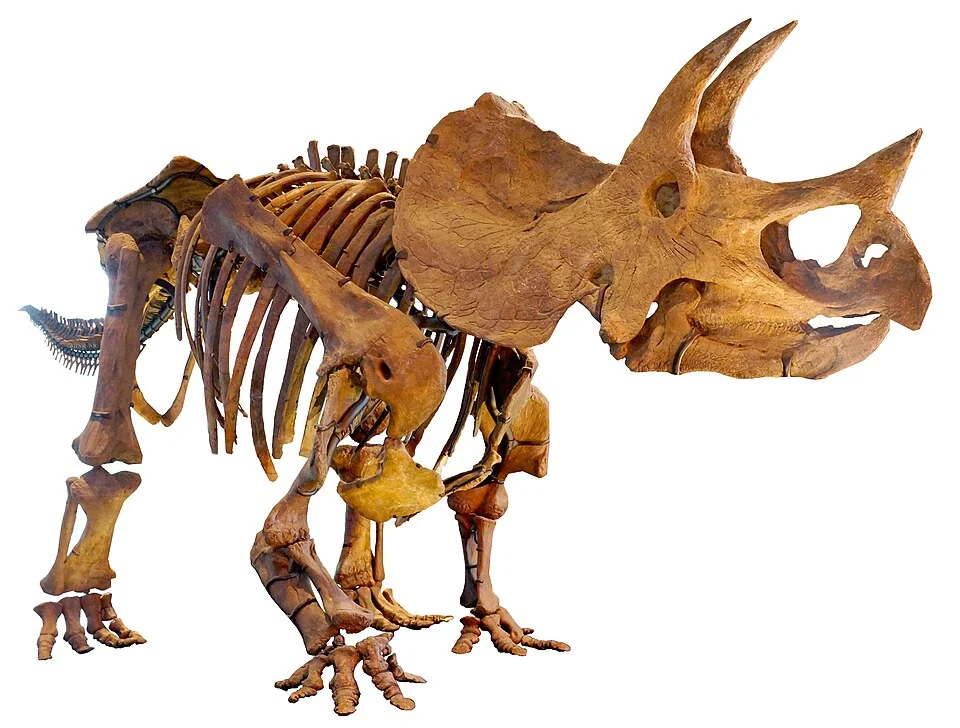
Triceratops
Image associated with the exact linked encyclopedia article; consult credited file description for its interpretation.
Overview
Triceratops had a beaked mouth, specialised teeth and a robust body supported on four limbs. Its facial horns and neck frill are among the most recognisable structures in dinosaur anatomy. Teeth processed plant material, while the skull's distinctive ornamentation prompts questions about display, recognition, protection and interactions with other animals.
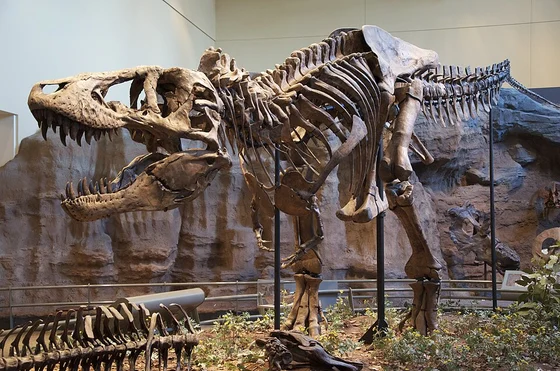
It shared Late Cretaceous North American ecosystems with Tyrannosaurus, but that coexistence does not establish a particular battle scene for every specimen. Skull shape changes during growth, complicating attempts to distinguish species or related genera. Well-documented fossils allow researchers to investigate those changes and possible injuries. Triceratops is therefore both an iconic animal and a case study in how variation, development and fossil preservation affect taxonomic interpretation.
Bone microstructure adds a different perspective to the familiar skull and horns. Jimmy de Rooij and colleagues examined Triceratops limb bones, ribs and vertebral processes in a study published online in 2023 and in a 2024 journal issue. Most material came from Wyoming's Darnell Triceratops Bonebed in the Lance Formation, interpreted as approximately 67 million years old from its stratigraphic setting. The assemblage preserved at least five individuals and was predominantly attributed to T. horridus. Additional Canadian limb bones broadened the size range; their assignment to T. cf. prorsus was qualified rather than treated as certain. The principal specimens are held by Naturalis, with comparative material in Canadian museum collections.
CT-guided coring reduced damage to the fossils while allowing standardized comparisons of their internal tissue. The researchers distinguished seven histological growth stages using bone organization, vascularity and remodelling. Larger sampled limb bones generally occupied later stages, but the scheme was not seven directly observed annual age classes. Its hatchling stage was hypothetical because hatchlings were absent, and an intermediate juvenile stage was partly extrapolated from poorly preserved material. Individual bones could also combine features of different stages. Tissue increasingly organized into parallel-fibred layers was interpreted as slower deposition relative to faster-growing woven tissue, alongside continuing vascular supply and replacement of older bone.
This growth record did not provide reliable birthdays or complete lifespans. Many bones lacked a sufficiently regular sequence of growth marks, and ribs and vertebrae did not solve that problem: remodelling and changes in shape further complicated their records. The authors therefore emphasized relative development instead of calculating confident ages at death or annual growth rates. Comparison with published Torosaurus limb histology also failed to separate the genera unequivocally using histology alone. Similar size–maturity patterns do not prove that Torosaurus is an adult Triceratops, nor do these sections alone establish their distinctness. More associated skeletons, anatomical comparisons and better-constrained growth samples were needed to address that taxonomic question.
Origins & earliest records
Triceratops fossils occur near the end of the Cretaceous in North America, including intervals approaching the mass extinction about 66 million years ago. The marker near 68 million years is representative. Its nineteenth-century naming records scientific recognition, not the origin of horned dinosaurs or a uniform age for every specimen.
Evidence & interpretation
Skulls and other skeletal elements directly record horns, frill and feeding anatomy. Bone texture and proportions inform growth-stage interpretation. Possible combat injuries require careful assessment because damage can occur after death. Taxonomic debates about related skull forms show that developmental variation must be considered before every distinct-looking specimen becomes a separate species.
Selected bibliography
Documented works and useful reading. This is not a list of every appearance.
- 01
Triceratops
Selected institutional scientific reading; not a complete bibliography.
- 02
Exploring the ceratopsid growth record: A comprehensive osteohistological analysis of Triceratops (Ornithischia: Ceratopsidae) and its implications for growth and ontogeny
Cretaceous Research 154:105738; online 7 October 2023. Selected complete Introduction, material/Methods, growth-stage account and Discussion/conclusions; CC BY 4.0.
Family, evolution & connections
Triceratops clade — Mallon et al. 2016
All ten red-clade terminals in Figure 14’s upper, traditional-epiparietal-homology panel.
Scroll sideways to see all branches. With a keyboard, focus the tree and use the arrow keys.
- Sampled Triceratops clade (bootstrap 74)
- Anchiceratops ornatus
- Arrhinoceratops and remaining sampled taxa (bootstrap 52)
- Arrhinoceratops brachyops
- Sampled six-way polytomy (bootstrap 78)
- Ojoceratops fowleri
- Torosaurus latus
- Torosaurus utahensis
- Nedoceratops hatcheri
- Triceratops pair (bootstrap 85)
- Triceratops prorsus
- Titanoceratops ouranos
- Regaliceratops peterhewsi
Reduced strict consensus from morphological parsimony; Bravoceratops and Eotriceratops removed as wildcard taxa. Matrix: 172 characters, 29 taxa; character 93 excluded. Bootstrap uses 1,000 replicates. A historical hypothesis with unresolved branching, not direct ancestry. The alternative homology analysis changes surrounding relationships and some supports. Missing data, character conflict and homology assumptions limit confidence. Species labels follow this study; separate tips do not settle synonymy disputes. No geological dates reproduced.
Selected horned dinosaurs — Sampson 2010
Ten terminals from the Kosmoceratops-led subtree of Figure S1; other taxa, including Torosaurus utahensis, pruned.
Scroll sideways to see all branches. With a keyboard, focus the tree and use the arrow keys.
- Selected Figure S1 subtree
- Kosmoceratops / Vagaceratops; bootstrap 84%, Bremer 4
- Kosmoceratops richardsoni
- Vagaceratops irvinensis
- Remaining sampled chasmosaurines
- Anchiceratops ornatus
- Arrhinoceratops and remaining sample
- Arrhinoceratops brachyops
- Unresolved three-way branch
- Ojoceratops fowleri
- Eotriceratops xerinsularis
- Remaining sampled crownward taxa
- Torosaurus latus
- Nedoceratops and Triceratops
- Nedoceratops hatcheri
- Triceratops pair
- Triceratops prorsus
Strict consensus of three most-parsimonious trees: 25 species, 148 equally weighted characters, length 263. PAUP*/TNT analyses; 10,000 bootstrap replicates. Historical morphological hypothesis, not direct ancestor chains. The three-way branch remains unresolved. Torosaurus and Nedoceratops retain the study’s operational labels; this tree does not independently settle synonymy or growth-stage interpretations. The genus profile links the T. horridus tip, not an invented combined terminal. Retained support belongs to an original node, not a reanalysis of this pruning. Figure S1 reports only bootstrap >50% and Bremer >1; omitted values are not zero. Geographic histories and Figure 7’s stratigraphic ranges are excluded.
Taxonomic classification
A hierarchy of classified groups, not a chain of direct ancestors.
- kingdomAnimalia
- phylumChordata
- familyCeratopsidae
- genusTriceratops
Kosmoceratops and Vagaceratops in Sampson’s 2010 tree
The Kosmoceratops–Vagaceratops pair lies beside a larger clade containing Triceratops in Figure S1. That topology does not identify either named genus as Triceratops’s direct ancestor. An internal three-way branch remains unresolved.
Located primary passages
Specific passages supporting details in this entry, grouped by their published witness.
Primary source witness
Cretaceous Research154(2024):105738; available online7October2023; DOI10.1016/j.cretres.2023.105738.
- The study examines Triceratops horridus material from a Wyoming bonebed and additional Canadian specimens qualified as T.cf.prorsus. Bone tissues provide a seven-stage relative developmental scheme associated with size, but preservation and irregular growth marks limit year-by-year ageing. Different skeletal elements preserve different records. The authors infer comparatively continuous growth while stressing limited comparative sampling. Histology alone does not resolve the Triceratops–Torosaurus taxonomic debate or establish clear differences between the two sampled Triceratops species.
Remaining Methods, descriptive Results, earlier Discussion, supplements and referenced fossils not independently inspected; no histological rerun or whole-paper claim.2006 cranial-study retrieval held after API error, not represented as fully read.
Encyclopedia background
An additional attributed reference, separate from the editorial profile above.
Read the open encyclopedia overview
Triceratops ( try-SERR-ə-tops; lit. 'three-horned face') is a genus of chasmosaurine ceratopsian dinosaur that lived during the late Maastrichtian age of the Late Cretaceous period, about 69 to 66 million years ago on the island continent of Laramidia, now forming western North America. It was one of the last-known non-avian dinosaurs and lived until the Cretaceous–Paleogene extinction event 66 million years ago. The name Triceratops, which means 'three-horned face', is derived from Ancient Greek trí- (τρί-), meaning 'three', kéras (κέρας), meaning 'horn', and ṓps (ὤψ), meaning 'face'.
Bearing a large bony frill, three horns on the skull, and a large, four-legged body, exhibiting convergent evolution with rhinoceroses, Triceratops is one of the most recognizable of all dinosaurs and the best-known ceratopsian. It was also one of the largest, measuring around 8–9 m (26–30 ft) long and weighing up to 6–10 t (5.9–9.8 long tons; 6.6–11.0 short tons). It shared the landscape with and was most likely preyed upon by Tyrannosaurus rex. The functions of the frills and three distinctive facial horns on its head have inspired countless debates. Traditionally, these have been viewed as defensive weapons against predators. More recent interpretations find it probable that these features were primarily used in species identification, courtship, and dominance display.
Triceratops was traditionally placed within the "short-frilled" ceratopsids, but modern cladistic studies show it to be a member of Chasmosaurinae, which usually have long frills. Two species, T. horridus and T. prorsus, are considered valid today. Seventeen different species, however, have been named throughout history. Research published in 2010 argued that the contemporaneous Torosaurus, a ceratopsid long regarded as a separate genus, represents Triceratops in its mature form. This view has been highly disputed, with some morphometric research and the apparent existence of authentic Torosaurus subadults favoring the distinctness of the two genera, according to newer studies.
Triceratops has been documented by numerous remains collected since the genus was first described in 1889 by American paleontologist Othniel Charles Marsh. Specimens representing life stages from hatchling to adult have been found. As the archetypal ceratopsian, Triceratops has been featured in numerous films, postage stamps, and many other media types.
Text from Wikipedia contributors, “Triceratops”. CC BY-SA 4.0. Extracted introduction; formatting changed. Retrieved 5 October 2026. The source article may have changed since retrieval.
References
Sources supporting this profile. Linked pages have their own scope and editorial standards.
- MuseumTriceratopsResearch access: 2026-10-05
- Researchde Rooij and colleagues 2024, primary osteohistology report, CC BY 4.0Research access: 2026-10-05
Image credits
Reference illustrationTriceratops
Image associated with the exact linked encyclopedia article; consult credited file description for its interpretation.