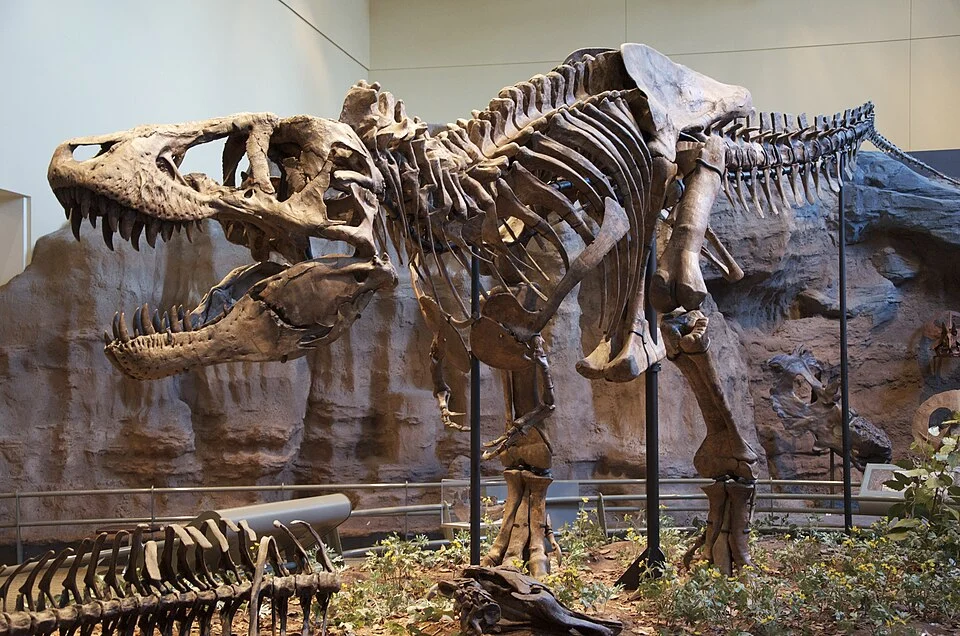
Tyrannosaurus rex
Image associated with the exact linked encyclopedia article; consult credited file description for its interpretation.
Overview
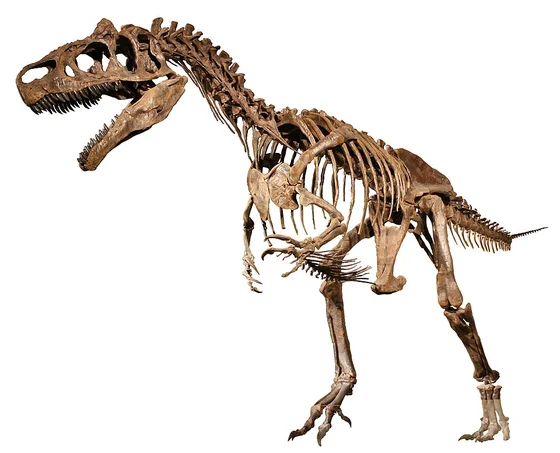
Tyrannosaurus rex occupied North American ecosystems near the end of the Cretaceous. Its skull and teeth were built to withstand substantial feeding forces, while its hind limbs supported a large two-legged body. Small forelimbs are striking but do not define the whole animal's biology. Its anatomy differs from that of earlier large theropods such as Allosaurus.
Numerous specimens permit study of growth, injuries and variation. Feeding evidence supports a carnivorous animal that could exploit prey and carcasses, without requiring a rigid choice between hunting and scavenging. Proposed pack behaviour, exact maximum speed and sensory reconstructions depend on different kinds of evidence and modelling. The species' fame should not erase the distinction between directly preserved bones, experimentally estimated capabilities and imagined scenes of daily life.
William Sellers and colleagues investigated adult locomotion in 2017 by combining a moving musculoskeletal model with estimates of stress in the leg bones. Their reconstruction used the specimen BHI 3033 and an estimated mass of about 7.2 tonnes. Allowing very high bone stresses produced faster movements, but imposing more realistic limits sharply reduced performance. Gaits with an aerial phase, when neither foot touched the ground, exceeded the permitted loads. This supported a restriction on adult aerial running under the tested assumptions; it did not establish that an adult was motionless, unable to hunt, or incapable of every movement described as running. The authors explicitly considered grounded running, in which the body can move with running-like mechanics while retaining ground contact.
The 2017 model simplified joints to hinge movements, estimated internal bone geometry from published tyrannosaur material, and treated bones as beams instead of running a complete finite-element analysis. Its search for muscle activation patterns was extensive but not exhaustive. Soft-tissue cushioning, different body reconstructions and more complete sensitivity tests could affect the result. Applying the adult result directly to juveniles would also overlook changes in body proportions during growth. Bone strength therefore adds an important constraint to speed estimates without turning one reconstruction into a measured speed for every Tyrannosaurus.
A different question was addressed by Pasha van Bijlert, A. J. Knoek van Soest and Anne Schulp in 2021: the preferred, potentially energy-saving walking pace. They reconstructed the tail of the adult specimen Trix as five connected segments supported by spring-like ligaments, then combined its estimated natural oscillation frequency with a step length scaled from a tyrannosaurid trackway. Their baseline estimate was 1.28 metres per second, about 4.6 kilometres per hour. This is a model of preferred walking, not a maximum pursuit speed or a directly timed fossil trackway. Ligament geometry, composition and vertebral movement introduced substantial uncertainty, while complex muscular interactions were deliberately simplified. A July 2021 correction changed a reference in the Figure 2 caption, rather than the reported baseline speed.
Origins & earliest records
Tyrannosaurus rex was named in 1905 from fossils representing the latest Cretaceous of western North America. Known occurrences extend towards the extinction at about 66 million years ago. The representative date near 67 million years describes fossil context, whereas naming and specimen collection are separate events in scientific history.
Evidence & interpretation
Skeletons, skulls and teeth establish anatomy, while bite marks, bone microstructure and comparative models inform feeding and growth. Estimated speed or bite force depends on assumptions about muscles and body mass. Behaviour is less directly preserved than skeletal structure, so particular social or hunting reconstructions remain hypotheses requiring multiple supporting observations.
Selected bibliography
Documented works and useful reading. This is not a list of every appearance.
- 01
Tyrannosaurus
Selected institutional scientific reading; not a complete bibliography.
- 02
Investigating the running abilities of Tyrannosaurus rex using stress-constrained multibody dynamic analysis
Complete main Methods, Results, Discussion and Conclusion independently read in official Europe PMC XML. Original summary adapted under CC BY4; simulation and supplements not rerun.
- 03
Natural Frequency Method: estimating the preferred walking speed of Tyrannosaurus rex based on tail natural frequency
Complete main Methods, Results, Discussion and Conclusion read; supplementary simulations not rerun. Original summary adapted under CC BY4.
- 04
Correction to: Natural Frequency Method
Complete correction body read in official Europe PMC XML: Figure 2 caption reference corrected to39.
Family, evolution & connections
Tyrannosauridae in Brusatte and Carr’s parsimony analysis (2016)
All 13 named Tyrannosauridae tips retained from Figure 1; other tyrannosauroids and outgroups omitted. Source genus-level labels preserved.
Scroll sideways to see all branches. With a keyboard, focus the tree and use the arrow keys.
- Tyrannosauridae — Bremer 2; jackknife below 50%
- Albertosaurinae — Bremer 3; jackknife 98%
- Gorgosaurus
- Albertosaurus
- Tyrannosaurinae — Bremer 2; jackknife below 50%
- Alioramini — Bremer 3; jackknife 84%
- Qianzhousaurus
- Alioramus pair — Bremer 1; jackknife below 50%
- Alioramus remotus
- Alioramus altai
- Remaining sampled tyrannosaurines — Bremer 2; jackknife 51%
- Nanuqsaurus / Teratophoneus pair — Bremer 1; jackknife 56%
- Nanuqsaurus
- Teratophoneus
- Remaining sampled branch — Bremer 1; jackknife below 50%
- Lythronax
- Daspletosaurus and remaining sampled genera — Bremer 2; jackknife 75%
- Daspletosaurus pair — Bremer 3; jackknife 80%
- Daspletosaurus
- Daspletosaurus n. sp. (2016 source label)
- Zhuchengtyrannus and sister pair — Bremer 1; jackknife 55%
- Zhuchengtyrannus
- Tarbosaurus / Tyrannosaurus pair — Bremer 2; jackknife 88%
- Tarbosaurus
Strict consensus of five most-parsimonious trees from 366 discrete anatomical characters, 28 tyrannosauroids and four outgroups; length 765, consistency index 0.557 and retention index 0.812. Node labels reproduce Bremer and jackknife support. A historical study hypothesis, not direct ancestry or a current universal consensus. The same-data Bayesian analysis differs in Dryptosaurus, Daspletosaurus monophyly and tyrannosaurine resolution; earlier Loewen topology also differs. Branches are not scaled to time. Figure bars mostly show age uncertainty, so no dates or ancestor links are reproduced. Several displayed nodes have jackknife support below 50%; the unnamed Daspletosaurus species retains its 2016 label.
Taxonomic classification
A hierarchy of classified groups, not a chain of direct ancestors.
- kingdomAnimalia
- phylumChordata
- familyTyrannosauridae
- genusTyrannosaurus
- speciesTyrannosaurus rex
Tarbosaurus in Brusatte and Carr’s 2016 analysis
Figure 1 places Tyrannosaurus and Tarbosaurus as sister tips, with Bremer support 2 and jackknife 88%. Neither is drawn as the other’s ancestor. This is a morphological study hypothesis, not inferred DNA kinship.
Zhuchengtyrannus in Brusatte and Carr’s 2016 analysis
Zhuchengtyrannus is sister to the Tarbosaurus–Tyrannosaurus pair in this strict parsimony consensus. That three-tip node has Bremer support 1 and jackknife 55%. The authors explicitly contrast an earlier topology pairing Zhuchengtyrannus with Tarbosaurus instead.
Encyclopedia background
An additional attributed reference, separate from the editorial profile above.
Read the open encyclopedia overview
Tyrannosaurus () is a genus of large theropod dinosaur. The type species Tyrannosaurus rex (rex meaning 'king' in Latin), often shortened to T. rex or colloquially T-Rex, is one of the best represented theropods. It lived throughout what is now western North America, on what was then an island continent known as Laramidia. Tyrannosaurus had a much wider range than other tyrannosaurids. Fossils are found in a variety of geological formations which have been dated to the late Maastrichtian age of the late Cretaceous period, 69 to 66 million years ago, with isolated specimens possibly indicating an earlier origin in the middle Campanian age. It was one of the last known members of the tyrannosaurids and among the last non-avian dinosaurs to exist before the Cretaceous–Paleogene extinction event.
Like other tyrannosaurids, Tyrannosaurus was a bipedal carnivore with a massive skull balanced by a long, heavy tail. Relative to its large and powerful hind limbs, the forelimbs of Tyrannosaurus were short but unusually powerful for their size, and they had two clawed digits. The most complete specimen measures 12.3–12.4 m (40–41 ft) in length, but according to most modern estimates, Tyrannosaurus could have exceeded sizes of 13 m (43 ft) in length, 3.7–4 m (12–13 ft) in hip height, and 8.8 t (8.7 long tons; 9.7 short tons) in mass. Although some other theropods might have rivaled or exceeded Tyrannosaurus in size, it is still among the largest known land predators, with its estimated bite force being the largest among all terrestrial animals. By far the largest carnivore in its environment, Tyrannosaurus rex was most likely an apex predator, preying upon hadrosaurs, juvenile armored herbivores like ceratopsians and ankylosaurs, and possibly sauropods. The question of whether Tyrannosaurus was an apex predator or a pure scavenger was among the longest debates in paleontology. Most paleontologists today accept that Tyrannosaurus was a predator, and the idea of Tyrannosaurus being primarily a scavenger has been discredited.
Some specimens of Tyrannosaurus rex are nearly complete skeletons. Soft tissue and proteins have been reported in at least one of these specimens. The abundance of fossil material has allowed significant research into many aspects of the animal's biology, including its life history and biomechanics. The feeding habits, physiology, and potential speed of Tyrannosaurus rex are a few subjects of debate. Its taxonomy is also controversial. The Asian Tarbosaurus bataar is very closely related to Tyrannosaurus and has sometimes been seen as a species of this genus. Several North American tyrannosaurids have been synonymized with Tyrannosaurus, while some Tyrannosaurus specimens have been proposed as distinct species. The validity of these species, such as the more recently discovered T. mcraeensis, is contentious.
Tyrannosaurus has been one of the best-known dinosaurs since the early 20th century. Its fossils have been a popular attraction in museums and it has appeared in media like Jurassic Park.
Text from Wikipedia contributors, “Tyrannosaurus”. CC BY-SA 4.0. Extracted introduction; formatting changed. Retrieved 5 October 2026. The source article may have changed since retrieval.
References
Sources supporting this profile. Linked pages have their own scope and editorial standards.
- MuseumTyrannosaurusResearch access: 2026-10-05
- Primary researchInvestigating the running abilities of Tyrannosaurus rex using stress-constrained multibody dynamic analysisResearch access: 2026-10-05
- Primary researchNatural Frequency Method: estimating the preferred walking speed of Tyrannosaurus rex based on tail natural frequencyResearch access: 2026-10-05
- CorrectionCorrection to: Natural Frequency MethodResearch access: 2026-10-05
- LicenceCreative Commons Attribution 4.0Research access: 2026-10-05
Image credits
Reference illustrationTyrannosaurus rex
Image associated with the exact linked encyclopedia article; consult credited file description for its interpretation.