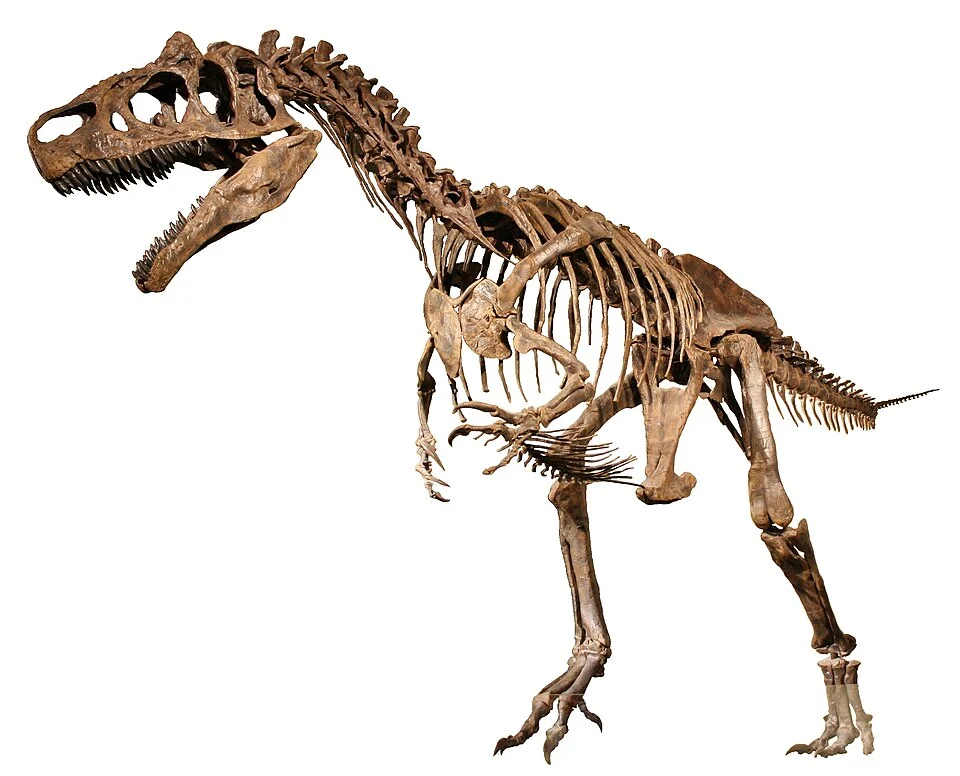
Allosaurus
Image associated with the exact linked encyclopedia article; consult credited file description for its interpretation.
Overview
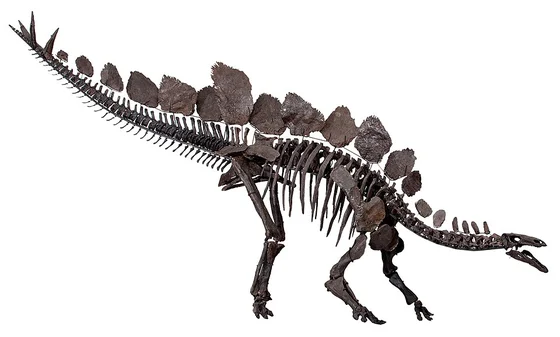
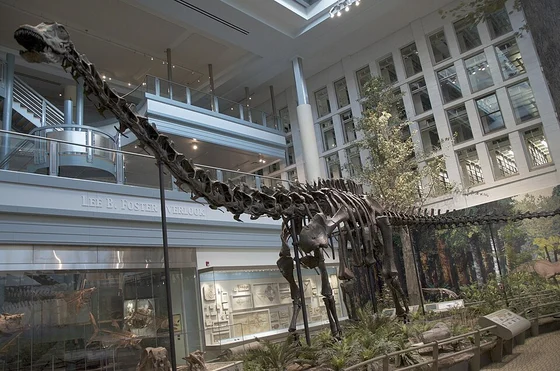
Allosaurus had a substantial skull with sharp, recurved teeth, a two-legged stance and three-fingered forelimbs. It belonged to a predatory dinosaur lineage distinct from the later tyrannosaurids. Its fossil record connects it with herbivores such as Stegosaurus and sauropods in North American Late Jurassic environments.
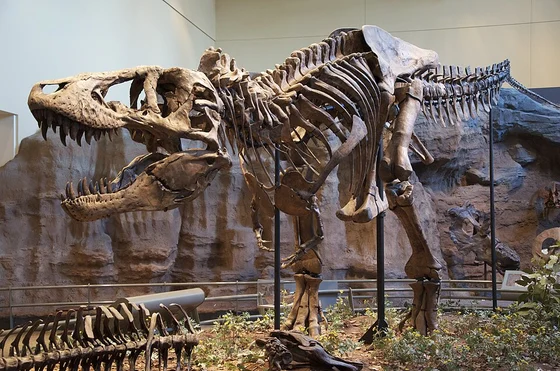
Many specimens provide information on growth, injury and variation, but abundant remains do not settle every question of social behaviour or hunting strategy. Mechanical reconstructions of the skull have suggested different ways of feeding, depending on assumptions about muscles and movement. The genus is best understood through its actual anatomical evidence rather than as a smaller substitute for Tyrannosaurus. Differences between predator lineages reveal that carnivorous dinosaurs were diverse in construction and ecological role.
One particular skeleton gives a more individual view of this dinosaur’s life. Foth and colleagues studied SMA 0005, nicknamed Big Al 2, an almost complete, partly articulated specimen excavated in 1996 from the Howe Stephens Quarry in Wyoming. They considered it probably adult and estimated a total length of 7.6 metres. Its Upper Jurassic Morrison Formation setting was assigned to the Late Kimmeridgian–Early Tithonian interval; this stratigraphic placement is not a direct date measured from the bones. The specimen had abnormalities in multiple body regions, including the lower jaw, neck, ribs, shoulder blade, pelvis and foot.
The researchers compared the two sides of the skeleton and used CT scans on selected elements. The left shoulder blade had fractured, displaced fragments that overlapped without completely fusing. They interpreted the limited bridging as a pseudarthrosis, a persistent false joint formed during an unsuccessful healing process. Several ribs likewise retained fracture and healing features. Their position near the damaged shoulder suggested a possible shared accident, but a fall or defensive blow from another animal could not be identified directly. Some other distortions could have arisen after burial rather than during life.
The lower jaw illustrates the difficulties of interpreting isolated fossils. Its unusually expanded front differed from the more normal opposite jaw, while CT data did not confirm tooth sockets for the first two mounted teeth. The researchers considered an old healed injury or developmental abnormality, without settling the cause. In the pelvis, an oblique break lacked unambiguous advanced healing and was potentially fatal, but alteration of the bone surface complicated the distinction between injury during life and damage after death.
Healing shows that this individual survived several serious problems. It does not demonstrate how it obtained food while impaired. The authors discussed hunting accidents, scavenging, lower food requirements and possible social assistance as alternatives, while acknowledging that gregarious behaviour would require more direct evidence. These specimen-specific diagnoses provide a record of survival and uncertainty rather than establishing pack hunting, a particular infection organism or a universal disease pattern for Allosaurus.
Origins & earliest records
Allosaurus fossils occur in Late Jurassic rocks, especially the Morrison Formation of North America. A marker around 150 million years represents this interval. Nineteenth-century naming and later species revisions date scientific work; they do not identify the precise origin of the genus or prove that all historically assigned remains belong together.
Evidence & interpretation
Skulls, teeth, limbs and numerous associated skeletons establish theropod anatomy and variation. Injuries can offer evidence of encounters or strenuous activity, but their cause may be ambiguous. Feeding and group-hunting hypotheses require additional support; fossil concentrations cannot automatically distinguish a social group from animals accumulated by geological or ecological processes. SMA 0005 diagnoses combine skeletal comparison and selected CT scans; reconstructed teeth, post-mortem alteration and uncertain injury mechanisms limit interpretation.
Selected bibliography
Documented works and useful reading. This is not a list of every appearance.
- 01
Allosaurus
Selected institutional scientific reading; not a complete bibliography.
- 02
New insights into the lifestyle of Allosaurus (Dinosauria: Theropoda) based on another specimen with multiple pathologies
PeerJ 3: e940, 12 May. Complete Introduction, Material and Methods, Discussion and Conclusions; selected dentary, rib, scapula and ischium Results. DOI 10.7717/peerj.940. Creative Commons Attribution licence.
Family, evolution & connections
Allosaurus and sampled relatives — one morphological topology
Ten displayed genus exemplars from the authors’ pruned Figure 55A.
Scroll sideways to see all branches. With a keyboard, focus the tree and use the arrow keys.
- Selected study topology
- Monolophosaurus
- Remaining displayed taxa
- Yangchuanosaurus / Sinraptor pair
- Yangchuanosaurus
- Sinraptor
- Allosaurus and other sampled branch
- Neovenator and selected carcharodontosaurids
- Neovenator
- Selected carcharodontosaurid branch
- Tyrannotitan
- Acrocanthosaurus and remaining sampled carcharodontosaurids
- Acrocanthosaurus
- Remaining sampled carcharodontosaurids
- Carcharodontosaurus
- Mapusaurus / Giganotosaurus pair
- Mapusaurus
- Giganotosaurus
Topology recovered by the present morphological analysis; actual figure inspected. Time axis, body-size optimization and ghost-lineage lengths omitted. Figure 55B gives a competing published topology, especially for Acrocanthosaurus. This older sampled hypothesis is not presented as the final consensus or a direct fossil-ancestor chain. Exemplars do not describe every species in each genus.
Sampled neotheropods in Zahner and Brinkmann’s example analysis (2019)
The 13-tip Neotheropoda subtree of Figure 2; Eoraptor, Eodromaeus and Tawa outgroups omitted.
Scroll sideways to see all branches. With a keyboard, focus the tree and use the arrow keys.
- Neotheropoda — Bremer 7; bootstrap 92%
- Coelophysoidea — Bremer 2; bootstrap not shown above 50%
- Segisaurus halli
- Remaining sampled coelophysoids — Bremer 1
- “Syntarsus” kayentakatae (source label)
- Panguraptor and Coelophysis pair — Bremer 1
- Panguraptor lufengensis
- Coelophysis pair — Bremer 2; bootstrap 80%
- Coelophysis rhodesiensis (source label)
- Zupaysaurus and averostran-line sample — Bremer 2; bootstrap not shown above 50%
- Zupaysaurus rougieri
- Notatesseraeraptor and remaining sample — Bremer 6; bootstrap 64%
- Notatesseraeraptor frickensis
- Dilophosaurus and remaining sample — Bremer 5; bootstrap 69%
- Dilophosaurus wetherilli
- Cryolophosaurus and Averostra — Bremer 1; bootstrap 60%
- Cryolophosaurus ellioti
- Averostra in this analysis — Bremer 5; bootstrap 74%
- Piatnitzkysaurus floresi
- Remaining sampled averostrans — Bremer 1
- Eustreptospondylus oxoniensis
- Ceratosaurus / Allosaurus pair — Bremer 1
- Ceratosaurus nasicornis
Single most-parsimonious tree from the authors’ 40%-completeness dataset, with Herrerasaurus replaced by Eodromaeus, plus Segisaurus and four averostrans. The analysis uses 155 cranial and 130 postcranial characters; length 547, consistency index 0.5210 and retention index 0.5379. One explicitly chosen example from several taxon-sampling analyses, not a pooled consensus. Including averostrans breaks the reduced analysis’s Dilophosauridae; adding Sinraptor can instead join Dilophosaurus and Cryolophosaurus. Removing Notatesseraeraptor produces 12 equally parsimonious trees and poor resolution. Coelophysoid relationships are weak. Bootstrap labels appear only where the figure reports values above 50%; absence is not zero support. Time-scaled geometry is omitted, and no fossil tip is labelled a direct ancestor. Historical names are preserved.
Taxonomic classification
A hierarchy of classified groups, not a chain of direct ancestors.
- kingdomAnimalia
- phylumChordata
- familyAllosauridae
- genusAllosaurus
Acrocanthosaurus in Eddy and Clarke’s topology
The authors place Acrocanthosaurus inside the sampled carcharodontosaurid branch rather than directly beside Allosaurus. Their comparison figure also shows a rival published arrangement. The saved tree follows Figure 55A, preserves that conflict, and treats both fossils as tips rather than direct ancestors.
Encyclopedia background
An additional attributed reference, separate from the editorial profile above.
Read the open encyclopedia overview
Allosaurus ( AL-o-SAWR-us) is a genus of theropod dinosaur that lived 155 to 143 million years ago during the late Jurassic period (latest Oxfordian to latest Tithonian ages). The first fossil remains that could definitively be ascribed to this genus were described in 1877 by Othniel C. Marsh. The name "Allosaurus" means "different lizard", alluding to its lightweight vertebrae, which Marsh believed were unique. The genus has a very complicated taxonomy and includes at least three valid species, the best known of which is A. fragilis. The bulk of Allosaurus remains come from North America's Morrison Formation, with material also known from the Alcobaça, Bombarral, and Lourinhã formations in Portugal. It was known for over half of the 20th century as Antrodemus, but a study of the abundant remains from the Cleveland-Lloyd Dinosaur Quarry returned the name "Allosaurus" to prominence. As one of the first well-known theropod dinosaurs, it has long attracted attention outside of paleontological circles.
Allosaurus was a large bipedal predator for its time. Its skull was light, robust, and equipped with dozens of sharp, serrated teeth. It averaged 7.5–8 meters (25–26 ft) in length for A. fragilis, with the largest specimens of A. fragilis estimated as being 9 meters (30 ft) long. Relative to the large and powerful legs, its three-fingered hands were small and the body was balanced by a long, muscular tail. It is classified in the family Allosauridae. As the most abundant large predator of the Morrison Formation, Allosaurus was an apex predator of the food chain and probably preyed on large herbivorous dinosaurs such as ornithopods, stegosaurids, and sauropods. Scientists have debated whether Allosaurus had cooperative social behavior and hunted in packs or was a solitary predator that forms congregations, with evidence supporting both arguments.
Text from Wikipedia contributors, “Allosaurus”. CC BY-SA 4.0. Extracted introduction; formatting changed. Retrieved 5 October 2026. The source article may have changed since retrieval.
References
Sources supporting this profile. Linked pages have their own scope and editorial standards.
- MuseumAllosaurusResearch access: 2026-10-05
- ResearchBig Al 2 specimen paleopathology studyResearch access: 2026-10-05
Image credits
Reference illustrationAllosaurus
Image associated with the exact linked encyclopedia article; consult credited file description for its interpretation.