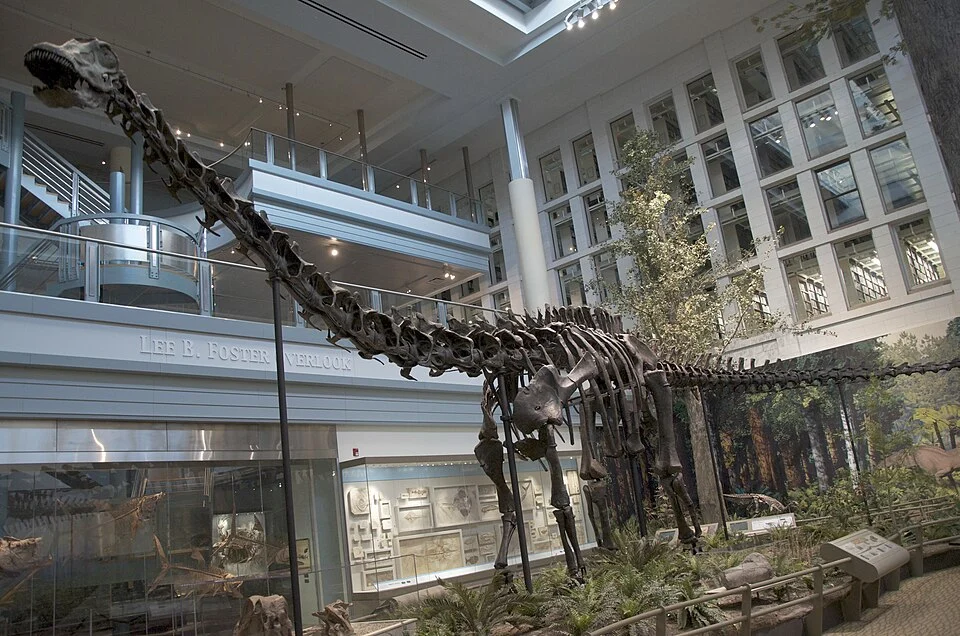
Diplodocus
Image associated with the exact linked encyclopedia article; consult credited file description for its interpretation.
Overview
Diplodocus had a small head, an elongate neck, a massive torso and a tapering tail. Its weight was supported by four limbs, and its teeth were suited to gathering vegetation rather than chewing in the manner of a mammal. The animal belonged to a diverse sauropod fauna of Late Jurassic North America.
Reconstructing such a large body requires more than extending a skeleton to its maximum possible length. Neck posture, joint mobility and soft tissues affect feeding height and movement. Familiar museum casts made Diplodocus influential in the public image of prehistoric life, but a displayed cast is not a separate fossil discovery. Studies of different specimens continue to refine proportions and relationships within diplodocid sauropods, leaving some aspects of habitual posture open to investigation.
John Whitlock’s 2011 study investigated feeding by comparing reconstructed snout outlines with microscopic tooth wear in diplodocoid sauropods. Diplodocus grouped with broad, relatively square-snouted Apatosaurus and Nigersaurus, rather than the narrower outlines reconstructed for Dicraeosaurus, Suuwassea and Tornieria. The comparison suggests differences in food selection, not simply different-sized versions of the same feeding apparatus. Some shape indices require reconstructed skulls, whereas an angle measured on the premaxilla provides a partly independent check. The small fossil samples limit statistical separation of every proposed group.
For Diplodocus, teeth from CM 11161 and USNM 2673 preserved relevant surface features. At small areas along wear facets of two CM 11161 premaxillary teeth, small pits were common and scratches were generally fine, approximately parallel and aligned along the tooth. Old preservative lacquer hampered observation, illustrating how museum treatment can affect later microscopic research. A loose USNM 2673 crown had larger scratches away from an active wear facet; the study did not treat those marks as confirmed products of a bite stroke. The distinction prevents every fossil scratch from being interpreted as dietary evidence.
Whitlock interpreted the combined broad snout and wear pattern as supporting relatively nonselective, low browsing on softer vegetation, potentially including low-growing ferns. The study defined ground-level feeding as within one metre of the ground; that analytical category is not a direct observation of a living animal’s posture. Its results made leaf stripping less plausible than ordinary low browsing because pits, rather than scratches alone, dominated much of the sampled wear. Earlier analyses of the same skull recovered different pit counts, possibly because of magnification, methodology and small samples. Only a minority of the forty-seven examined sauropod teeth preserved usable dietary signals. Microwear therefore supports a specific feeding interpretation while retaining uncertainty about exact plants, changes over time and behaviours not recorded in the sampled tooth surfaces.
Origins & earliest records
Diplodocus is known from Late Jurassic deposits in North America, around 150 million years old in representative occurrences. Its nineteenth-century naming and subsequent international casts concern research and exhibition history. A fossil occurrence establishes the animal's presence at a locality, not the first origin of long-necked dinosaurs or every later sauropod lineage.
Evidence & interpretation
Skeletons and skulls provide anatomical evidence, while joint comparisons and modelling constrain movement. Missing cartilage and muscles limit exact neck-posture estimates. Composite mounts or casts may combine information from several sources, making it essential to distinguish actual preserved bones from restored portions when evaluating proportions or claims about feeding behaviour.
Selected bibliography
Documented works and useful reading. This is not a list of every appearance.
- 01
Diplodocus
Selected institutional scientific reading; not a complete bibliography.
- 02
Inferences of Diplodocoid (Sauropoda: Dinosauria) Feeding Behavior from Snout Shape and Microwear Analyses
PLOS ONE 6(4): e18304, 6 April. Complete snout/microwear quantification and statistics methods, Results, Discussion through comparative/leaf-stripping sections. Open Creative Commons Attribution permission; remaining ecological discussion and supplements not fully inspected.
Family, evolution & connections
Nine named diplodocines in Tschopp et al. (2015)
Pruned named-tip subtree of Figure 120, the authors’ combined species-level summary; unnamed candidate taxon omitted.
Scroll sideways to see all branches. With a keyboard, focus the tree and use the arrow keys.
- Selected named Diplodocinae
- Tornieria africana
- Remaining selected subtree
- Supersaurus pair
- Supersaurus lourinhanensis
- Supersaurus vivianae
- Remaining selected subtree
- Leinkupal laticauda
- Remaining selected subtree
- Galeamopus hayi
- Two terminal sister pairs
- Diplodocus carnegii
- Diplodocus hallorum
- Kaatedocus / Barosaurus pair
- Kaatedocus siberi
- Barosaurus lentus
Morphological specimen-level analyses and taxonomic assessment summarized into species relationships. This combined diagram is not one raw equal- or implied-weight consensus. Individual analyses differ for some specimens. Figure 120 supplies no numerical node support or divergence dates. Names reflect the study’s revisions, including Galeamopus and Supersaurus lourinhanensis. Terminal taxa are relatives, not demonstrated direct ancestors.
Taxonomic classification
A hierarchy of classified groups, not a chain of direct ancestors.
- kingdomAnimalia
- phylumChordata
- familyDiplodocidae
- genusDiplodocus
Encyclopedia background
An additional attributed reference, separate from the editorial profile above.
Read the open encyclopedia overview
Diplodocus (, , or ) is an extinct genus of diplodocid sauropod dinosaurs known from the Late Jurassic of North America and Europe. The first fossils of Diplodocus were discovered in 1877 by S. W. Williston. The generic name, coined by Othniel Charles Marsh in 1878, is a Neo-Latin term derived from Greek διπλός (diplos) "double" and δοκός (dokos) "beam", in reference to the double-beamed chevron bones located in the underside of the tail, which were then considered unique.
The genus lived in what is now mid-western North America, at the end of the Jurassic period. It is one of the more common dinosaur fossils found in the middle to upper Morrison Formation, with most specimens being found in rocks dated between about 151.88 and 149.1 million years ago, during the latest Kimmeridgian Age, although it may have made it into the Tithonian, with at least one specimen (AMNH FR 223) being potentially from among the youngest deposits of the formation. The Morrison Formation records an environment and time dominated by gigantic sauropod dinosaurs, such as Apatosaurus, Barosaurus, Brachiosaurus, Brontosaurus, and Camarasaurus. Its great size may have been a deterrent to the predators Allosaurus and Ceratosaurus: their remains have been found in the same strata, which suggests that they coexisted with Diplodocus.
Text from Wikipedia contributors, “Diplodocus”. CC BY-SA 4.0. Extracted introduction; formatting changed. Retrieved 5 October 2026. The source article may have changed since retrieval.
References
Sources supporting this profile. Linked pages have their own scope and editorial standards.
- MuseumDiplodocusResearch access: 2026-10-05
- ResearchInferences of Diplodocoid (Sauropoda: Dinosauria) Feeding Behavior from Snout Shape and Microwear AnalysesResearch access: 2026-10-05
Image credits
Reference illustrationDiplodocus
Image associated with the exact linked encyclopedia article; consult credited file description for its interpretation.