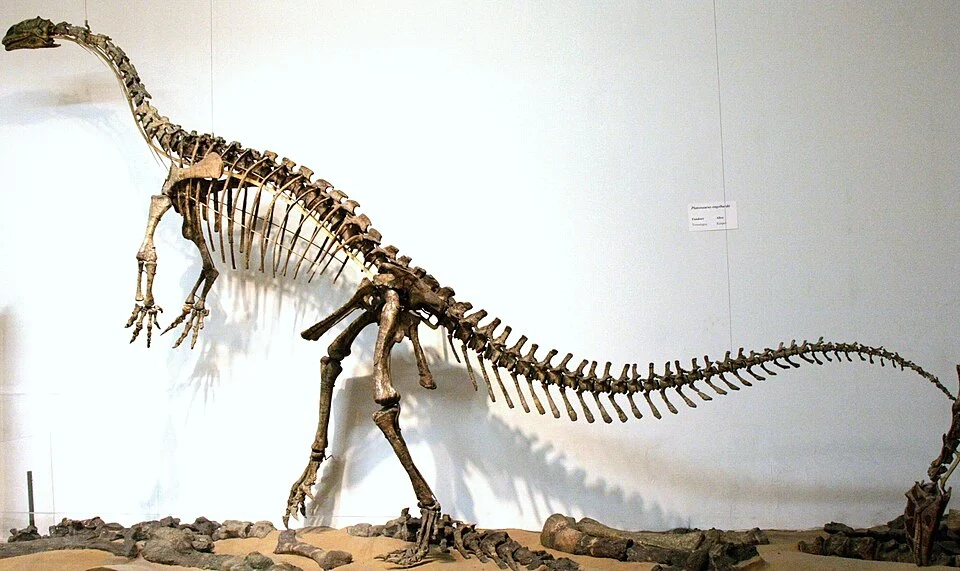
Plateosaurus
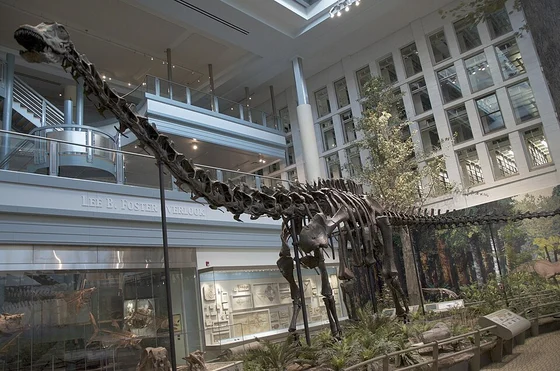
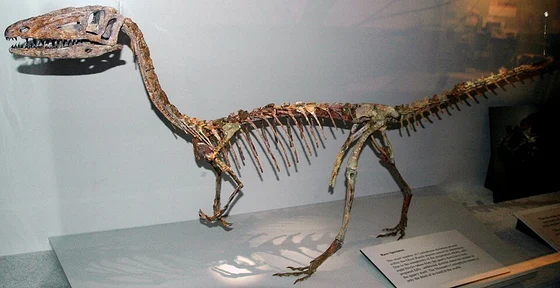
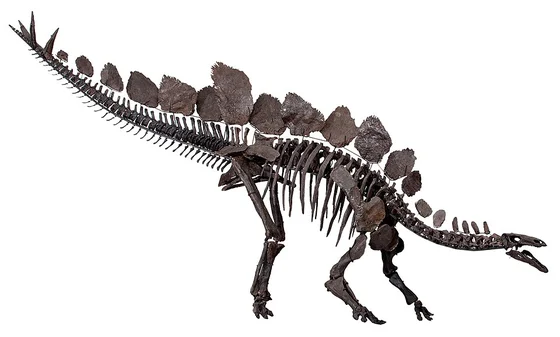
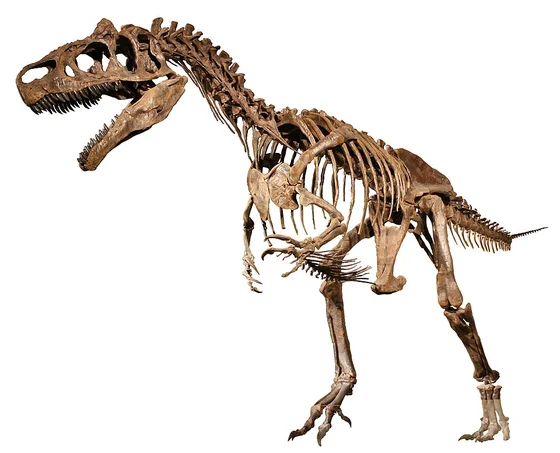
Image associated with the exact linked encyclopedia article; consult credited file description for its interpretation.
Overview
Plateosaurus had a relatively small head, an elongate neck and powerful hind limbs. Its teeth and overall anatomy support a largely plant-eating lifestyle. It belongs to the early sauropodomorph radiation, offering comparisons with the much larger, fully quadrupedal sauropods that became prominent later in the Mesozoic.
Fossils from European localities include substantial assemblages and specimens at different sizes. These help researchers investigate growth and movement, but the positions of limbs in a mount are reconstructions rather than preserved walking sequences. Older descriptions of posture and diet have changed with detailed study. The large thumb claw may have had several possible functions. Plateosaurus should consequently be read as a well-studied early dinosaur whose habits remain more uncertain than its basic skeletal organisation.
Juvenile material from Frick, Switzerland, provides a specific test of how size relates to maturity. Hofmann and Sander studied 17 isolated cervical and dorsal neural arches excavated in 2011 from bone field MSF 11.3 at the Gruhalde clay quarry. Repeated positions in the dorsal series indicate at least two juvenile individuals, rather than 17 separate animals. Their arches had not fused to the vertebral bodies: the exposed joint surfaces retained a characteristic interlocking texture. Nevertheless, the ridges and depressions of the arches were already well developed and resembled those of the mature comparison skeletons. The researchers classified these animals as late immature, rather than newly hatched dinosaurs.
The juveniles did not preserve complete associated skeletons from which body size could simply be measured. The study therefore used the length between vertebral articulations as a proxy, calibrated against mature specimens. Its femur-length estimates range from about 479 to 595 millimetres, overlapping the size of smaller mature animals documented in earlier histological work. The comparison depends on assigning isolated arches to their positions and on proportional relationships in a small adult sample. Damage, deformation and obscured measurements limited that analysis. These estimates are distinct from directly measuring a juvenile thigh bone, and skeletal maturity does not itself provide an exact calendar age.
The authors interpreted the size–maturity overlap as additional support for developmental plasticity: individuals could follow different growth trajectories. They did not exclude multiple species, populations separated in time, sexual differences or combinations of these explanations. The new juveniles also did not automatically disprove the proposal that large animals became trapped in muddy ground, because these immature individuals were still comparatively large. Evidence for vertebral fusion spreading from the tail was circumstantial, and closure from several positions remained possible. The study thus supplies a documented developmental comparison while keeping growth variability, bonebed formation and the detailed sequence of maturation as separate questions.
Origins & earliest records
Plateosaurus was scientifically named in the nineteenth century and is known from Late Triassic rocks in Europe, around 210 million years old in the museum profile. The naming date records taxonomic history. Its fossils document part of sauropodomorph diversification rather than proving that the genus was the direct ancestor of all sauropods.
Evidence & interpretation
Skeletons, teeth and fossil assemblages provide strong evidence for sauropodomorph anatomy. Comparisons and mechanical models test posture and movement. Proposed herding or claw function are interpretations, not directly witnessed facts. Several anatomical and taxonomic questions have been revisited as researchers distinguish species, growth stages and historical reconstruction choices.
Selected bibliography
Documented works and useful reading. This is not a list of every appearance.
- 01
Plateosaurus
Selected institutional scientific reading; not a complete bibliography.
- 02
The first juvenile specimens of Plateosaurus engelhardti from Frick, Switzerland: isolated neural arches and their implications for developmental plasticity in a basal sauropodomorph
PeerJ 2: e458. Complete Methods, selected material and general/MNI/morphometric Results, complete Discussion and Conclusions read. CC BY4.0. Detailed individual-arch descriptions and supplemental models not independently examined.
Family, evolution & connections
Plateosaurus and selected sauropodomorphs in a 2022 analysis
Eight named terminals pruned from Figure 19, Analysis 2. Remaining Massopoda and other sampled taxa are omitted; this is not the figure’s separately labelled reduced tree.
Scroll sideways to see all branches. With a keyboard, focus the tree and use the arrow keys.
- Selected Analysis 2 sauropodomorphs
- Efraasia
- Remaining sampled terminals
- Plateosauravus
- Remaining sampled terminals
- Ruehleia
- Selected branches
- Unaysaurus and plateosaurid units - bootstrap 59%
- Unaysaurus
- Plateosaurid operational units - bootstrap 70%
- “Sellosaurus” complex
- Selected riojasaurids - bootstrap 84%
- Eucnemesaurus
- Riojasaurus
Morphological parsimony in TNT 1.1 with sectorial, ratchet, drift and tree-fusing searches and 1,000 random-addition sequences. Analysis 2 restricts the Plateosaurus operational unit and replaces the other unit with the historical “Sellosaurus” complex, excluding its cranial scores. Displayed percentages are the figure’s absolute bootstrap values from 100 replicates. Alternative specimen definitions, exclusions, constraints and implied weighting are separate analyses. The “Sellosaurus” complex is a composite operational unit, not a confirmed single individual or independently resolved species. Historical labels remain as published. Pruning does not identify direct ancestors, dates or resolve omitted polytomies.
Taxonomic classification
A hierarchy of classified groups, not a chain of direct ancestors.
- kingdomAnimalia
- phylumChordata
- familyPlateosauridae
- genusPlateosaurus
Unaysaurus and the “Sellosaurus” operational complex
Figure 19’s second analysis groups the restricted Plateosaurus trossingensis unit with a historical “Sellosaurus” complex, then with Unaysaurus. The paper separately tests alternative specimen definitions and constraints; this displayed result is a study-specific hypothesis, not a direct-ancestor chain.
Encyclopedia background
An additional attributed reference, separate from the editorial profile above.
Read the open encyclopedia overview
Plateosaurus (probably meaning "broad lizard", often mistranslated as "flat lizard") is a genus of plateosaurid dinosaur that lived during the Late Triassic epoch of the Triassic period, around 214 to 204 million years ago, in what is now Central and Northern Europe. Plateosaurus is a basal (early) sauropodomorph dinosaur, a so-called "prosauropod". The type species is Plateosaurus trossingensis; before 2019, that honor was given to Plateosaurus engelhardti, but it was ruled as undiagnostic (i.e. indistinguishable from other dinosaurs) by the ICZN. Currently, there are three valid species; in addition to P. trossingensis, P. longiceps and P. gracilis are also known. However, others have been assigned in the past, and there is no broad consensus on the species taxonomy of plateosaurid dinosaurs. Similarly, there are a plethora of synonyms (invalid duplicate names) at the genus level.
Discovered in 1834 by Johann Friedrich Engelhardt and described three years later by Hermann von Meyer, Plateosaurus was the fifth named dinosaur genus that is still considered valid. Although it had been described before Richard Owen formally named Dinosauria in 1842, it was not one of the three genera used by Owen to define the group, because at the time, it was poorly known and difficult to identify as a dinosaur. It is now among the dinosaurs best known to science: over 100 skeletons have been found, some of them nearly complete. The abundance of its fossils in Swabia, Germany, has led to the nickname Schwäbischer Lindwurm (Swabian lindworm).
Plateosaurus was a bipedal herbivore with a small skull on a long, flexible neck, sharp but plump plant-crushing teeth, powerful hind limbs, short but muscular arms and grasping hands with large claws on three fingers, possibly used for defence and feeding. Unusually for a dinosaur, Plateosaurus showed strong developmental plasticity: instead of having a fairly uniform adult size, fully grown individuals were between 4.8 and 10 metres (16 and 33 ft) long and weighed between 600 and 4,000 kilograms (1,300 and 8,800 lb). Commonly, the animals lived for at least 12 to 20 years, but the maximum life span is not known.
Despite the great quantity and excellent quality of the fossil material, Plateosaurus was for a long time one of the most misunderstood dinosaurs. Some researchers proposed theories that were later shown to conflict with geological and palaeontological evidence, but have become the paradigm of public opinion. Since 1980 the taxonomy (relationships), taphonomy (how the animals became embedded and fossilised), biomechanics (how their skeletons worked), and palaeobiology (life circumstances) of Plateosaurus have been re-studied in detail, altering the interpretation of the animal's biology, posture and behaviour.
Text from Wikipedia contributors, “Plateosaurus”. CC BY-SA 4.0. Extracted introduction; formatting changed. Retrieved 5 October 2026. The source article may have changed since retrieval.
References
Sources supporting this profile. Linked pages have their own scope and editorial standards.
- MuseumPlateosaurusResearch access: 2026-10-05
- ResearchFrick juvenile vertebral development and size estimatesResearch access: 2026-10-06
Image credits
Reference illustrationPlateosaurus
Image associated with the exact linked encyclopedia article; consult credited file description for its interpretation.