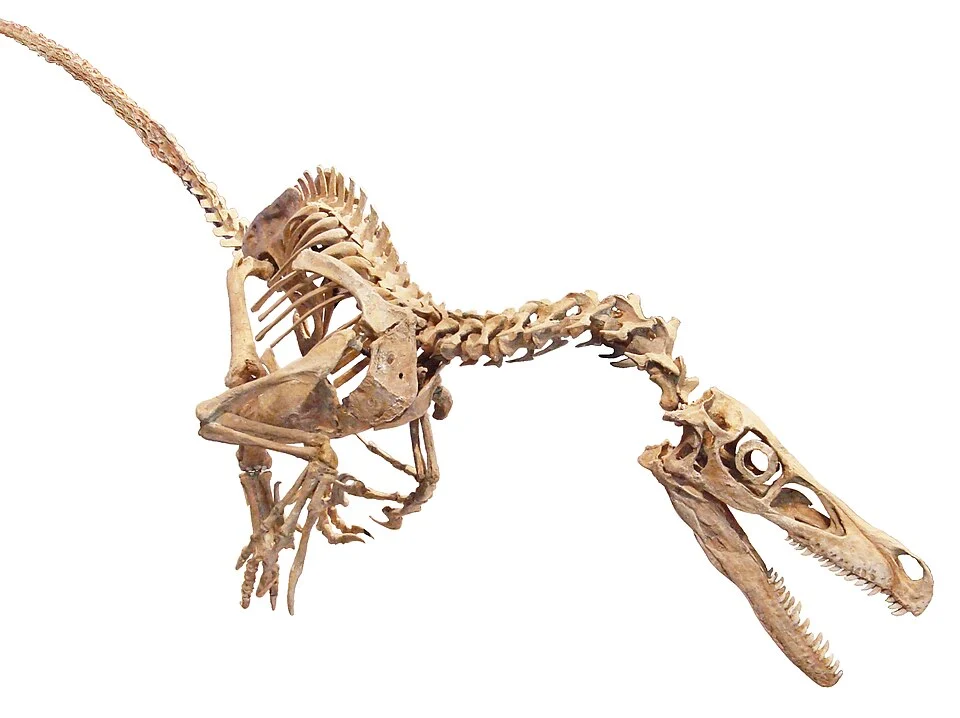
Velociraptor
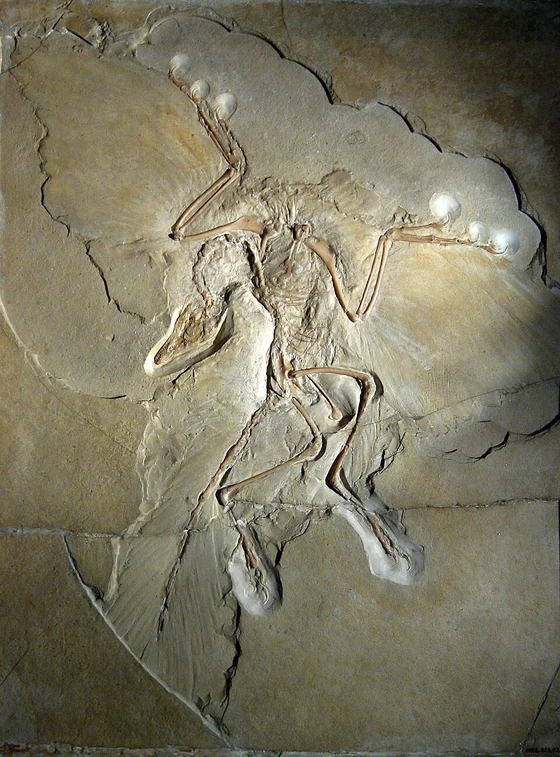
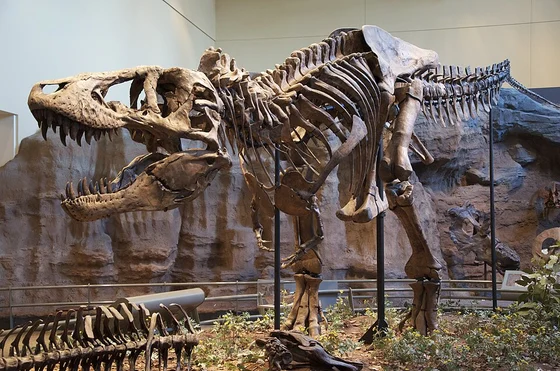
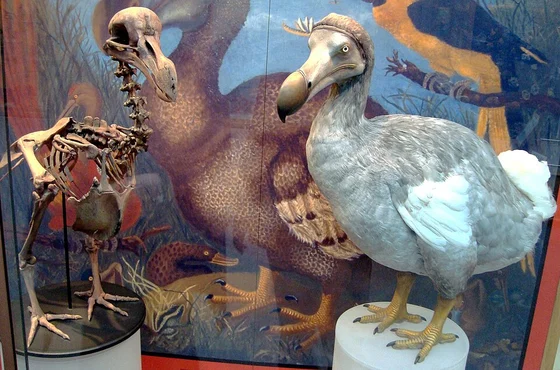
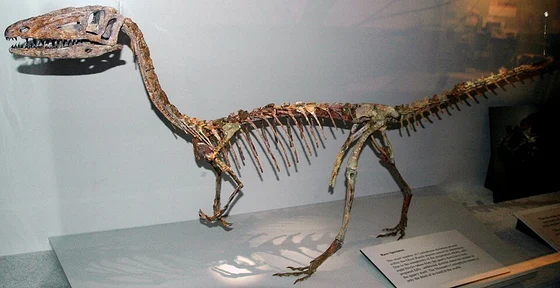
Image associated with the exact linked encyclopedia article; consult credited file description for its interpretation.
Overview
Velociraptor was much smaller than its familiar cinematic image. It had a slender skull, a long tail and a conspicuous curved claw on the second toe. Its dromaeosaurid relationships place it among theropods closely relevant to bird origins, with feathers forming part of the wider anatomical context of this branch.
Fossils from Central Asia provide details of its skeleton and interactions with other dinosaurs. A spectacular fighting association offers evidence of an encounter, although the exact sequence leading to burial remains reconstructed. Forearm evidence also supports feather attachment. Such findings make Velociraptor useful for studying predation and feather evolution, but neither an enlarged movie reconstruction nor one dramatic fossil establishes its everyday behaviour, social system or complete appearance.
A 2020 study by King and colleagues reconstructed internal spaces in the partial braincase of Velociraptor mongoliensis specimen IGM 100/976. Collected in Mongolia from the Djadokhta Formation, it preserves the hindbrain region but only an uninformative part of the midbrain. High-resolution CT images allowed the researchers to segment a digital endocast, cranial-nerve passages and the bony inner-ear labyrinth. An endocast records the surrounding cavity rather than preserving a complete living brain. The missing regions restrict what can be concluded about senses whose principal processing structures were not retained.
The reconstructed floccular regions extend prominently between the inner-ear canals. The authors connected their size with stabilization of the head and eyes during movement, supporting an interpretation of effective balance in an agile biped. They also emphasized that these cavities may have held blood vessels and other tissue, so their volume does not necessarily equal the volume of the neural lobes. The semicircular canals and cochlear duct provide additional anatomical comparisons. Their preserved shape is directly reconstructed from the fossil, whereas the resulting conclusions about tracking moving prey remain functional interpretations.
The authors used a relationship between cochlear-duct length and braincase dimensions established in living archosaurs to estimate hearing frequencies. For this specimen they calculated a mean near 2.4 kilohertz and an upper limit near four kilohertz. These are model-based proxies, not hearing tests or recovered calls. Resemblance to living birds does not demonstrate identical vocal behaviour, social organization or sensory performance. The paper considered the sensory evidence consistent with active predation while recognizing scavenging within the broader dietary account. The reconstructed anatomy cannot on its own establish the frequency of hunting versus carrion feeding, and the specimen does not resolve every behavioural difference across the genus.
Origins & earliest records
Velociraptor was described in the twentieth century from Central Asian fossils and is known from Late Cretaceous deposits. The marker near 75 million years is representative rather than an exact genus origin. Its scientific discovery and popular portrayal are separate histories; movie proportions should not replace measurements of actual specimens.
Evidence & interpretation
Skeletons show the distinctive foot claw and dromaeosaurid anatomy. Forearm features and comparisons support feathers, while associated specimens document at least one close interaction with prey. Precise combat mechanics, habitual hunting strategy and group behaviour require inference. Different species and preservation conditions limit attempts to turn one fossil into a universal behavioural account.
Selected bibliography
Documented works and useful reading. This is not a list of every appearance.
- 01
Velociraptor
Selected institutional scientific reading; not a complete bibliography.
- 02
The endocranium and trophic ecology of Velociraptor mongoliensis
Journal of Anatomy; DOI 10.1111/joa.13253. Complete Methods, Results, sensory Discussion and Conclusions read; separate trophic Discussion not independently reviewed. CC BY 4.0. Original CT data and image pixels not examined.
Family, evolution & connections
Oviraptorid relationships in the Nemegtomaia specimen study
All twelve tips in Fanti, Currie and Badamgarav (2012), Figure 8; Velociraptor is the study outgroup, not an oviraptorid.
Scroll sideways to see all branches. With a keyboard, focus the tree and use the arrow keys.
- Sampled theropods
- Sampled oviraptorosaurs
- Avimimus portentosus
- Oviraptoridae (Oviraptor placement unresolved)
- Oviraptor philoceratops
- Rinchenia / Citipati group (85% bootstrap; decay 3)
- Rinchenia mongoliensis
- Citipati pair (92%; decay 3)
- Citipati osmolskae
- Citipati n. sp., MPC-D 100/42
- Sampled Ingeniinae (82%; decay 3)
- Khaan mckennai
- Remaining sampled ingeniines (75%; decay 2)
- Conchoraptor gracilis
- Machairasaurus and remaining sample (86%; decay 2)
- Machairasaurus leptonychus
- Ingenia and sister pair (87%; decay 2)
- Ingenia yanshini
- Nemegtomaia / Heyuannia pair (84%; decay 2)
- Nemegtomaia barsboldi
- Heyuannia huangi
Equal-weight parsimony, 183 morphological characters, three ordered; exhaustive search yielded two shortest trees of length 210. Figure 8 retains unresolved Oviraptor placement. Labels record printed bootstrap percentage / decay support. The two shortest trees place Oviraptor differently; the three-way split must remain unresolved. Sparse coding caused several taxa to be excluded, while sparse ingroup Oviraptor, Heyuannia and Machairasaurus were retained. Rescoring five estimated Nemegtomaia ratios as unknown preserved topology but reduced bootstrap support. Historical specimen labels and genus names are retained; no direct ancestry or dates inferred.
Taxonomic classification
A hierarchy of classified groups, not a chain of direct ancestors.
- kingdomAnimalia
- phylumChordata
- familyDromaeosauridae
- genusVelociraptor
Encyclopedia background
An additional attributed reference, separate from the editorial profile above.
Read the open encyclopedia overview
Velociraptor (; lit. 'swift thief') is a genus of small dromaeosaurid dinosaurs that lived in Asia during the Late Cretaceous epoch, about 75 million to 71 million years ago (Mya). Two species are currently recognized, although others have been assigned in the past. The type species is V. mongoliensis, named and described in 1924. Fossils of this species have been discovered in the Djadochta Formation, Mongolia. A second species, V. osmolskae, was named in 2008 for skull material from the Bayan Mandahu Formation, China. A possible record is known from the Nemegt Formation.
Smaller than other dromaeosaurids like Deinonychus and Achillobator, Velociraptor was about 1.5–2.07 m (4.9–6.8 ft) long with a body mass of around 14.1–19.7 kg (31–43 lb). It nevertheless shared many of the same anatomical features. It was a bipedal, feathered carnivore with a long tail and an enlarged sickle-shaped claw on each hindfoot, which is thought to have been used to tackle and restrain prey. Velociraptor can be distinguished from other dromaeosaurids by its long and low skull, with an upturned snout.
Velociraptor (commonly referred to as "raptor") is one of the dinosaur genera most familiar to the general public due to its prominent role in the Jurassic Park films. In reality, Velociraptor was roughly the size of a turkey, considerably smaller than the approximately 2 m (6.6 ft) long and 90 kg (200 lb) reptiles seen in the novels and films (which were based on members of the related genus Deinonychus). Today, Velociraptor is well known to paleontologists, with over a dozen described fossil skeletons. One particularly famous specimen preserves a Velociraptor locked in combat with a Protoceratops.
Text from Wikipedia contributors, “Velociraptor”. CC BY-SA 4.0. Extracted introduction; formatting changed. Retrieved 5 October 2026. The source article may have changed since retrieval.
References
Sources supporting this profile. Linked pages have their own scope and editorial standards.
- MuseumVelociraptorResearch access: 2026-10-05
- ResearchPartial braincase and bony labyrinth reconstructionResearch access: 2026-10-06
Image credits
Reference illustrationVelociraptor
Image associated with the exact linked encyclopedia article; consult credited file description for its interpretation.