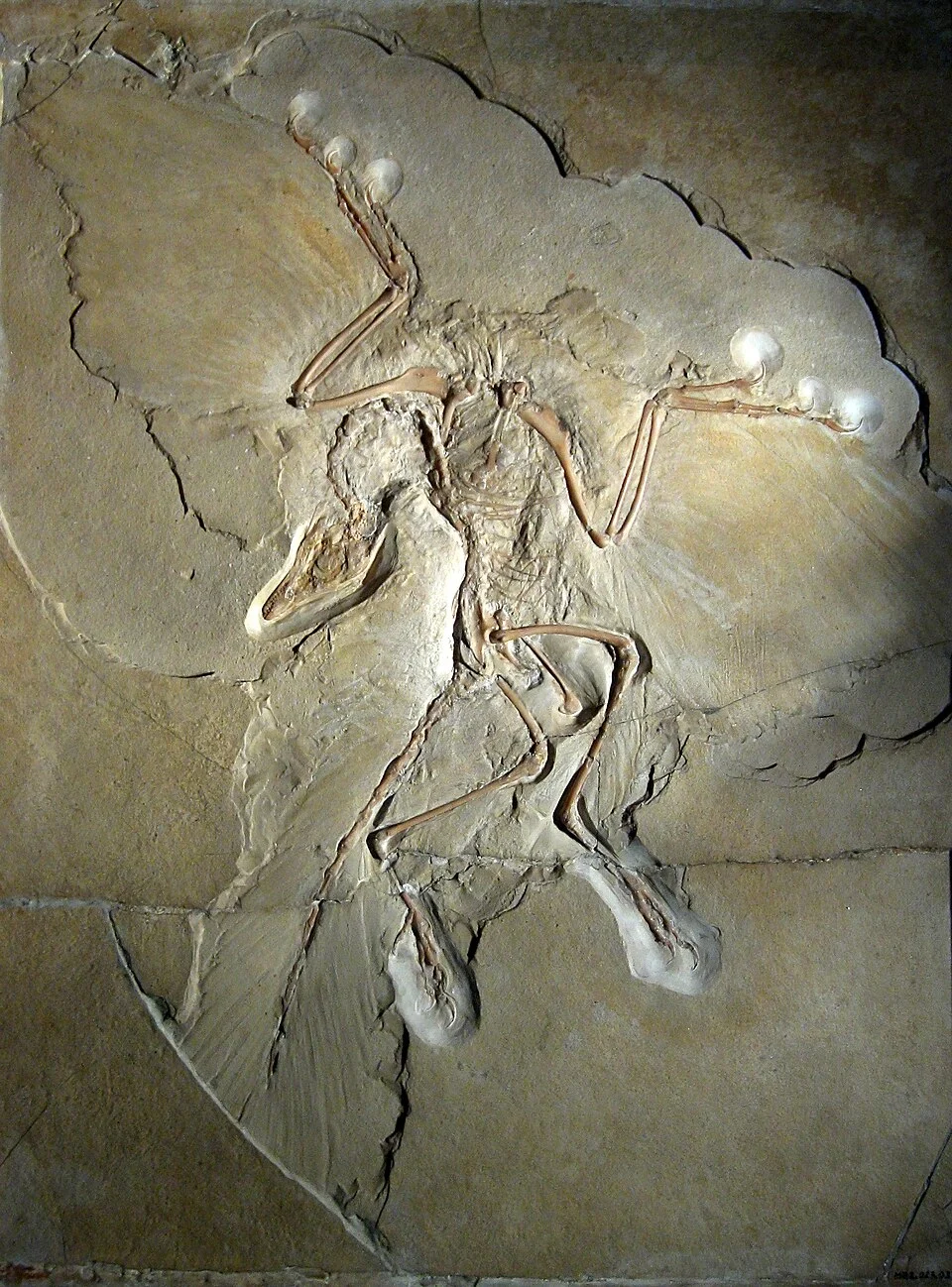
Archaeopteryx
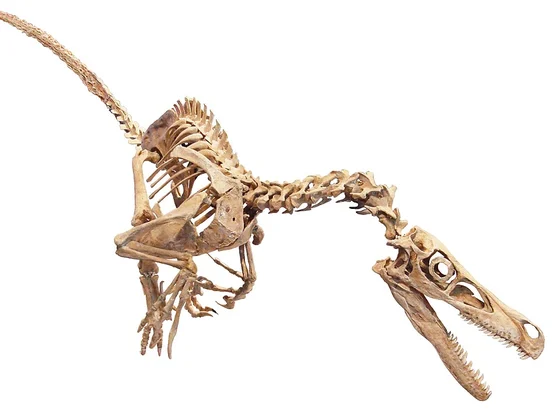
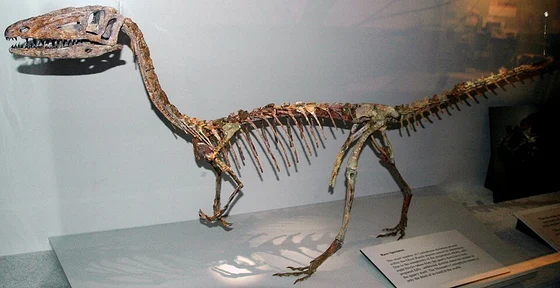
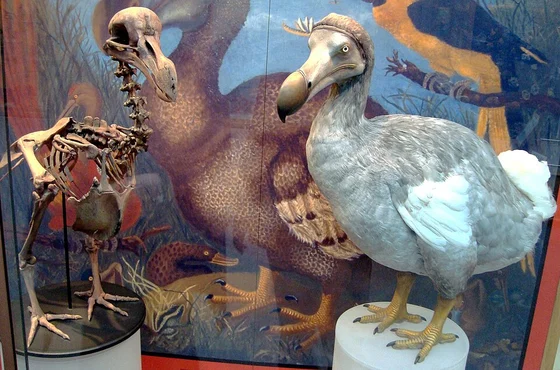
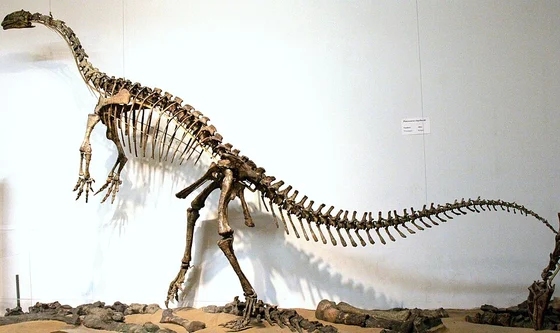
Image associated with the exact linked encyclopedia article; consult credited file description for its interpretation.
Overview
Archaeopteryx fossils from southern Germany preserve a combination of features central to the study of bird origins. Flight feathers and wings occur alongside a toothed jaw, separate clawed fingers and a long skeletal tail. This mosaic is informative because bird evolution involved a sequence of changes within theropod dinosaurs rather than the sudden appearance of a wholly new body.
Exceptional preservation reveals feather form, while skeletal comparisons place the genus among early avialans and close relatives. The capacity and style of flight remain subjects of anatomical and functional investigation. Its historical prominence does not make it the first feathered dinosaur, a proven direct ancestor of living birds or the only useful transitional fossil. Later discoveries have placed Archaeopteryx within a much broader evolutionary context.
Dennis Voeten and colleagues investigated flight in 2018 using synchrotron X-ray imaging of the Eichstätt, Munich and Bürgermeister–Müller specimens. Virtual sections through their upper-arm and ulna bones allowed comparisons with archosaurs using different forms of locomotion, without cutting the fossils apart. The reconstructed thin bone walls and resistance to twisting grouped Archaeopteryx with flying birds in their analyses. The closest functional comparisons involved birds that use relatively short bursts of flapping. This was evidence about the mechanical demands experienced by the wings, rather than an observation of the animal taking off or a calculation of a particular flight distance.
The interpretation has several limits. Fossil sections had to be restored after crushing, some individuals were probably immature, and body masses were estimated. Distinguishing flight from non-flight worked better than assigning a precise flight style: the alternative classifications correctly assigned only about 54–57 percent of the known training species to their detailed locomotor categories. The authors still favoured active flapping, while retaining uncertainty about its exact form. Archaeopteryx also lacked several components associated with the modern bird wingbeat. They proposed a more oblique stroke rather than assuming the same strongly vertical movement used by many living birds. These results concern functional similarities, not proof that Archaeopteryx was the direct ancestor of modern birds.
The public abstract of Jingmai O’Connor and colleagues’ 2025 Chicago specimen study reports a nearly complete, largely uncrushed skeleton prepared with guidance from micro-CT data. Preserved skin, foot pads and feather tracts add evidence beyond bone shape. The authors interpret the feet as suited to non-raptorial movement on land and identify inner wing feathers that could maintain a continuous aerodynamic surface. Their findings support a mosaic of early avian traits; the abstract does not supply a direct measurement of flight performance. The full subscription article has not been assessed for this account.
Origins & earliest records
Archaeopteryx became scientifically prominent in the nineteenth century through feather and skeletal discoveries in Late Jurassic rocks. The fossils are about 150 million years old. Those discoveries document an early avialan combination of characters, while the evolutionary origins of feathers, flight and birds require comparison with additional taxa and earlier evidence.
Evidence & interpretation
Feather impressions and articulated skeletons provide unusually direct evidence of external and internal anatomy. Comparisons with other theropods establish a mosaic of features. Flight performance and exact phylogenetic placement rely on analytical assumptions, and differing specimens or species interpretations can affect conclusions without undermining the central evidence for feathered dinosaur ancestry.
Selected bibliography
Documented works and useful reading. This is not a list of every appearance.
- 01
Archaeopteryx
Selected institutional scientific reading; not a complete bibliography.
- 02
Wing bone geometry reveals active flight in Archaeopteryx
Complete main Results, Discussion and Methods read, with rights statement. Summary adapted under CC BY4. No supplementary data reanalysis.
- 03
Chicago Archaeopteryx informs on the early evolution of the avian bauplan
Complete public abstract and bibliographic record read; full subscription article not read. Nature641:1201–1207.
Family, evolution & connections
A tentative 2011 alternative for Archaeopteryx and paravian relatives
Figure 4 paravian subtree, collapsing its sampled avialans. This displays the paper’s historical alternative, not a current-consensus classification.
Scroll sideways to see all branches. With a keyboard, focus the tree and use the arrow keys.
- Selected 2011 paravian hypothesis
- Sampled Avialae (collapsed, as defined in this study)
- Deinonychosauria (this study’s placement)
- Archaeopteryx and paired relatives
- Anchiornis / Xiaotingia pair
- Anchiornis
- Xiaotingia
- Other sampled deinonychosaurs
- Troodontidae
- Sampled dromaeosaur branches
- Unenlagiines
- Microraptor and other sampled dromaeosaurs
- Microraptor
- Other dromaeosaurs (collapsed)
Morphological phylogenetic analysis incorporating Xiaotingia, summarized by the published simplified cladogram; full matrix detail is referred to the paper’s supplement. The authors explicitly call statistical support tentative. This result places Archaeopteryx outside their Avialae, unlike the conventional placement they discuss. Their caption flags anatomical features requiring confirmation. Group terminals are source summaries, not individual ancestors; no dates or modern taxonomic verdict are transferred.
Taxonomic classification
A hierarchy of classified groups, not a chain of direct ancestors.
- kingdomAnimalia
- phylumChordata
- cladeDinosauria
- cladeTheropoda
- genusArchaeopteryx
Tyrannosaurus rex
Archaeopteryx and Tyrannosaurus belong to the broader theropod dinosaur radiation, but they occupy different branches and lived at different times. The museum's bird-evolution account explains the wider relationship. A tree should not draw Archaeopteryx as Tyrannosaurus's descendant or Tyrannosaurus as the ancestor of all birds; shared ancestry is a branching relationship.
Anchiornis / Xiaotingia pair in the 2011 hypothesis
Xu and colleagues’ Figure 4 places Archaeopteryx beside the Anchiornis / Xiaotingia pair. The authors describe the supporting statistics as tentative; this records their hypothesis without presenting it as settled modern classification.
Encyclopedia background
An additional attributed reference, separate from the editorial profile above.
Read the open encyclopedia overview
Archaeopteryx ( ; lit. 'ancient wing'), sometimes referred to by its German name, "Urvogel " (lit. 'Primeval Bird') is an extinct genus of bird-like dinosaurs. The genus name derives from the Ancient Greek ἀρχαῖος (archaîos), meaning 'ancient', and πτέρυξ (ptérux), meaning 'feather, wing'. Between the late 19th century and the early 21st century, Archaeopteryx was generally accepted by palaeontologists and popular reference books as the oldest known bird (member of the group Avialae). Older potential avialans have since been identified, including Anchiornis, Xiaotingia, Aurornis, and Baminornis.
Archaeopteryx lived in the Late Jurassic around 150 million years ago, in what is now southern Germany, during a time when Europe was an archipelago of islands in a shallow warm tropical sea, much closer to the equator than it is now. Similar in size to a Eurasian magpie, with the largest individuals possibly attaining the size of a raven, the largest species of Archaeopteryx could grow to about 50 cm (20 in) in length. Despite their small size, broad wings, and inferred ability to fly or glide, Archaeopteryx had more in common with other small Mesozoic dinosaurs than with modern birds. In particular, they shared the following features with the dromaeosaurids and troodontids: jaws with sharp teeth, three fingers with claws, a long bony tail, hyperextensible second toes ("killing claw"), feathers (which also suggest warm-bloodedness), and various features of the skeleton.
These features make Archaeopteryx a clear candidate for a transitional fossil between non-avian dinosaurs and avian dinosaurs (birds). Thus, Archaeopteryx plays an important role, not only in the study of the origin of birds, but in the study of dinosaurs. It was named from a single feather in 1861, the identity of which has been controversial. That same year, the first complete specimen of Archaeopteryx was announced. Over the years, twelve more fossils of Archaeopteryx have surfaced. Despite variation among these fossils, most experts regard all the remains that have been discovered as belonging to a single species or at least genus, although this is still debated.
Most of these 14 fossils include impressions of feathers. Because these feathers are of an advanced form (flight feathers), these fossils are evidence that the evolution of feathers began before the Late Jurassic. The type specimen of Archaeopteryx was discovered just two years after Charles Darwin published On the Origin of Species. Archaeopteryx seemed to confirm Darwin's theories and has since become a key piece of evidence for the origin of birds, the transitional fossils debate, and confirmation of evolution. Archaeopteryx was long considered to be the beginning of the evolutionary tree of birds. However, in recent years, the discovery of several small, feathered dinosaurs has created a mystery for palaeontologists, raising questions about which animals are the ancestors of modern birds and which are their relatives.
Text from Wikipedia contributors, “Archaeopteryx”. CC BY-SA 4.0. Extracted introduction; formatting changed. Retrieved 5 October 2026. The source article may have changed since retrieval.
References
Sources supporting this profile. Linked pages have their own scope and editorial standards.
- MuseumArchaeopteryxResearch access: 2026-10-05
- Primary researchWing bone geometry reveals active flight in ArchaeopteryxResearch access: 2026-10-05
- Primary researchChicago Archaeopteryx informs on the early evolution of the avian bauplanResearch access: 2026-10-05
- LicenceCreative Commons Attribution 4.0Research access: 2026-10-05
Image credits
Reference illustrationArchaeopteryx
Image associated with the exact linked encyclopedia article; consult credited file description for its interpretation.