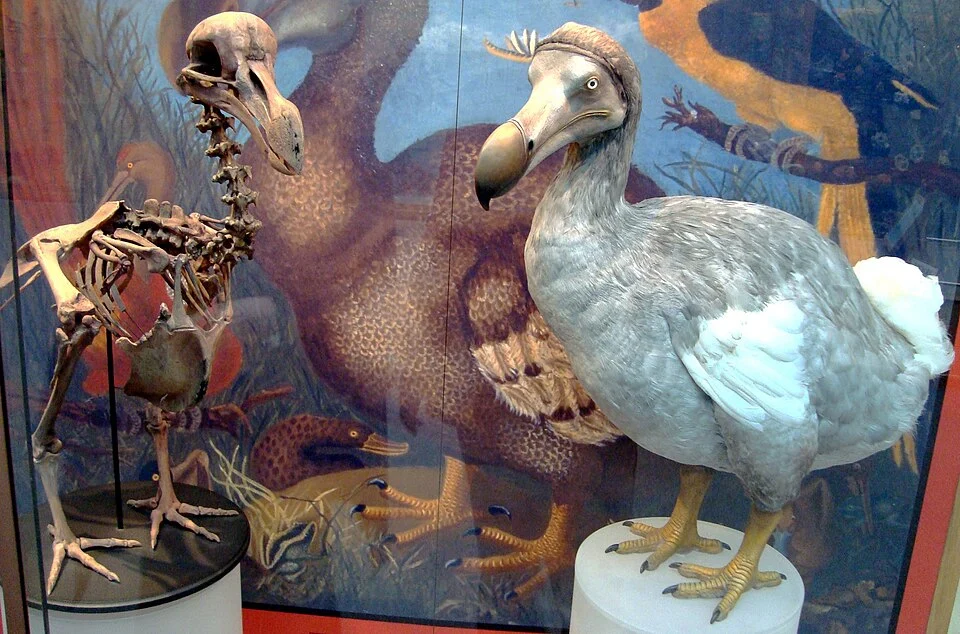
Dodo
Image associated with the exact linked encyclopedia article; consult credited file description for its interpretation.
Overview
The dodo, Raphus cucullatus, lived on Mauritius in the Indian Ocean. It descended from flying pigeons but evolved a large ground-dwelling form in an island environment. Familiar paintings often exaggerate its ungainly appearance; skeletal and ecological research supports an animal well suited to its habitat rather than an inherently incompetent bird.
Written reports, surviving remains and the Mare aux Songes fossil site provide different views of its life. Introduced animals, hunting and habitat change followed human settlement and contributed to disappearance. Precise final extinction dating is difficult because reliable sightings were sparse. The dodo also illustrates how quickly ecological relationships can be altered on islands, while warning against turning uncertain historical reports or popular anecdotes into a detailed scientific portrait.
A 2017 study by D. Angst and colleagues examined thin sections from 22 dodo bones: five femora, fourteen tibiotarsi, two tarsometatarsi and one humerus. The material came from the Mare aux Songes swamp and several caves, with specimens held in Mauritian, French and British collections. These were fragmentary, unassociated bones, rather than 22 complete skeletons. Their microscopic structure preserved evidence that paintings cannot supply. Rapidly deposited tissue dominated early growth, while slower outer layers recorded a more prolonged approach to full skeletal maturity. The youngest sampled individual was already a late juvenile, so the earliest development was reconstructed rather than directly sampled.
Two bones contained medullary tissue, a temporary calcium resource associated with eggshell production in ovulating birds. This allowed the researchers to identify reproductive females without relying on a simple division into larger and smaller skeletons. Other specimens contained enlarged resorption cavities. By comparison with living birds, the authors interpreted these as possible evidence of the calcium demands of moulting. The actual observations are tissue structures and cavities; their connections to particular annual activities depend on comparative interpretation. Preservation also varied: the swamp material generally retained its microscopic structure better than the cave specimens.
The team proposed breeding around August, followed by rapid chick growth before the cyclone season, and adult moulting roughly between March and late July. That calendar depends on treating growth interruptions as annual responses to summer conditions and assuming a sufficiently regular rate of bone deposition between them. It should therefore be read as a proposed seasonal reconstruction, rather than a directly observed breeding diary. Historical reports of differing plumage were compatible with the proposed moult sequence, but do not independently prove every stage. The study illustrates how fossils, living relatives and historical testimony can inform one another while retaining different degrees of uncertainty.
Origins & earliest records
The dodo's lineage reached Mauritius after the island formed, but its exact species origin is not securely dated here. Dutch sailors recorded it in 1598, and credible seventeenth-century reports mark its final known history. First European documentation does not mean the animal originated then or that the final sighting equals the last death.
Evidence & interpretation
Bones, limited preserved tissues, historical descriptions and environmental remains constrain anatomy and habitat. Many mounted skeletons combine bones from multiple individuals. Artistic depictions and sailors' accounts require source criticism, while sparse final sightings complicate exact extinction dating. Genetic relationships support pigeon ancestry rather than older rail, vulture or ostrich comparisons.
Selected bibliography
Documented works and useful reading. This is not a list of every appearance.
- 01
The dodo bird: The real facts about this icon of extinction
Selected institutional scientific reading; not a complete bibliography.
- 02
Bone histology sheds new light on the ecology of the dodo (Raphus cucullatus, Aves, Columbiformes)
Complete published main text, Materials and Methods read. Supplementary tables and historical works cited by the authors not newly read in full. Summary adapted under CC BY4; seasonal timing remains a hypothesis.
Family, evolution & connections
Dodo and sampled pigeon relatives — mitochondrial tree
Five tips pruned from the sampled Indo-Pacific portion of Figure 1.
Scroll sideways to see all branches. With a keyboard, focus the tree and use the arrow keys.
- Selected Indo-Pacific pigeon branch
- Goura cristata (crowned pigeon)
- Selected four-taxon group
- Caloenas pair
- Caloenas maculata (spotted green pigeon)
- Caloenas nicobarica (Nicobar pigeon)
- Dodo/solitaire pair
- Pezophaps solitaria (Rodrigues solitaire)
Published molecular-clock mitogenome topology; actual figure inspected. Unsampled taxa and time scale omitted. Mitochondrial history may differ from nuclear species history. Support varies across nodes. Broader placements conflict with an earlier study; this does not establish living pigeons as direct ancestors or identify every closest relative outside the sample.
Taxonomic classification
A hierarchy of classified groups, not a chain of direct ancestors.
- kingdomAnimalia
- phylumChordata
- classAves
- orderColumbiformes
- familyColumbidae
- genusRaphus
- speciesRaphus cucullatus
Pigeons
The museum identifies the dodo as a flightless pigeon and discusses its relationships with other pigeons. This is an evolutionary connection rather than a resemblance-based classification. A family tree should place it within the pigeon lineage, not draw modern pigeons as direct ancestors or imply that flightlessness means the bird was primitive.
Rodrigues solitaire (Pezophaps solitaria)
The 2016 mitogenome tree pairs the dodo with the Rodrigues solitaire. These are extinct relatives in the sampled topology, not successive stages of one species or a direct ancestor–descendant pair. Mitochondrial sampling and node support limit the inference.
Nicobar and spotted green pigeons (Caloenas pair)
The sampled mitochondrial tree places a Nicobar/spotted-green pigeon pair beside the dodo/solitaire pair. This distinguishes a sister group from direct ancestry: neither sampled Caloenas species is portrayed as the dodo’s parent. The relationship is scoped to this molecular dataset.
Encyclopedia background
An additional attributed reference, separate from the editorial profile above.
Read the open encyclopedia overview
The dodo (Raphus cucullatus) is an extinct flightless bird that was endemic to Mauritius, an island east of Madagascar in the Indian Ocean. The dodo's closest relative was the also-extinct and flightless Rodrigues solitaire. The two formed the subtribe Raphina, a clade of extinct flightless birds that are a part of the group that includes pigeons and doves (the family Columbidae). The closest living relative of the dodo is the Nicobar pigeon. A white dodo was once thought to have existed on the nearby island of Réunion, but it is now believed that this assumption was merely confusion based on the also-extinct Réunion ibis and paintings of white dodos.
Subfossil remains show the dodo measured about 62.6–75 centimetres (2.05–2.46 ft) in height and may have weighed 10.6–17.5 kg (23–39 lb) in the wild. The dodo's appearance in life is evidenced only by drawings, paintings, and written accounts from the 17th century. Since these portraits vary considerably, and since only some of the illustrations are known to have been drawn from live specimens, the dodos' exact appearance in life remains unresolved, and little is known about its behaviour. It has been depicted with brownish-grey plumage, yellow feet, a tuft of tail feathers, a grey, naked head, and a black, yellow, and green beak. It used gizzard stones to help digest its food, which is thought to have included fruits, and its main habitat is believed to have been the woods in the drier coastal areas of Mauritius. One account states its clutch consisted of a single egg. It is presumed that the dodo became flightless because of the ready availability of abundant food sources and a relative absence of predators on Mauritius. Though the dodo has historically been portrayed as being fat and clumsy, it is now thought to have been well-adapted for its ecosystem.
The first recorded mention of the dodo was by Dutch sailors in 1598. In the following years, the bird was hunted by sailors and invasive species, while its habitat was being destroyed. The last widely accepted sighting of a dodo was in 1662. Its extinction was not immediately noticed, and some considered the bird to be a myth. In the 19th century, research was conducted on a small quantity of remains of four specimens that had been brought to Europe in the early 17th century. Among these is a dried head, the only soft tissue of the dodo that remains today. Since then, a large amount of subfossil material has been collected on Mauritius, mostly from the Mare aux Songes swamp. The extinction of the dodo less than a century after its discovery called attention to the previously unrecognised problem of human involvement in the disappearance of entire species. The dodo achieved widespread recognition from its role in the story of Alice's Adventures in Wonderland, and it has since become a fixture in popular culture, often as a symbol of extinction and obsolescence.
Text from Wikipedia contributors, “Dodo”. CC BY-SA 4.0. Extracted introduction; formatting changed. Retrieved 5 October 2026. The source article may have changed since retrieval.
References
Sources supporting this profile. Linked pages have their own scope and editorial standards.
- MuseumThe dodo bird: The real facts about this icon of extinctionResearch access: 2026-10-05
- Primary researchBone histology sheds new light on the ecology of the dodo (Raphus cucullatus, Aves, Columbiformes)Research access: 2026-10-05
- LicenceCreative Commons Attribution 4.0Research access: 2026-10-05
Image credits
Reference illustrationDodo
Image associated with the exact linked encyclopedia article; consult credited file description for its interpretation.