Thylacine
Image associated with the exact linked encyclopedia article; consult credited file description for its interpretation.
Overview
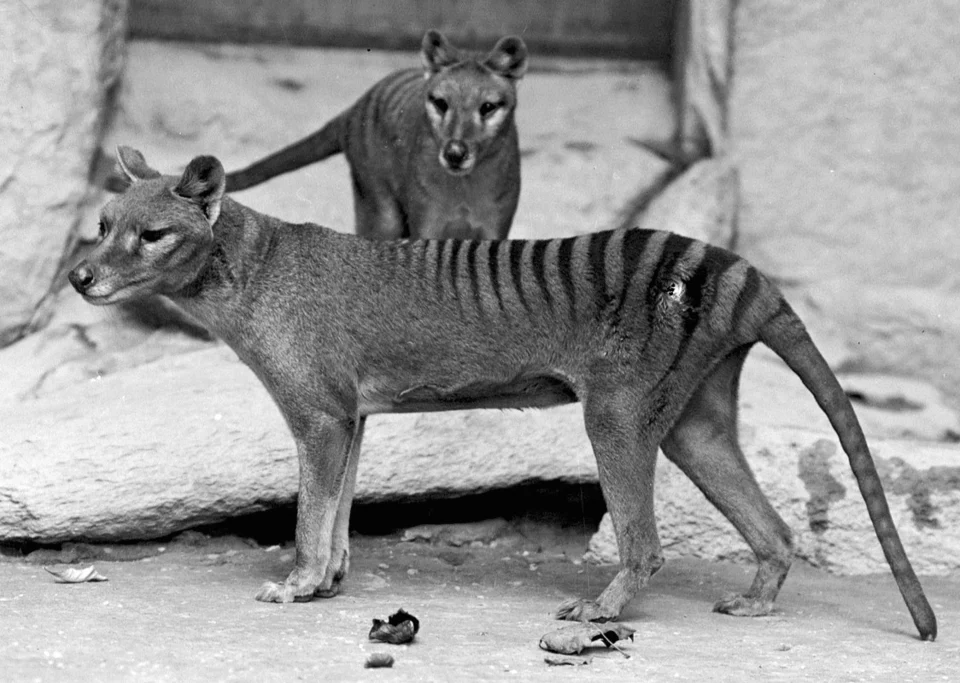
The thylacine, Thylacinus cynocephalus, had a dog-like outline and a stiff-looking tail, but belonged to the marsupial mammals. Its dark stripes produced the familiar Tasmanian tiger name. Fossil and historical evidence record a wider former distribution than Tasmania alone, demonstrating that its final range was not its whole evolutionary history.
European colonists blamed thylacines for livestock losses and supported extensive killing through bounties. Habitat change and other pressures accompanied the population collapse. The last known captive animal died in Hobart in 1936, shortly after legal protection arrived. Later searches and reported sightings have not supplied conclusive evidence of survival. Modern interest in reconstruction or proposed de-extinction does not establish that the extinct species has already been restored.
Douglass S. Rovinsky, Alistair R. Evans and Justin W. Adams investigated feeding ecology in 2021 through museum skulls. They sampled 223 specimens across 57 species, including sixteen thylacines, and used three-dimensional scans to compare 381 anatomical landmarks and surface points. The comparison included other marsupials and placental predators, with an evolutionary tree assembled from earlier studies. Whole-skull, facial and braincase shapes were analysed separately. This matters because an animal can resemble another in its general outline while differing in the structures most relevant to handling prey.
The strongest repeated convergence was with the side-striped and black-backed jackals, maned wolf and Pampas fox. These comparisons offered more useful feeding analogues than a broad equation with the grey wolf or domestic dog. Whole-skull and facial analyses placed the thylacine among predators whose usual prey weighed less than 45 percent of their own body mass. The braincase analysis instead assigned it to the larger-prey group. The authors discussed how differences between marsupial and placental braincase proportions could make that region a poorer predictor, while acknowledging the small marsupial sample. The disagreement between anatomical regions is part of the result, rather than something to omit from the reconstruction.
The proposed preference for smaller prey remains an inference from shape and comparative ecology, not a recovered list of thylacine meals. Nor does resemblance to jackals demonstrate identical hunting behaviour. The study discussed earlier limb research indicating that thylacines lacked the running specializations of these canids, and it did not find an exact match with any living comparison species. Its authors suggested small marsupials as plausible prey while separating feeding habits from hunting strategy. Consequently, the familiar phrase “marsupial wolf” is a useful historical nickname but an incomplete account of either evolutionary relationships or ecology. Convergent features arose in distinct mammalian lineages; they do not make the thylacine a member of the dog family.
Origins & earliest records
Thylacines existed in Australia and nearby regions before the final Tasmanian population. The species' geological origin is distinct from European records and its nineteenth-century persecution. The death of the last known captive animal on 7 September 1936 is documented; it is not necessarily the exact death date of the final wild individual.
Evidence & interpretation
Museum specimens, fossils, photographs, films and historical bounty records provide anatomical and population evidence. Reported later sightings lack conclusive verification. The National Museum of Australia also corrects the familiar story that the last captive animal was a male named Benjamin, showing how historical claims require re-examination as well as biological ones.
Selected bibliography
Documented works and useful reading. This is not a list of every appearance.
- 01
Extinction of thylacine
Selected institutional scientific reading; not a complete bibliography.
- 02
Functional ecological convergence between the thylacine and small prey-focused canids
Complete Methods and Discussion, focal prey-size and convergence Results read. Full numerical supplementary analyses not independently rerun. Summary adapted under CC BY4; skull-based ecological inference distinguished from observed behaviour.
Family, evolution & connections
Thylacine placement from retroposon insertions
Dasyuromorphia subtree of Figure 2a; Dasyuridae collapsed and outer marsupial groups omitted.
Scroll sideways to see all branches. With a keyboard, focus the tree and use the arrow keys.
- Sampled Dasyuromorphia (supported solid branches)
- Numbat and sampled Dasyuridae
- Numbat
- Dasyuridae (collapsed sampled group)
Presence/absence of SINE insertions. Solid branches represent the supported topology; the paper counts 11 markers for the thylacine split versus four and one for conflicting placements. Dashed alternatives are attributed to incomplete lineage sorting and are not silently merged. The thylacine is a sister lineage, not an ancestor of living numbats or dasyurids. Internal Dasyuridae and demographic curves are omitted; no dates shown.
Taxonomic classification
A hierarchy of classified groups, not a chain of direct ancestors.
- kingdomAnimalia
- phylumChordata
- classMammalia
- orderDasyuromorphia
- familyThylacinidae
- genusThylacinus
- speciesThylacinus cynocephalus
Numbat and sampled Dasyuridae (Feigin retroposon tree)
Retroposon insertions support the thylacine beside numbat plus Dasyuridae. Conflicting insertions and incomplete lineage sorting remain explicit; this is not a direct ancestor chain.
Encyclopedia background
An additional attributed reference, separate from the editorial profile above.
Read the open encyclopedia overview
The thylacine ( THY-luh-seen; Thylacinus cynocephalus), also commonly known as the Tasmanian tiger, Tasmanian wolf or marsupial wolf, is an extinct species of carnivorous marsupial formerly native to the Australian mainland, Tasmania and New Guinea. It became extinct on mainland Australia and New Guinea approximately 3,600–3,200 years ago, possibly following the arrival of the dingo, which was introduced to Australia around the same period but never reached Tasmania. Prior to European settlement, the species remained widespread in Tasmania, where its population was estimated to number several thousand individuals. During the 19th century, the species was increasingly persecuted because of its perceived threat to livestock, with government-sponsored bounty schemes encouraging its extermination. The last known individual died at Hobart Zoo in Tasmania on 7 September 1936.
The thylacine was known as the Tasmanian tiger because of the dark transverse stripes that radiated from the top of its back, and it was called the Tasmanian wolf because it resembled a medium- to large-sized canid. The name thylacine is derived from thýlakos meaning 'pouch' and -ine meaning 'pertaining to', and refers to the marsupial pouch. Both sexes had a pouch. The females used theirs for rearing young, and the males used theirs as a protective sheath, covering the external reproductive organs. The animal had a stiff tail and could open its jaws to an unusual extent. Recent studies and anecdotal evidence on its predatory behaviour suggest that the thylacine was a solitary ambush predator specialised in hunting small- to medium-sized prey. Accounts suggest that, in the wild, it fed on small birds and mammals. It was the only member of the genus Thylacinus and family Thylacinidae to have survived until modern times. Its closest living relatives are the other members of Dasyuromorphia, including the Tasmanian devil, from which it is estimated to have split 42–36 million years ago.
Intensive hunting on Tasmania is generally blamed for its extinction, but other contributing factors were disease, the introduction of and competition with dingoes, human encroachment into its habitat and climate change. Since extinction there have been numerous searches and reported sightings of live animals, none of which have been confirmed.
The thylacine has been used extensively as a symbol of Tasmania. The animal is featured on the official coat of arms of Tasmania. Since 1996, National Threatened Species Day has been commemorated in Australia on 7 September, the date on which the last known thylacine died in 1936. Universities, museums and other institutions across the world research the animal. Its whole genome sequence has been mapped, and there are efforts to clone and bring it back to life.
Text from Wikipedia contributors, “Thylacine”. CC BY-SA 4.0. Extracted introduction; formatting changed. Retrieved 5 October 2026. The source article may have changed since retrieval.
References
Sources supporting this profile. Linked pages have their own scope and editorial standards.
- MuseumExtinction of thylacineResearch access: 2026-10-05
- Primary researchFunctional ecological convergence between the thylacine and small prey-focused canidsResearch access: 2026-10-05
- LicenceCreative Commons Attribution 4.0Research access: 2026-10-05
Image credits
Reference illustrationThylacine
Image associated with the exact linked encyclopedia article; consult credited file description for its interpretation.