Smilodon
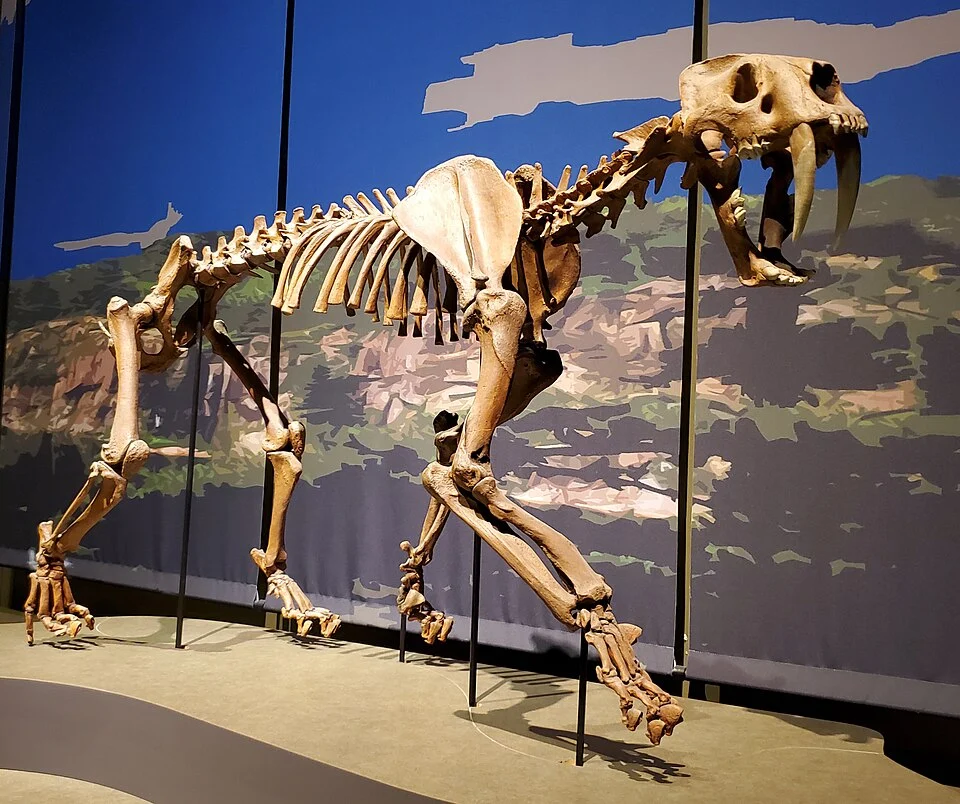
Image associated with the exact linked encyclopedia article; consult credited file description for its interpretation.
Overview
Smilodon combined long upper canine teeth with a robust body and strong forelimbs. It was a member of an extinct cat lineage, rather than a true tiger with unusually long teeth. Different species occurred in the Americas, and the abundant Smilodon fatalis material at Rancho La Brea provides an especially important window into the genus.
The asphalt deposits preserve many individuals, allowing study of anatomy, growth and injury. Tooth shape and body construction inform proposed ways of restraining and killing prey, but they do not preserve a film of the hunt. Evidence of healed injuries has also encouraged debate about social support. Such interpretations should be separated from the directly observable bones and should not treat every Smilodon species as ecologically or behaviourally identical.
Julie Meachen-Samuels and Blaire Van Valkenburgh investigated the forelimbs of Smilodon fatalis using radiographs in 2010. Their comparisons included 28 living cat species and the extinct American lion, Panthera atrox. They measured both the outer diameter of the humerus and the space occupied by its marrow cavity, rather than judging strength from the external outline alone. Measurements near the middle of the bone reduced interference from prominent muscle attachments. The resulting calculations estimate resistance to bending and compression; they are not direct measurements of forces exerted during an actual hunt.
The Smilodon humerus combined a broad outer diameter with unusually thick cortical bone, the dense tissue surrounding the marrow cavity. Relative to bone length, it resisted estimated bending loads exceptionally well. The American lion could show similar absolute resistance, but its humerus was longer. This distinction matters because a large animal can have strong bones simply through overall size. Smilodon also had thickened bone in the femur, yet the thigh bone remained within the comparative range for cats after scaling to length. The unusually pronounced difference between forelimb and hindlimb therefore carries more information than the general observation that its skeleton was robust.
The authors interpreted that pattern as an adaptation for restraining prey before a carefully positioned killing bite. Immobilizing a struggling animal could reduce the chance of breaking the elongated canine teeth. They considered other activities that can strengthen forelimbs, including digging, swimming and climbing, but favoured prey handling when the limb evidence was combined with claws, muscle attachments and skull anatomy. The comparison does not identify an exact prey species, demonstrate cooperative hunting or establish that all saber-toothed cats hunted alike. Their suggestion that specialization contributed to extinction is a further ecological hypothesis, rather than a result directly measured from these radiographs.
Origins & earliest records
Smilodon is represented in Pleistocene deposits of the Americas. The timeline marker near 20,000 years ago is an illustrative late occurrence, not the genus' earliest origin or precise extinction date. La Brea collecting and species descriptions belong to scientific history, distinct from the much longer evolution of saber-toothed cats.
Evidence & interpretation
Abundant bones and teeth establish its cat anatomy, distinctive canines and robust limbs. Fossil injuries and chemical dietary evidence inform ecology, but social care and exact killing technique remain interpretations. Asphalt trapping produces a selective sample, so the relative abundance of predators in the deposit does not straightforwardly measure their abundance in the living ecosystem.
Selected bibliography
Documented works and useful reading. This is not a list of every appearance.
- 01
Smilodon, Saber-Tooths, and Tigers…Oh My!
Selected institutional scientific reading; not a complete bibliography.
- 02
Radiographs Reveal Exceptional Forelimb Strength in the Sabertooth Cat, Smilodon fatalis
Complete main Results, Discussion and Methods prose read. Original summary under the article’s unrestricted CC Attribution grant; equations and supplementary measurements not recomputed.
Family, evolution & connections
Sampled cats and sabre-toothed relatives — Westbury et al. 2021
Fifteen Supplementary Figure S2 terminals; the hyena roots this sample.
Scroll sideways to see all branches. With a keyboard, focus the tree and use the arrow keys.
- Sample with hyena outgroup
- Spotted hyena
- Sampled Felidae
- Sampled sabre-toothed cats
- Homotherium latidens
- Sampled living cats
- Sampled big cats
- Clouded leopard
- Sampled Panthera
- Snow leopard
- Lion, leopard and jaguar
- Jaguar
- Lion / leopard pair
- Lion
- Leopard
- Other sampled living cats
- Caracal
- Remaining sampled cats
- Ocelot
- Lynx and remaining sample
- Lynx
- Paired sampled lineages
- Cheetah / puma pair
- Cheetah
- Puma
- Domestic cat / leopard cat pair
- Domestic cat
- Leopard cat
Neighbour joining from genome-wide transversion distances, using a low-coverage Smilodon populator palaeogenome. No dates or confidence values are represented. The 100-scaffold replication confirms Smilodon placement, not every branch with a bootstrap percentage. Figure 1 uses genetic-drift distances; its modern-cat branching is not blended here. Undetected ancient gene flow cannot be excluded. These tips are not direct ancestors.
Taxonomic classification
A hierarchy of classified groups, not a chain of direct ancestors.
Homotherium latidens
Westbury and colleagues recover Smilodon populator and Homotherium latidens as sisters beside sampled living cats. This genomic result does not make either fossil species the other’s ancestor.
Encyclopedia background
An additional attributed reference, separate from the editorial profile above.
Read the open encyclopedia overview
Smilodon is a genus of extinct felids. It is one of the best-known saber-toothed predators and prehistoric mammals. Although commonly known as the saber-toothed tiger, it was not closely related to the tiger or other modern cats, belonging to the extinct subfamily Machairodontinae, with an estimated date of divergence from the ancestor of living cats around 20 million years ago. Smilodon was one of the last surviving machairodonts alongside Homotherium. Smilodon lived in the Americas during the Pleistocene to early Holocene epoch (2.5 mya – at latest 8,200 years ago). The genus was named in 1842 based on fossils from Brazil; the generic name means 'scalpel' or 'two-edged knife' combined with 'tooth'. Three species are recognized today: S. gracilis, S. fatalis, and S. populator. The two latter species were probably descended from S. gracilis, which itself probably evolved from Megantereon. The hundreds of specimens obtained from the La Brea Tar Pits in Los Angeles constitute the largest collection of Smilodon fossils.
Overall, Smilodon was more robustly built than any extant cat, with particularly well-developed forelimbs and exceptionally long upper canine teeth. Its jaw had a bigger gape than that of modern cats, and its upper canines were slender and fragile, being adapted for precision killing. S. gracilis was the smallest species at 55 to 100 kg (121 to 220 lb) in weight. S. fatalis had a weight of 160 to 280 kg (350 to 620 lb) and height of 100 cm (39 in) and body length of 175 cm (69 in). Both of these species are mainly known from North America, but remains from South America have also been attributed to them (primarily from the northwest of the continent). S. populator from South America was the largest species, at 220 to 470 kg (490 to 1,040 lb) in weight and 120 cm (47 in) in height, and was among the largest known felids. The coat pattern of Smilodon is unknown, but it has been artistically restored with plain or spotted patterns.
In North America, Smilodon hunted large herbivores such as bison and camels, and it remained successful even when encountering new prey taxa in South America such as Macrauchenia and ground sloths. Smilodon is thought to have killed its prey by holding it still with its forelimbs and biting it, but in what manner the bite itself was delivered is unclear. Scientists debate whether Smilodon had a social or a solitary lifestyle; analysis of modern predator behavior, as well as of Smilodon's fossil remains, could be construed to lend support to either view. Smilodon probably lived in relatively closed habitats such as forests and bush, which would have provided cover for ambushing prey, although S. populator has been suggested to have hunted in open terrain. Smilodon died out as part of the end-Pleistocene extinction event, which occurred around 13,000-9,000 years ago, along with most other large animals across the Americas. Its reliance on large animals has been proposed as the cause of its extinction. Smilodon may have been impacted by habitat turnover and loss of prey on which it specialized, due to possible climatic impacts, the effects of recently arrived humans on prey populations, and other factors.
Text from Wikipedia contributors, “Smilodon”. CC BY-SA 4.0. Extracted introduction; formatting changed. Retrieved 5 October 2026. The source article may have changed since retrieval.
References
Sources supporting this profile. Linked pages have their own scope and editorial standards.
- MuseumSmilodon, Saber-Tooths, and Tigers…Oh My!Research access: 2026-10-05
- Primary researchRadiographs Reveal Exceptional Forelimb Strength in the Sabertooth Cat, Smilodon fatalisResearch access: 2026-10-05
Image credits
Reference illustrationSmilodon
Image associated with the exact linked encyclopedia article; consult credited file description for its interpretation.