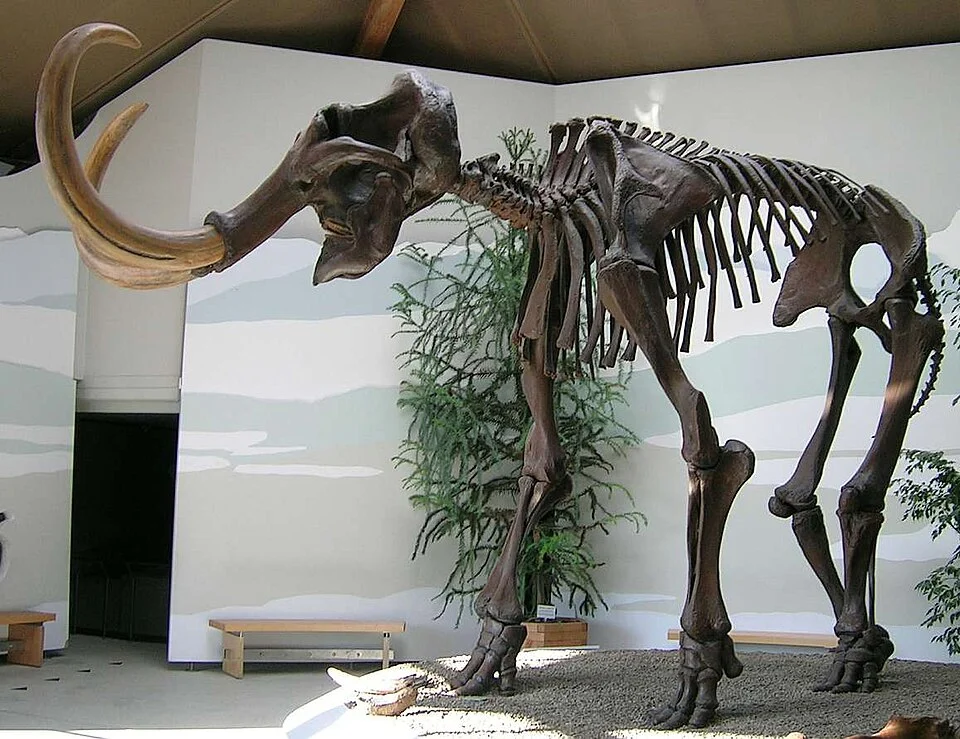
Woolly mammoth
Image associated with the exact linked encyclopedia article; consult credited file description for its interpretation.
Overview
The woolly mammoth had a dense coat, curved tusks and a body adapted to cold northern environments. It belonged to the elephant family and occupied parts of Eurasia and North America. Frozen remains, skeletal fossils and ancient DNA provide unusually varied evidence for a prehistoric mammal, although preservation differs greatly between localities.
Most mainland populations disappeared earlier than the final island survivors. Mammoths persisted on St Paul Island and on Wrangel Island after the end of the Pleistocene, with the latest Wrangel record around four thousand years ago. Explanations for disappearance include environmental change and human impacts, but their relative importance varied by place. Small-population genetic effects are informative without establishing a single universal extinction mechanism for every mammoth population.
Van der Valk and colleagues recovered DNA from three ancient Siberian molars in 2021. Their analyses distinguished the Krestovka lineage from the ancestry represented by Adycha and the early woolly mammoth Chukochya. They inferred that Columbian mammoths combined Krestovka-related and woolly ancestry, complicating a simple branching history. Many candidate cold-adaptation changes already occurred in Adycha, while some later changes accumulated gradually. Fragmented DNA required stringent authentication and filtering. The oldest specimens were dated through geological evidence and molecular models, with substantial uncertainty; their names and ages should not be treated as three equally well-preserved, complete woolly mammoth genomes.
A separate 2024 study by Marianne Dehasque and colleagues examined 21 Siberian woolly mammoth genomes, including fourteen from the isolated Wrangel Island population and seven older specimens. Thirteen genomes were newly sequenced. The island samples spanned approximately 9,200 to 4,300 calibrated years before present. This time series allowed the researchers to compare changes over many generations instead of drawing a population history from only two individuals. They found a sharp loss of genetic diversity around isolation, followed by a much slower decline, and evidence that close-relative inbreeding became less prominent after the initial bottleneck.
Forward simulations supported a severe reduction in effective population size followed by recovery within roughly twenty generations. Effective population size is a genetic modelling quantity, not a direct census of surviving animals. The researchers inferred subsequent demographic stability while detecting continuing genetic costs. Predicted high-impact mutations declined through purifying selection, whereas moderate-impact variants increased. Before comparing individuals, they reduced all genomes to the same sequencing depth. That correction was consequential: unequal coverage could otherwise create an apparent excess of harmful mutations in one of the youngest mammoths. Population recovery and the disappearance of inherited genetic burdens therefore operated on different timescales.
The 2024 analysis did not identify a definitive cause of the final extinction. Its youngest genome preceded the last approximately ten generations, leaving a gap in which conditions could have changed. The authors considered a rapid environmental or disease event, possibly interacting with genetic vulnerability, but could not exclude a late genetic tipping point. They also stressed that mutation effects were predicted using African elephant annotations, while strict filtering could miss genuine variants; comparisons were more secure than treating every estimate as an exact biological measurement. Wrangel Island consequently supplies a detailed local case, rather than one explanation for all mammoth disappearances.
Origins & earliest records
Woolly mammoths evolved within a much older proboscidean history. This entry uses a late Pleistocene marker as a representative occurrence and records Holocene island survival separately. A preserved carcass or ancient genome documents an individual population and date, not the exact first appearance of the species or all mammoths.
Evidence & interpretation
Bones, preserved tissues, radiocarbon dates and ancient genomes support anatomy and population histories. Island and mainland records must be compared separately. Fossil sampling and the timing of human arrival complicate extinction explanations, while genomic decline alone cannot demonstrate that every final population disappeared for the same reason or at the same moment.
Selected bibliography
Documented works and useful reading. This is not a list of every appearance.
- 01
Were all mammoths woolly?
Selected institutional scientific reading; not a complete bibliography.
- 02
Million-year-old DNA sheds light on the genomic history of mammoths
Selected sampling, dating, ancestry, adaptation, Discussion and ancient-DNA processing sections read from author-hosted PDF; not a new complete-paper audit.
- 03
Temporal dynamics of woolly mammoth genome erosion prior to extinction
Complete main Results, Discussion and limitations plus Methods from sample collection through statistical analysis read. Actual sample table and limitations pages inspected; supplementary analyses not rerun. Summary adapted under CC BY4.
Family, evolution & connections
Elephants and mammoths: mitochondrial branching
Selected topology from Rohland and colleagues (2007), with American mastodon as the outgroup.
Scroll sideways to see all branches. With a keyboard, focus the tree and use the arrow keys.
- Sampled proboscidean lineages
- American mastodon (Mammut americanum)
- Sampled Elephantidae
- Mammoth–Asian elephant branch
- Asian elephant (Elephas maximus)
Complete mitochondrial genomes; maximum-likelihood, neighbour-joining and Bayesian analyses agreed on the mammoth–Asian elephant grouping. A selected gene-history tree, not every elephant species or a complete nuclear-genome history. Living elephants are not mammoth ancestors. Branch lengths and dates are omitted.
Elephant nuclear genomes — Palkopoulou 2018
Seven collapsed taxon groups from Figure 1, all-substitutions panel; within-group sample branches omitted.
Scroll sideways to see all branches. With a keyboard, focus the tree and use the arrow keys.
- Sampled proboscideans
- Mammut americanum
- Elephantids (100 / 100)
- Asian elephants and mammoths (100 / 100)
- Elephas maximus
- Mammoths (100 / 100)
- Mammuthus columbi
- African and straight-tusked groups (100 / 100)
- Forest and straight-tusked groups (100 / 100)
- Loxodonta cyclotis
- Palaeoloxodon antiquus
PHYLIP neighbor joining from nuclear pairwise divergence; 100 bootstrap replicates. Retained original-node support pairs are all-substitutions / transversions; not recomputed after collapsing. An average genetic-distance tree, not the complete species history: admixture analyses recover gene flow, especially involving straight-tusked elephants. Internal woolly-mammoth branching differs between panels. No direct ancestors or dates inferred.
Taxonomic classification
A hierarchy of classified groups, not a chain of direct ancestors.
- kingdomAnimalia
- phylumChordata
- classMammalia
- orderProboscidea
- familyElephantidae
- genusMammuthus
- speciesMammuthus primigenius
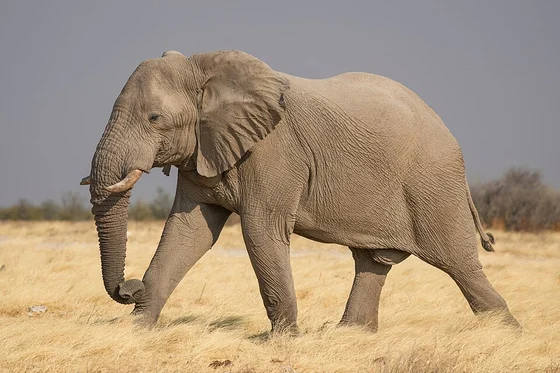
African savanna elephant
Mammoths and African elephants belong to the broader elephant lineage, making them appropriate relatives on a branching tree. The museum notes that mammoths are more closely related to Asian elephants, so this link must not depict African savanna elephants as their direct ancestors or closest living counterpart. Shared trunks and tusks are not sufficient to resolve the branches alone.
Asian elephant
Rohland and colleagues reconstructed mitochondrial relationships using mastodon as an outgroup. Their analyses group woolly mammoth with Asian elephant rather than African elephant. This documents a shared branching history in the sampled mitochondrial genomes; neither living elephant species is presented as the mammoth’s direct ancestor.
Columbian mammoth
North American woolly specimens show Columbian-related ancestry; this is gene flow, not a simple ancestor chain.
Encyclopedia background
An additional attributed reference, separate from the editorial profile above.
Read the open encyclopedia overview
The woolly mammoth (Mammuthus primigenius) is an extinct species of mammoth that lived from the Middle Pleistocene until its extinction in the Holocene epoch. It was one of the last in a line of mammoth species, beginning with the African Mammuthus subplanifrons in the early Pliocene. The woolly mammoth began to diverge from the steppe mammoth about 800,000 years ago in Siberia. Its closest extant relative is the Asian elephant. The Columbian mammoth (Mammuthus columbi) lived alongside the woolly mammoth in North America, and DNA studies show that the two hybridised with each other. Mammoth remains were long known in Asia before they became known to Europeans. The origin of these remains was long debated and often explained as the remains of legendary creatures. The mammoth was identified as an extinct elephant species by Georges Cuvier in 1796.
The appearance and behaviour of the woolly mammoth are among the best studied of any prehistoric animal because of the discovery of frozen carcasses in Siberia and North America, as well as skeletons, teeth, stomach contents, dung, and depiction from life in prehistoric cave paintings. It was roughly the same size as modern African elephants. Males reached shoulder heights between 2.67 and 3.49 m (8 ft 9 in and 11 ft 5 in) and weighed between 3.9 and 8.2 t (3.8 and 8.1 long tons; 4.3 and 9.0 short tons). Females reached 2.3–2.6 m (7 ft 7 in – 8 ft 6 in) in shoulder heights and weighed between 2.8 and 4 t (2.8 and 3.9 long tons; 3.1 and 4.4 short tons). A newborn calf weighed about 90 kg (200 lb).
The woolly mammoth was well adapted to the cold environments present during glacial periods, including the last ice age. It was covered in fur, with an outer covering of long guard hairs and a shorter undercoat. The colour of the coat varied from dark to light. The ears were small and tail was short to minimise frostbite and heat loss. It had long, curved tusks and four molars, which were replaced six times during the lifetime of an individual. Its behaviour was similar to that of modern elephants, and it used its tusks and trunk for manipulating objects, fighting, and foraging. The diet of the woolly mammoth was mainly forbs and grasses. Individuals could probably reach the age of 60. Its habitat was the mammoth steppe, which stretched across northern Eurasia and North America.
The woolly mammoth coexisted with early humans, who hunted the species for food, and used its bones and tusks for making art, tools, and dwellings. The population of woolly mammoths declined at the end of the Late Pleistocene, with the last populations on mainland Siberia persisting until around 10,000 years ago, although isolated populations survived on St. Paul Island until 5,600 years ago and on Wrangel Island until 4,000 years ago. After its extinction, humans continued using its ivory as a raw material, a tradition that continues today. The completion of the mammoth genome project in 2015 sparked discussion about potentially reviving the woolly mammoth through several various methods. However, none of these approaches are currently feasible.
Text from Wikipedia contributors, “Woolly mammoth”. CC BY-SA 4.0. Extracted introduction; formatting changed. Retrieved 5 October 2026. The source article may have changed since retrieval.
References
Sources supporting this profile. Linked pages have their own scope and editorial standards.
- MuseumWere all mammoths woolly?Research access: 2026-10-05
- Primary researchVan der Valk et al.2021Research access: 2026-10-05
- Primary researchDehasque et al.2024Research access: 2026-10-05
- LicenceCreative Commons Attribution 4.0 for Dehasque et al.2024Research access: 2026-10-05
Image credits
Reference illustrationWoolly mammoth
Image associated with the exact linked encyclopedia article; consult credited file description for its interpretation.