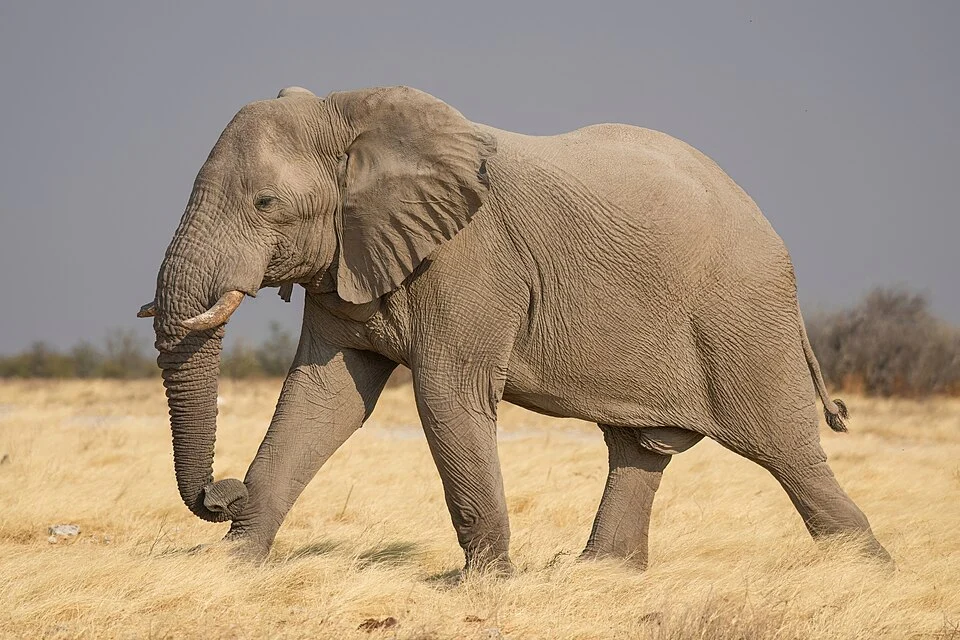
African savanna elephant
Image associated with the exact linked encyclopedia article; consult credited file description for its interpretation.
Overview
African savanna elephants have flexible trunks, large ears and continually replaced cheek teeth suited to a diet of varied vegetation. Their feeding and movement can reshape habitats, linking the survival of individuals with broader ecological processes. The species occupies several types of environment rather than only open grassland.
Elephant social relationships and communication are studied through long-term observation, while anatomy and genetics help distinguish savanna elephants from forest elephants and Asian elephants. Conservation pressures include habitat fragmentation and killing for ivory, with circumstances differing between regions. Recognising the separate African species matters because broad statements about African elephants can conceal different ecological and conservation histories. No individual elephant represents all possible body size, behaviour or habitat use within the species.
A 2010 study by Nadin Rohland and colleagues compared African savanna and forest elephants with Asian elephants, woolly mammoth and American mastodon. Its shared nuclear dataset contained 39,763 aligned base pairs across 375 loci, rather than complete genomes of every sampled animal. Most comparisons represented one individual per taxon, with a second Asian elephant available for some loci. The nuclear relationships placed forest and savanna elephants together as sister taxa, and Asian elephants with mammoths. The depth of forest-savanna divergence supported treating the two African forms as distinct species, rather than reading shared mitochondrial lineages as proof of one undifferentiated population.
The demographic analysis estimated the initial forest-savanna population divergence within a broad 1.9-7.1 million-year interval. This combined fossil-calibration uncertainty with model uncertainty; it is not the age of an individual elephant or a precise date at which every exchange of genes stopped. The fitted model assumed instantaneous population splits and constant population sizes over specified intervals. The authors explicitly allowed that later gene flow could have occurred. Their sample was too small to fit a more detailed isolation-and-migration analysis with useful power.
The distinction between nuclear DNA and maternally inherited mitochondrial DNA is especially important in elephants with female-centered social groups. The authors discussed repeated migration by savanna males into forest-derived maternal groups as a possible explanation for animals with savanna-like nuclear ancestry but forest-associated mitochondrial lineages. This was an explanatory hypothesis, not an observed reconstruction of each ancient encounter. Ancient mastodon DNA also introduced a technical limit: many apparent mastodon-specific differences failed validation, so that raw sequence was not used to calibrate elephantid divergences. Genetic-diversity estimates from such small samples were likewise provisional. The study provides a located historical test of elephant relationships while leaving population history, gene flow and present conservation conditions to further evidence.
Origins & earliest records
The living species is part of a much older proboscidean radiation. Its formal name and changing distinction from forest elephants concern taxonomic history, not the original evolution of trunks or tusks. This entry does not infer a species-origin date from ancient elephant relatives or from the first European description.
Evidence & interpretation
Observations, skeletal anatomy and genetic comparisons support species identity and ecological understanding. Repeated monitoring can track particular populations, but regional estimates do not automatically establish a continent-wide trend. Behaviour varies with age, sex, social setting and environment, so traits documented in one herd should not be treated as fixed for every elephant.
Selected bibliography
Documented works and useful reading. This is not a list of every appearance.
- 01
Elephant
Selected institutional scientific reading; not a complete bibliography.
- 02
Genomic DNA Sequences from Mastodon and Woolly Mammoth Reveal Deep Speciation of Forest and Savanna Elephants
PLOS Biology 8:e1000564; complete main report and Methods. CC Attribution.
- 03
Reconciling Apparent Conflicts between Mitochondrial and Nuclear Phylogenies in African Elephants
Ishida and coauthors, PLOS ONE6(6)e20642,8June2011; DOI10.1371/journal.pone.0020642
Family, evolution & connections
Elephants and mammoths: mitochondrial branching
Selected topology from Rohland and colleagues (2007), with American mastodon as the outgroup.
Scroll sideways to see all branches. With a keyboard, focus the tree and use the arrow keys.
- Sampled proboscidean lineages
- American mastodon (Mammut americanum)
- Sampled Elephantidae
- Mammoth–Asian elephant branch
- Asian elephant (Elephas maximus)
Complete mitochondrial genomes; maximum-likelihood, neighbour-joining and Bayesian analyses agreed on the mammoth–Asian elephant grouping. A selected gene-history tree, not every elephant species or a complete nuclear-genome history. Living elephants are not mammoth ancestors. Branch lengths and dates are omitted.
Elephant nuclear genomes — Palkopoulou 2018
Seven collapsed taxon groups from Figure 1, all-substitutions panel; within-group sample branches omitted.
Scroll sideways to see all branches. With a keyboard, focus the tree and use the arrow keys.
- Sampled proboscideans
- Mammut americanum
- Elephantids (100 / 100)
- Asian elephants and mammoths (100 / 100)
- Elephas maximus
- Mammoths (100 / 100)
- Mammuthus columbi
- African and straight-tusked groups (100 / 100)
- Forest and straight-tusked groups (100 / 100)
- Loxodonta cyclotis
- Palaeoloxodon antiquus
PHYLIP neighbor joining from nuclear pairwise divergence; 100 bootstrap replicates. Retained original-node support pairs are all-substitutions / transversions; not recomputed after collapsing. An average genetic-distance tree, not the complete species history: admixture analyses recover gene flow, especially involving straight-tusked elephants. Internal woolly-mammoth branching differs between panels. No direct ancestors or dates inferred.
Taxonomic classification
A hierarchy of classified groups, not a chain of direct ancestors.
- kingdomAnimalia
- phylumChordata
- classMammalia
- orderProboscidea
- familyElephantidae
- genusLoxodonta
- speciesLoxodonta africana
Forest and straight-tusked elephants
Figure 1 places savanna elephants beside the forest/straight-tusked cluster; admixture models complicate that average branching.
Located primary passages
Specific passages supporting details in this entry, grouped by their published witness.
Reconciling Apparent Conflicts between Mitochondrial and Nuclear Phylogenies in African Elephants
Ishida and coauthors, PLOS ONE6(6)e20642,8June2011; DOI10.1371/journal.pone.0020642
- This2011 analysis supports distinguishing savanna and forest elephants using nuclear markers while explaining why mitochondrial lineages do not divide neatly between them. Its sampled populations show strong nuclear separation with limited admixture; carrying a forest-associated mitochondrial lineage does not by itself identify a savanna elephant as a recent hybrid. Different genetic evidence can retain different histories.
Selected sections, not a complete review of methods, forensic-marker results, supplements or raw data. Historical authors’ account of2011 conservation classifications is not presented as current institutional policy. No extrapolation to human race.
Encyclopedia background
An additional attributed reference, separate from the editorial profile above.
Read the open encyclopedia overview
The African bush elephant (Loxodonta africana), also known as the African savanna elephant, is a species of elephant native to sub-Saharan Africa and the largest living terrestrial animal, with fully grown bulls reaching an average shoulder height of 3.04–3.36 m (10.0–11.0 ft) and a body mass of 5.2–6.9 t (5.7–7.6 short tons); the largest recorded specimen had a shoulder height of 3.96 m (13.0 ft) and an estimated body mass of 10.4 t (11.5 short tons). It is characterised by its long prehensile trunk with two finger-like processes; a concave back; large ears which help reduce body heat; and sturdy tusks that are noticeably curved. Its skin is grey with scanty hairs, and bending cracks which support thermoregulation by retaining water.
The African bush elephant inhabits a variety of habitats such as forests, grasslands, woodlands, wetlands and agricultural land. It is a mixed herbivore feeding mostly on grasses, creepers, herbs, leaves, and bark. The average adult consumes about 150 kg (330 lb) of vegetation and 230 L (51 imp gal; 61 US gal) of water each day. It is a social animal that lives in herds of cows and their offspring. Adult bulls usually live alone or in small bachelor groups. During the mating season, males undergo musth, a period of high testosterone levels and heightened aggression. The menstrual cycle of cows lasts three to four months, and gestation around 22 months, the longest of any mammal.
Since 2021, the African bush elephant has been listed as Endangered on the IUCN Red List. It is threatened foremost by habitat destruction, and in parts of its range also by poaching for meat and ivory. Between 2003 and 2015, the illegal killing of 14,606 African bush elephants was reported by rangers across 29 range countries. Chad is a major transit country for smuggling of ivory in West Africa, though this trend was curtailed by raising penalties for poaching and improving law enforcement. Poaching of the elephant in the 1970–1980s were considered the largest killings in history. In human culture, elephants have been extensively featured in literature, folklore and media, and are most valued for their large tusks.
Text from Wikipedia contributors, “African bush elephant”. CC BY-SA 4.0. Extracted introduction; formatting changed. Retrieved 5 October 2026. The source article may have changed since retrieval.
References
Sources supporting this profile. Linked pages have their own scope and editorial standards.
- ResearchElephantResearch access: 2026-10-05
- ResearchRohland and colleagues 2010, CC AttributionResearch access: 2026-10-05
Image credits
Reference illustrationAfrican savanna elephant
Image associated with the exact linked encyclopedia article; consult credited file description for its interpretation.