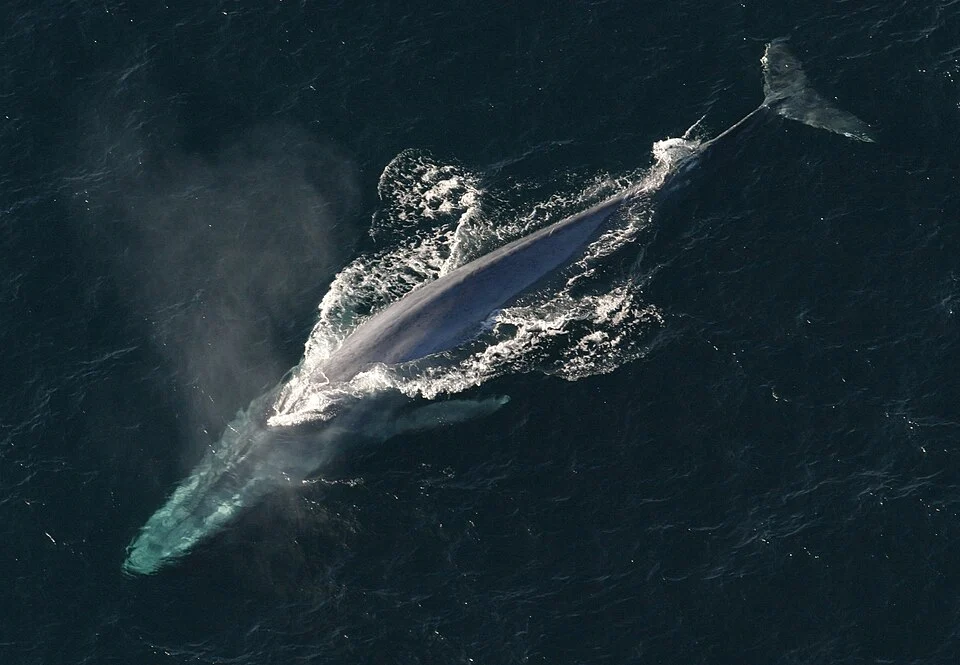
Blue whale
Image associated with the exact linked encyclopedia article; consult credited file description for its interpretation.
Overview
Blue whales strain small prey from seawater using baleen plates. Their immense bodies therefore depend on dense concentrations of small crustaceans rather than large individual prey. They are rorquals, with throat pleats that expand during feeding. Size and body proportions vary among populations and recognised subspecies, so one exceptional individual should not define the whole species.
Field research combines sightings, photographs, tags, genetics and acoustic recordings to investigate movement and population structure. Some populations undertake long seasonal movements, while others are less well understood. Commercial whaling greatly reduced numbers during the twentieth century. Current threats include ship collisions and entanglement in fishing gear. Conservation assessments depend on particular populations and regions, making a simple worldwide abundance claim less useful than carefully attributed monitoring evidence.
Sushma Jossey and colleagues compared present-day and historical North Atlantic genomes in a 2024 study. Their nuclear analyses placed the sampled northeastern whales within a broader set of northwestern relationships, rather than dividing the ocean into two entirely separate evolutionary branches. Different statistical measures captured moderate differentiation in one comparison and low allelic differentiation in another. The authors therefore described a more complex pattern than a simple choice between one uniform population and two isolated populations. Their mitochondrial reconstruction also differed from the nuclear tree: the Antarctic comparison specimen nested among North Atlantic maternal lineages instead of branching outside them.
Demographic modelling compared scenarios with no exchange, equal exchange in both directions, and unequal exchange between the eastern and western North Atlantic. The asymmetric model received the strongest support, with more inferred gene flow from west to east. These are estimates across generations, not direct observations of a particular whale crossing the ocean. Currents and changing food distributions were discussed as possible contributors, requiring further investigation. The associated family tree displays relationships among sampled individuals; it cannot on its own show the direction or amount of gene flow, and it is not a list of separate whale species.
The same study detected fin-whale ancestry in all of its present-day North Atlantic blue-whale samples and in four of six historical samples. Separate introgression analyses inferred predominantly fin-to-blue gene flow, with approximately 3.5 percent fin-whale ancestry in the sampled North Atlantic genomes. This regional estimate should not be assigned to every blue whale worldwide. Relatively small historical and recent samples also prevented the authors from establishing whether hybridization rates were changing or whether genetic swamping was occurring. High genetic diversity and low measured inbreeding did not erase the effects of past whaling: long generation times can delay the genomic signature of a recent population reduction. Broader sampling and continued monitoring remained necessary.
Origins & earliest records
The modern species belongs to a baleen-whale lineage with a much longer fossil history. This profile does not assign an exact evolutionary origin to blue whales from the age of whales generally. Scientific description, historical whaling and current monitoring are separate stages in human knowledge of an already existing species.
Evidence & interpretation
Direct observations, photo-identification, genetics, tags and underwater acoustics establish feeding and movement patterns. Records from dead whales add anatomical and age information. Uneven survey coverage limits abundance estimates, and subspecies or population differences complicate generalisations. The cited NOAA profile supports ecological description without resolving every migratory route or demographic trend.
Selected bibliography
Documented works and useful reading. This is not a list of every appearance.
- 01
Blue Whale
Selected institutional scientific reading; not a complete bibliography.
- 02
Population structure and history of North Atlantic Blue whales (Balaenoptera musculus musculus) inferred from whole genome sequence analysis
Focal genomic and introgression Methods/Results, population-structure, heterozygosity and hybridization Discussion, Figure1B and licence independently read. Summary adapted under CC BY4. Supplementary analyses not rerun; correction verified separately.
- 03
Correction: Population structure and history of North Atlantic Blue whales
Complete correction body read. Corrects the BioProject identifier to PRJNA704862; it does not change the displayed phylogeny.
- 04
Metabolic Expenditures of Lunge Feeding Rorquals Across Scale: Implications for the Evolution of Filter Feeding and the Limits to Maximum Body Size
Jean Potvin, Jeremy A.Goldbogen and Robert E.Shadwick, PLOS ONE7(9)e44854,14September2012; DOI10.1371/journal.pone.0044854
Family, evolution & connections
Selected baleen-whale species tree — Árnason et al. 2018
Eight sampled baleen-whale species in Figure 1A; duplicate sei-whale individuals collapsed to one species tip.
Scroll sideways to see all branches. With a keyboard, focus the tree and use the arrow keys.
- Sampled baleen whales
- Right-whale pair
- North Atlantic right whale
- Bowhead whale
- Sampled rorquals and gray whale
- Minke whale
- Remaining sampled rorquals and gray whale (conflicting internal signals)
- Blue/sei pair
- Sei whale
- Gray/fin/humpback grouping (gray placement contested)
- Gray whale
- Fin/humpback pair
- Fin whale
- Humpback whale
ASTRAL multispecies-coalescent tree from 34,192 genomic fragments; topology checked against the actual figure. Gray-whale placement and the earliest rorqual split have conflicting quartet support. The study reports introgressive gene flow; this branching view omits reticulations. One study’s sampled topology, not a settled universal tree. No dates or direct ancestors inferred.
Sampled blue-whale nuclear relationships — Jossey and colleagues (2024)
All sixteen visibly depicted terminals in Figure 1B: fourteen North Atlantic blue-whale samples, one Antarctic blue-whale sample and the fin-whale outgroup. Sample labels denote individuals, not separate species or ancestors.
Scroll sideways to see all branches. With a keyboard, focus the tree and use the arrow keys.
- Sampled nuclear relationships
- Fin — outgroup
- Sampled blue whales
- Ant — Antarctic sample
- Sampled North Atlantic whales (bootstrap 100 in both analyses)
- Four sampled northwest whales (bootstrap 100 in both analyses)
- NWa4
- Three sampled northwest whales (bootstrap 100 in both analyses)
- NWa3
- NWa-R4 / NW-M6 (bootstrap 100 in both analyses)
- NWa-R4
- NW-M6
- NW9 and remaining sampled whales (bootstrap 100 in both analyses)
- NW9
- Remaining sampled North Atlantic whales (RAxML bootstrap 91; SVDQuartets value not shown)
- NE73 / NE4 (bootstrap 100 in both analyses)
- NE73
- NE4
- NE1
- NEAr / NE3 (bootstrap 100 in both analyses)
- NEAr
- NE3
- NE2
- NE72
- NWB7
- NW7
Figure 1B summarizes RAxML-NG and SVDQuartets analyses of 176,382 filtered SNPs. RAxML used GTR+G with Lewis ascertainment correction and 500 bootstrap replicates; SVDQuartets sampled all quartets with 1,000 bootstrap replicates. The diagram retains the published branching and original displayed supports; they were not recomputed. Northeast samples nest among northwest samples; this is not a split into two reciprocally monophyletic geographic populations. Shallow relationships remain unresolved, and the reduced high-coverage analyses disagree on the most divergent northwest sample. The mitochondrial tree places the Antarctic sample differently. Gene flow is not represented by these branches. The caption’s separate PCA census lists eight northeast samples, whereas this tree visibly labels seven; no missing individual is invented. Adapted from Jossey et al. under CC BY 4.0: layout changed and branch lengths omitted; no dates inferred.
Taxonomic classification
A hierarchy of classified groups, not a chain of direct ancestors.
- kingdomAnimalia
- phylumChordata
- classMammalia
- orderCetacea
- familyBalaenopteridae
- genusBalaenoptera
- speciesBalaenoptera musculus
Homo sapiens
A blue whale and a human are mammals with a distant shared ancestry, despite their markedly different aquatic and terrestrial adaptations. Their authoritative species accounts support the identities at both ends. This broad tree connection does not make either species ancestral to the other, and it should not imply that similar intelligence or social behaviour establishes their evolutionary relationship.
Hippopotamuses
Nikaido, Rooney and Okada tested shared retroposon insertions and recovered a whale–hippopotamus grouping within even-toed ungulates. Blue whales belong to the whale branch, while living hippopotamuses occupy its surviving non-cetacean sister group. This does not mean whales evolved from modern hippopotamuses, nor identify a particular fossil ancestor.
Sei whale
Figure 1A in Árnason and colleagues’ 2018 genomic study groups blue and sei whales together in its sampled species tree. This is an evolutionary relationship inferred from genomic fragments, not a genus hierarchy or a claim that one living species became the other. The paper also reports conflicting internal signals and gene flow elsewhere among rorquals, which limit a simple branching representation.
Eastern North Pacific krill, chiefly Thysanoessa spinifera
Savoca and colleagues combined whale feeding tags, prey-density acoustics and body measurements to model krill consumption in the eastern North Pacific. Their daily estimates concern feeding days, not a fixed year-round ration. Engulfment calculations assumed complete krill capture; daily consumption was simulated rather than weighed directly. Antarctic blue-whale estimates additionally borrowed feeding and prey measurements from other regions.
Fin whale (Balaenoptera physalus)
Jossey and colleagues detected fin-whale introgression in all sampled present-day North Atlantic blue whales and four of six historical samples. Dfoil analyses inferred gene flow from fin whales into blue whales, contributing approximately 3.5% of the sampled genomes. Their small historical sample cannot establish whether hybridization rates are changing. This gene-flow result is not direct ancestry and cannot be represented by a simple branching tree.
Located primary passages
Specific passages supporting details in this entry, grouped by their published witness.
Metabolic Expenditures of Lunge Feeding Rorquals Across Scale: Implications for the Evolution of Filter Feeding and the Limits to Maximum Body Size
Jean Potvin, Jeremy A.Goldbogen and Robert E.Shadwick, PLOS ONE7(9)e44854,14September2012; DOI10.1371/journal.pone.0044854
- This model links increasing rorqual body size to disproportionately demanding power delivery during engulfment. Blue-whale examples test whether those brief feeding demands could help constrain size, alongside prey availability and recovery. A simulated33-metre animal is explicitly hypothetical. The conclusions qualify the proposed limit because alternative lunging mechanics, prey types and feeding strategies could change the modeled costs.
No full independent methods/Results review, computational replication or raw tag-data analysis. Predicted metabolic rates are model outputs rather than direct calorimetry;2012 proposed size constraints are not an established universal maximum.
Encyclopedia background
An additional attributed reference, separate from the editorial profile above.
Read the open encyclopedia overview
The blue whale (Balaenoptera musculus) is a species of baleen whale and the largest marine mammal in the rorqual family Balaenopteridae. Reaching a maximum confirmed length of 29.9–30.5 m (98–100 ft) and weighing up to 190–200 t (190–200 long tons; 210–220 short tons), it is the largest animal known to have ever existed. The blue whale's long and slender body can be of various shades of greyish-blue on its upper surface and somewhat lighter underneath. Four subspecies are recognized: B. m. musculus in the North Atlantic and North Pacific, B. m. intermedia in the Southern Ocean, B. m. brevicauda (the pygmy blue whale) in the Indian Ocean and South Pacific Ocean, and B. m. indica in the Northern Indian Ocean. There is a population in the waters off Chile that may constitute a fifth subspecies.
In general, blue whale populations migrate between their summer feeding areas near the poles and their winter breeding grounds near the tropics. There is also evidence of year-round residencies, and partial or age- and sex-based migration. Blue whales are filter feeders; their diet consists almost exclusively of krill. They are generally solitary or gather in small groups, and have no well-defined social structure other than mother–calf bonds. Blue whales vocalize, with a fundamental frequency ranging from 8 to 25 Hz; their vocalizations may vary by region, season, behavior, and time of day.
The blue whale was abundant in nearly all the Earth's oceans until the end of the 19th century. It was hunted almost to the point of extinction by whalers until the International Whaling Commission banned all blue whale hunting in 1966. The International Union for Conservation of Nature has listed blue whales as endangered as of 2018. Blue whales continue to face numerous man-made threats such as ship strikes, pollution, ocean noise, and climate change.
Text from Wikipedia contributors, “Blue whale”. CC BY-SA 4.0. Extracted introduction; formatting changed. Retrieved 5 October 2026. The source article may have changed since retrieval.
References
Sources supporting this profile. Linked pages have their own scope and editorial standards.
- ResearchBlue WhaleResearch access: 2026-10-05
- Primary researchJossey et al.2024: North Atlantic population genomicsResearch access: 2026-10-05
- CorrectionJossey et al.2024: BioProject correctionResearch access: 2026-10-05
- LicenceCreative Commons Attribution 4.0Research access: 2026-10-05
Image credits
Reference illustrationBlue whale
Image associated with the exact linked encyclopedia article; consult credited file description for its interpretation.