Ichthyosaurus
Image associated with the exact linked encyclopedia article; consult credited file description for its interpretation.
Overview
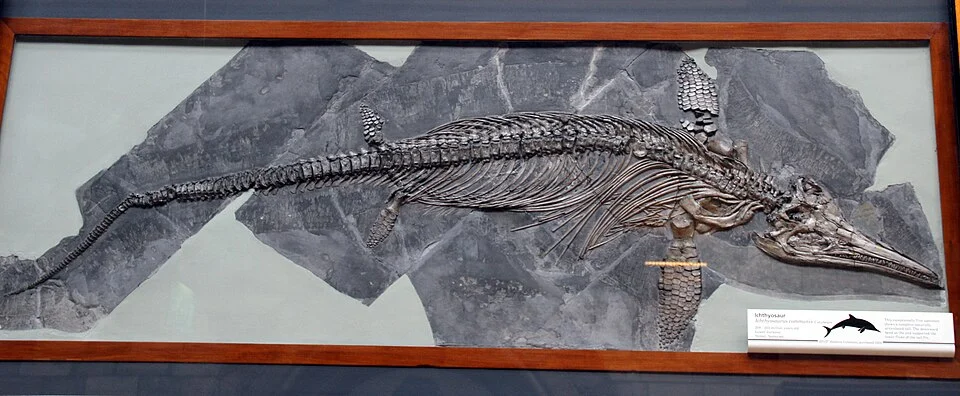
Ichthyosaurus had a streamlined body, flipper-like limbs and an elongate toothed snout. Its resemblance to dolphins reflects comparable demands of swimming rather than close mammalian ancestry. The genus is one member of the much wider ichthyosaur radiation, which included animals with different sizes, proportions and geological ranges.
Early specimens associated with Mary Anning and the Dorset coast played a major role in palaeontology. Initially, several marine reptiles were grouped under the same genus; later comparisons separated distinct lineages. Complete and partial skeletons now allow detailed anatomical study, while soft-tissue examples elsewhere in the ichthyosaur record inform broader reconstruction. An Early Jurassic Ichthyosaurus should not inherit every trait or enormous size claimed for much later or earlier members of the whole group.
Lomax and Sachs described a specimen assigned to Ichthyosaurus somersetensis in 2017. NLMH 106234, housed in Hannover, was collected at Doniford Bay, Somerset, from lower Hettangian Blue Lias strata. Its apparently complete display skeleton is a composite: most of the tail consists of another individual’s bones and replicas, and portions of the skull, vertebral column and forefin were reconstructed. The researchers distinguished these additions from genuine anatomy before interpreting the specimen. The estimated original length of three to 3.3 metres was therefore a reconstruction using skull and body proportions, not a measurement of the displayed tail.
An embryo is preserved between the ribs near the middle-to-posterior dorsal vertebrae. It includes 23 preserved vertebral centra, of which 16 are articulated or associated, delicate rib fragments, a partial fin interpreted as a forefin and a probable shoulder-blade element. Its articulated vertebral section measures approximately 6.37 centimetres, but the exact position within the original embryonic column cannot be established. The fin shows poorly ossified, spongy material. Some proposed notches may be preservation artefacts, and the possible fifth digit is uncertain. These distinctions keep identifiable embryonic remains separate from a complete reconstructed baby skeleton.
The adult also extends knowledge of variation within the species. A branching arrangement in its hindfin produces four elements in a row previously described with three. Its fork-like ilium could reflect individual variation, pathology or size-related differences; exposure and preservation might have concealed similar features in other specimens. The paper therefore argues for combining several anatomical characters when assigning species. Only one embryo was preserved in this specimen and the two other Ichthyosaurus pregnancies then discussed, but this does not establish a universal litter size: additional embryos might have been lost or removed during preparation. Suggested sex-related differences in limb and pelvic anatomy remain hypotheses supported by a small comparative sample, rather than diagnostic rules for every skeleton.
Origins & earliest records
Ichthyosaurus was named during the early nineteenth-century investigation of marine reptile fossils, including Dorset material. Its familiar fossil record is Early Jurassic, represented here near 195 million years ago. The history of ichthyosaurs as a larger group begins earlier, so the genus' discovery and range cannot substitute for the entire radiation.
Evidence & interpretation
Skeletons establish a marine reptile with specialised limbs and teeth. Comparisons clarify which historically assigned specimens actually belong to Ichthyosaurus. Some features reconstructed for the genus draw on broader ichthyosaur evidence and must be distinguished from directly preserved anatomy. The record supports convergence with dolphins without implying close ancestry or identical physiology.
Selected bibliography
Documented works and useful reading. This is not a list of every appearance.
- 01
What is an ichthyosaur? The real sea dragons that once swam beneath the waves
Selected institutional scientific reading; not a complete bibliography.
- 02
On the largest Ichthyosaurus: A new specimen of Ichthyosaurus somersetensis containing an embryo
Acta Palaeontologica Polonica 62(3): 575–584; online 28 August. Complete Introduction, material/Methods, size account, embryo and Discussion sections, plus selected pelvic/hindfin description read. Published PDF explicitly CC BY 4.0. Detailed skull/vertebral/forefin descriptions and original pixels not independently examined.
Family, evolution & connections
Selected ichthyosaur branches in the 2016 strict consensus
Figure 1a subtree containing Suevoleviathan and Thunnosauria; Baracromia is retained as one collapsed terminal encompassing its sampled members.
Scroll sideways to see all branches. With a keyboard, focus the tree and use the arrow keys.
- Selected Suevoleviathan / Thunnosauria subtree
- Suevoleviathan disinteger
- Sampled Thunnosauria
- Ichthyosaurus / Malawania pair
- Malawania anachronus
- Other sampled thunnosaurs
- Hauffiopteryx typicus
- Stenopterygius and sampled Baracromia
- Stenopterygius quadriscissus
- Sampled Baracromia (collapsed)
Equal-weight maximum-parsimony strict consensus of 12 trees, each length 209, as labeled in Figure 1a. Only branching is transferred, omitting time scaling, geological ranges and ecological color coding. Panel 1b is an ecological clustering dendrogram, not the source of this phylogeny. Low support and incomplete fossil samples limit finer resolution, especially inside the collapsed Baracromia. No fossil tip is asserted to be a direct ancestor.
Taxonomic classification
A hierarchy of classified groups, not a chain of direct ancestors.
- kingdomAnimalia
- phylumChordata
- familyIchthyosauridae
- genusIchthyosaurus
Malawania anachronus
Figure 1a pairs Ichthyosaurus communis with Malawania anachronus. Their widely separated fossil ranges do not turn either sampled terminal into the other’s direct ancestor.
Encyclopedia background
An additional attributed reference, separate from the editorial profile above.
Read the open encyclopedia overview
Ichthyosaurus (derived from Greek ἰχθύς (ichthys) meaning 'fish' and σαῦρος (sauros) meaning 'lizard') is an extinct genus of ichthyosaurs from the Early Jurassic (Hettangian - Pliensbachian) of Europe (Belgium, England, Germany and Portugal). Some specimens of the ichthyosaurid Protoichthyosaurus from England and Switzerland have been erroneously referred to this genus in the past. It is among the best known ichthyosaur genera, as it is the type genus of the order Ichthyosauria.
Text from Wikipedia contributors, “Ichthyosaurus”. CC BY-SA 4.0. Extracted introduction; formatting changed. Retrieved 5 October 2026. The source article may have changed since retrieval.
References
Sources supporting this profile. Linked pages have their own scope and editorial standards.
- MuseumWhat is an ichthyosaur? The real sea dragons that once swam beneath the wavesResearch access: 2026-10-05
- ResearchComposite Somerset skeleton and embryonic remainsResearch access: 2026-10-06
Image credits
Reference illustrationIchthyosaurus
Image associated with the exact linked encyclopedia article; consult credited file description for its interpretation.