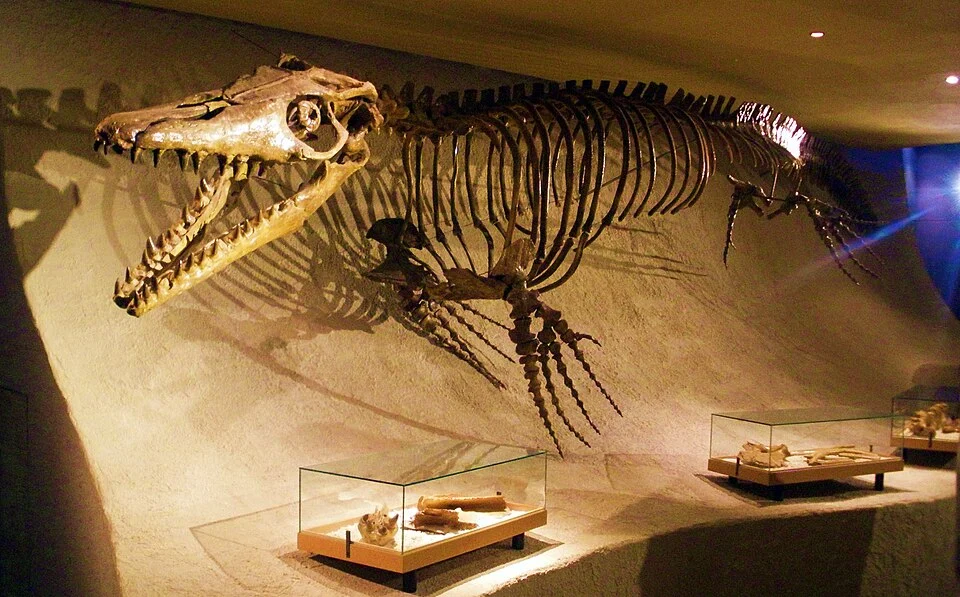
Mosasaurus
Image associated with the exact linked encyclopedia article; consult credited file description for its interpretation.
Overview
Mosasaurus had powerful jaws, teeth suited to capturing animal prey and a body adapted to swimming. It lends its name to the wider mosasaur group but does not stand for every mosasaur species. As a squamate, it belonged to a reptile branch different from dinosaurs, plesiosaurs and ichthyosaurs.
The first famous discoveries near Maastricht prompted debates about whether the animal was a fish, crocodile or whale. Comparative anatomy eventually clarified its reptilian identity. Different Mosasaurus species vary in proportions, and overall size is often estimated from incomplete remains. This makes spectacular maximum-length claims less secure than the presence of particular skull features. Its history also illustrates how fossil discovery helped scientists recognise animals with no exact living counterpart.
A 2023 study examined a more limited question: what microscopic tooth wear can reveal about feeding in the Maastrichtian seas of the Netherlands and Belgium. Holwerda and colleagues compared five locally preserved mosasaur taxa, including Mosasaurus hoffmanni. Their fossils came from approximately 68–66-million-year-old strata, an environmental and stratigraphic context rather than an age independently measured from every tooth. Eighteen tooth crowns were initially sampled across the five taxa; four belonged to M. hoffmanni. Multiple teeth from the two Prognathodon taxa represented single individuals, so tooth number and individual number were not interchangeable.
The researchers made high-fidelity casts and measured small areas of non-chewing tooth surfaces using three-dimensional microscopy. They avoided wear facets likely caused by opposing teeth and compared surface textures with an existing dataset of living monitor lizards and crocodilians whose diets were known. Texture measurements were projected into that comparative framework. This tests properties associated with food contact rather than simply assuming that a pointed tooth identifies a fish eater or that a robust tooth must crush shells.
The four Mosasaurus samples occupied a broad region of the resulting texture space, overlapping several living dietary groups. The authors interpreted this as compatible with dietary generalism, potentially including both vertebrate and invertebrate prey. It is not a list of identified stomach contents or proof that every individual consumed the same foods. The broader mosasaur comparison suggested partial dietary differences between some groups, yet considerable overlap rather than strict separation into neat feeding categories.
The inference remains exploratory. Few fossil teeth were available, the extinct animals differed anatomically from their living comparators, and their fully aquatic setting complicates transfer of dietary categories. Even the living groups overlapped in texture space. Size, habitat and opportunistic feeding might have helped several predatory reptiles share the ecosystem, but those explanations require further evidence. The study therefore adds a quantitative constraint on plausible diets while preserving uncertainty about particular prey, competition and population-wide variation.
Origins & earliest records
Fossils found near Maastricht in the eighteenth century became central to the history of Mosasaurus, named in 1822. Its geological record belongs to the Late Cretaceous. A representative marker near 70 million years does not date the origin of all mosasaurs, which appear earlier, or replace species-specific ranges.
Evidence & interpretation
Skulls, teeth, vertebrae and limbs support marine squamate identity. Comparative anatomy tests affinities, while size reconstruction uses assumptions about missing body proportions. The relationships of mosasaurs to particular living squamate branches remain debated. Different species and incomplete skeletons make a single definitive giant silhouette unsuitable as a universal reconstruction. Three-dimensional tooth textures constrain dietary hypotheses through comparisons with living reptiles; small fossil samples and overlapping reference categories limit prey identification.
Selected bibliography
Documented works and useful reading. This is not a list of every appearance.
- 01
What is a mosasaur? Facts about Mosasaurus and its relatives
Selected institutional scientific reading; not a complete bibliography.
- 02
Three-dimensional dental microwear in type-Maastrichtian mosasaur teeth (Reptilia, Squamata)
Scientific Reports 13: 18720, 9 November. Complete main Introduction, Results, Discussion, Conclusions, Materials and Methods and captions. CC BY 4.0.
Family, evolution & connections
Sampled Mosasaurus and Plotosaurus in the 2017 Bayesian tree
Five-tip subtree of Figure 3; more distant mosasaurines and outer branches omitted.
Scroll sideways to see all branches. With a keyboard, focus the tree and use the arrow keys.
- Selected Figure 3 mosasaurine subtree
- Plesiotylosaurus crassidens
- Sampled Mosasaurus / Plotosaurus branch
- Mosasaurus conodon
- Remaining sampled Mosasaurus / Plotosaurus
- Mosasaurus missouriensis
- M. hoffmannii / Plotosaurus pair
- Plotosaurus bennisoni
Maximum posterior clade credibility tree with a lognormal rate prior across characters and uniform hyperprior. Plotosaurus is nested among the selected Mosasaurus tips in this particular analysis; genus classification is not substituted for branching evidence. The paper reports method-dependent rearrangements and poorer resolution in Bayesian consensus trees. No direct ancestor, dates or aquatic-trait history inferred from this pruning.
Taxonomic classification
A hierarchy of classified groups, not a chain of direct ancestors.
- kingdomAnimalia
- phylumChordata
- familyMosasauridae
- genusMosasaurus
Plotosaurus bennisoni (Simões 2017 MCC hypothesis)
Figure 3 pairs M. hoffmannii with Plotosaurus bennisoni inside the sampled Mosasaurus branch. This study-specific topology differs from simply grouping tips by genus names.
Encyclopedia background
An additional attributed reference, separate from the editorial profile above.
Read the open encyclopedia overview
Mosasaurus (; "lizard of the Meuse River") is the type genus (defining example) of the Mosasauridae, an extinct group of aquatic squamate reptiles. It lived from about 82 to 66 million years ago during the Campanian and Maastrichtian stages of the Late Cretaceous. The genus was one of the first Mesozoic marine reptiles known to science—the first fossils of Mosasaurus were found as skulls in a chalk quarry near the Dutch city of Maastricht in the late 18th century, and were initially thought to be crocodiles or whales. One skull discovered in 1778 was famously nicknamed the "great animal of Maastricht". In 1808, naturalist Georges Cuvier concluded that it belonged to a giant marine lizard with similarities to monitor lizards but otherwise unlike any known living animal. This concept was revolutionary at the time and helped support the then-developing ideas of extinction. Cuvier did not designate a scientific name for the animal; this was done by William Daniel Conybeare in 1822 when he named it Mosasaurus in reference to its origin in fossil deposits near the Meuse River. The exact affinities of Mosasaurus as a squamate remain controversial, and scientists continue to debate whether its closest living relatives are monitor lizards or snakes.
The largest species, M. hoffmanni, is estimated to measure up to 12 meters (39 ft) in maximum length. The skull of Mosasaurus had robust jaws and strong muscles capable of powerful bites using dozens of large teeth adapted for cutting prey. Its four limbs were shaped into paddles to steer the animal underwater. Its tail was long and ended in a downward bend and a paddle-like fluke. Mosasaurus possessed excellent vision to compensate for its poor sense of smell, and a high metabolic rate suggesting it was endothermic ("warm-blooded"), an adaptation in squamates only found in mosasaurs. There is considerable morphological variability across the currently-recognized species in Mosasaurus—from the robustly-built M. hoffmanni to the slender and serpentine M. lemonnieri—but an unclear diagnosis (description of distinguishing features) of the type species M. hoffmanni led to a historically problematic classification. As a result, more than fifty species have been attributed to the genus in the past. A redescription of the type specimen in 2017 helped resolve the taxonomy issue and confirmed at least four other species to be within the genus. Another five species still nominally classified within Mosasaurus are planned to be reassessed.
Fossil evidence suggests Mosasaurus inhabited much of the Atlantic Ocean and the adjacent seaways. Mosasaurus fossils have been found in North and South America, Europe, Africa, Western Asia, and Antarctica. This distribution encompassed a wide range of oceanic climates including tropical, subtropical, temperate, and subpolar. Mosasaurus was a common large predator in these oceans and was positioned at the top of the food chain. Paleontologists believe its diet would have included virtually any animal; it likely preyed on bony fish, sharks, cephalopods, birds, and other marine reptiles including sea turtles and other mosasaurs. It likely preferred to hunt in open water near the surface. From an ecological standpoint, Mosasaurus probably had a profound impact on the structuring of marine ecosystems; its arrival in some locations such as the Western Interior Seaway in North America coincides with a complete turnover of faunal assemblages and diversity. Mosasaurus faced competition with other large predatory mosasaurs such as Prognathodon and Tylosaurus—which were known to feed on similar prey—though they were able to coexist in the same ecosystems through niche partitioning. There were still conflicts among them, as an instance of Tylosaurus attacking a Mosasaurus has been documented. Several fossils document deliberate attacks on Mosasaurus individuals by members of the same species. Fighting likely took place in the form of snout grappling, as seen in modern crocodiles.
Text from Wikipedia contributors, “Mosasaurus”. CC BY-SA 4.0. Extracted introduction; formatting changed. Retrieved 5 October 2026. The source article may have changed since retrieval.
References
Sources supporting this profile. Linked pages have their own scope and editorial standards.
- MuseumWhat is a mosasaur? Facts about Mosasaurus and its relativesResearch access: 2026-10-05
- ResearchType-Maastrichtian dental microwear studyResearch access: 2026-10-05
Image credits
Reference illustrationMosasaurus
Image associated with the exact linked encyclopedia article; consult credited file description for its interpretation.