Megalodon
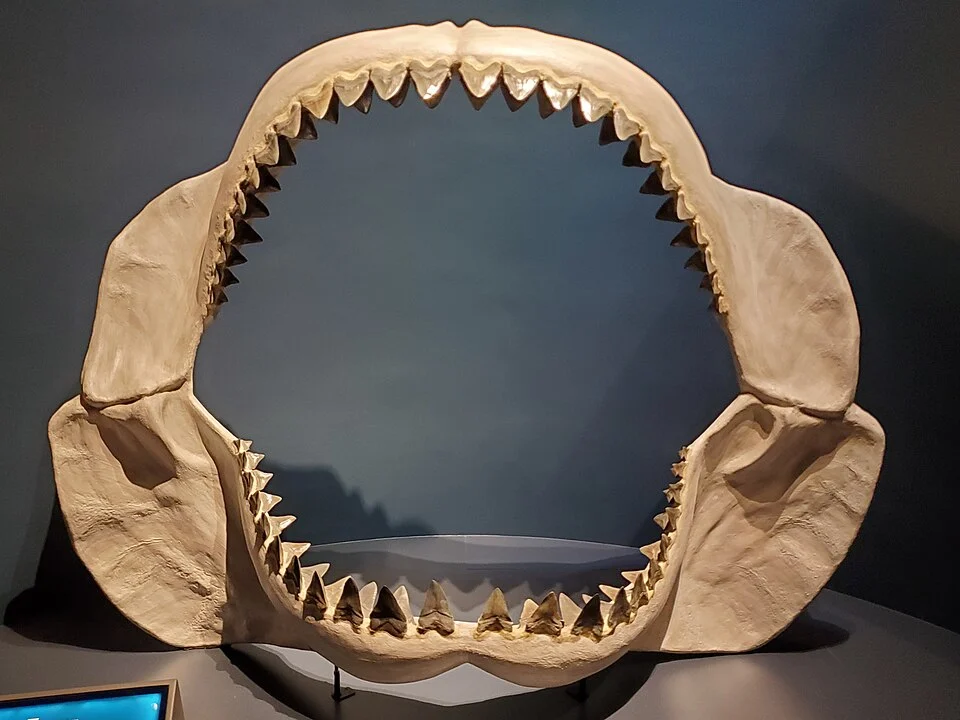
Image associated with the exact linked encyclopedia article; consult credited file description for its interpretation.
Overview
Megalodon belonged to the extinct otodontid shark lineage rather than being merely an oversized modern great white. Large teeth and occasional vertebral remains document a widespread marine predator. Bite evidence and comparisons support feeding on large marine animals, but the precise outline of the living shark is less certain than the structure of its teeth.
Reconstructing total length from isolated elements requires assumptions about proportions and comparison with other sharks. Recent work has questioned familiar stocky portrayals, illustrating that an iconic silhouette may outlast the evidence behind it. Known fossils disappear by the Pliocene, approximately 3.6 million years ago. Claims that megalodon survives in an unexplored ocean lack credible supporting evidence and conflict with the geological record and ecological expectations for such a large predator.
Jack Cooper and colleagues’ 2022 reconstruction combined Belgian vertebrae, a separate fossil tooth set and scans of living white sharks, with adjustments informed by other lamnids. Their digital model measured 15.9 metres and yielded a mass estimate of approximately 61.6 tonnes. Those numbers describe a constructed model, not a complete fossil animal measured or weighed in life. Missing vertebrae, the combination of different individuals and assumptions about soft tissues affect the result. The paper defended using multiple living analogues while acknowledging uncertainty about relationships among lamniform sharks.
Phillip Sternes and colleagues challenged that reconstruction in 2024. They compared the Belgian specimen’s roughly 11.1 metres of preserved vertebral material with a shorter total-length estimate obtained from white-shark proportions. They argued that this mismatch favoured a more elongated animal. Their critique also questioned vertebral ordering, the allocation of tail vertebrae and jaw proportions. Their alternative silhouette was explicitly schematic: the head, fins and degree of elongation remained unknown. The disagreement concerns how to reconstruct incomplete evidence, not whether the fossil shark existed.
Kenshu Shimada and colleagues developed another approach in 2025, assembling comparative measurements from 145 living and 20 extinct shark species across ten orders. They estimated missing head and tail lengths using proportions measured in other sharks, rather than treating the great white as a complete template. For the Belgian specimen, they used approximately 11 metres as a working trunk length. Median head and tail proportions from a selected lamniform comparison group produced an estimated total length of about 16.4 metres. Sharks with exceptionally extended snouts or tail fins were excluded from that particular comparison. Such choices are part of the model and must accompany the number.
The same study scaled that estimate to larger Danish vertebrae, producing a possible length of about 24.3 metres. The relevant fossil centrum was approximately 23 centimetres across, compared with 15.5 centimetres for the largest centrum in the Belgian series. Neither specimen preserved associated teeth; their assignment to megalodon relied on size, vertebral structure and the surrounding fossil record. The authors explicitly described their length estimates as hypothetical. Scaling vertebral width and head or tail proportions directly with total length assumes relationships that have not been established for megalodon throughout its growth. Consequently, 24.3 metres is a published model estimate, not a measured complete skeleton or a settled maximum size.
Origins & earliest records
Megalodon fossils span the Miocene and Pliocene, with the cited museum account placing known occurrences around 23 to 3.6 million years ago. Its lineage extends further back, but those ancestors were not the same species. Scientific classification has changed, so older names such as Carcharodon megalodon need historical context.
Evidence & interpretation
Teeth provide the dominant fossil record; vertebrae and bite marks add different information. Total size and body form are reconstructed indirectly, making exact maximum estimates dependent on the chosen model. The absence of credible recent remains supports extinction, while purported sightings or cinematic scenarios do not supply scientific evidence of survival.
Selected bibliography
Documented works and useful reading. This is not a list of every appearance.
- 01
Megalodon: The truth about the largest shark that ever lived
Selected institutional scientific reading; not a complete bibliography.
- 02
The extinct shark Otodus megalodon was a transoceanic superpredator: Inferences from 3D modeling
Anatomical Results, Body size Discussion and fossil/model-construction Methods read. Brief factual account; CC BY-NC4 is not unrestricted.
- 03
White shark comparison reveals a slender body for the extinct megatooth shark, Otodus megalodon (Lamniformes: Otodontidae)
Complete main Methods, Results/Discussion and Conclusions read; appendices not assessed. Brief factual account under restricted reuse.
- 04
Reassessment of the possible size, form, weight, cruising speed, and growth parameters of the extinct megatooth shark, Otodus megalodon (Lamniformes: Otodontidae), and new evolutionary insights into its gigantism, life history strategies, ecology, and extinction
Complete sampling and length-estimation Methods and total-length Discussion read. Summary adapted under the original publisher’s CC BY4 notice; other analyses not comprehensively assessed.
Family, evolution & connections
Taxonomic classification
A hierarchy of classified groups, not a chain of direct ancestors.
- kingdomAnimalia
- phylumChordata
- classChondrichthyes
- orderLamniformes
- familyOtodontidae
- genusOtodus
- speciesOtodus megalodon
Encyclopedia background
An additional attributed reference, separate from the editorial profile above.
Read the open encyclopedia overview
Otodus megalodon ( MEG-əl-ə-don; meaning "big tooth"), commonly known as megalodon, is an extinct species of giant mackerel shark that lived approximately 23 to 3.58 million years ago (Mya), from the Early Miocene to the Early Pliocene epochs. This prehistoric fish was once thought to be a member of the family Lamnidae and a close relative of the great white shark (Carcharodon carcharias), but has been reclassified into the extinct family Otodontidae, which diverged from the great white shark during the Early Cretaceous.
While regarded as one of the largest and most powerful predators to have ever lived, megalodon is only known from fragmentary remains, and its appearance and maximum size are uncertain. Scientists have argued whether its body form was more stocky or elongated than the modern lamniform sharks. Maximum body length estimates between 14.2 and 24.3 metres (47 and 80 ft) based on various analyses have been proposed, though the modal lengths for individuals of all ontogenetic stages from juveniles to adults are estimated at 10.5 meters (34 ft). Their teeth were thick and robust, built for grabbing prey and breaking bone, and their large jaws could exert a bite force of up to 108,500 to 182,200 newtons (24,390 to 40,960 lbf).
Megalodon probably had a major impact on the structure of marine communities. The fossil record indicates that it had a cosmopolitan distribution. It probably targeted large prey, such as whales, seals and sea turtles. Juveniles inhabited warm coastal waters and fed on fish and small whales. Unlike the great white, which attacks prey from the soft underside, megalodon probably used its strong jaws to break through the chest cavity and puncture the heart and lungs of its prey.
The animal faced competition from whale-eating cetaceans, such as Livyatan and other macroraptorial sperm whales and possibly smaller ancestral killer whales (Orcinus), although the inclusion of early Orcinus as a direct competitor is uncertain, as species such as Orcinus citoniensis were likely adapted for feeding on small fish and cephalopods rather than large marine mammals. As the shark preferred warmer waters, it is thought that oceanic cooling associated with the onset of the ice ages, coupled with the lowering of sea levels and resulting loss of suitable nursery areas, may have contributed to its decline. A reduction in the diversity of baleen whales and a shift in their distribution toward polar regions may have reduced megalodon's primary food source. The shark's extinction coincides with a gigantism trend in baleen whales.
Text from Wikipedia contributors, “Megalodon”. CC BY-SA 4.0. Extracted introduction; formatting changed. Retrieved 5 October 2026. The source article may have changed since retrieval.
References
Sources supporting this profile. Linked pages have their own scope and editorial standards.
- MuseumMegalodon: The truth about the largest shark that ever livedResearch access: 2026-10-05
- MuseumMegalodon, Otodus megalodonResearch access: 2026-10-05
- Primary researchCooper and colleagues (2022): three-dimensional reconstructionResearch access: 2026-10-05
- Primary researchSternes and colleagues (2024): reconstruction reassessmentResearch access: 2026-10-05
- Primary researchReassessment of the possible size, form, weight, cruising speed, and growth parameters of the extinct megatooth shark, Otodus megalodon (Lamniformes: Otodontidae), and new evolutionary insights into its gigantism, life history strategies, ecology, and extinctionResearch access: 2026-10-05
- LicenceCreative Commons Attribution 4.0 — 2025 studyResearch access: 2026-10-05
Image credits
Reference illustrationMegalodon
Image associated with the exact linked encyclopedia article; consult credited file description for its interpretation.