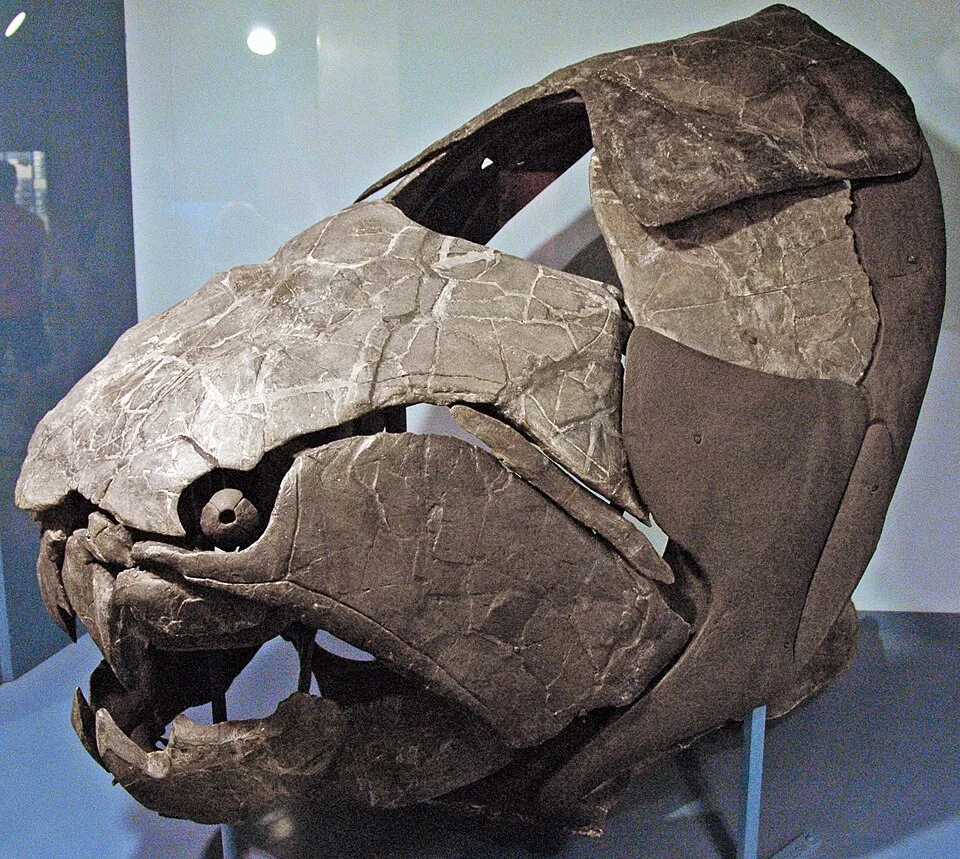
Dunkleosteus
Image associated with the exact linked encyclopedia article; consult credited file description for its interpretation.
Overview
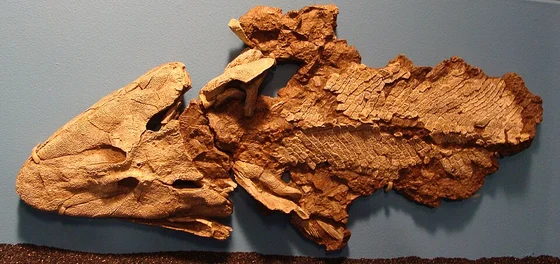
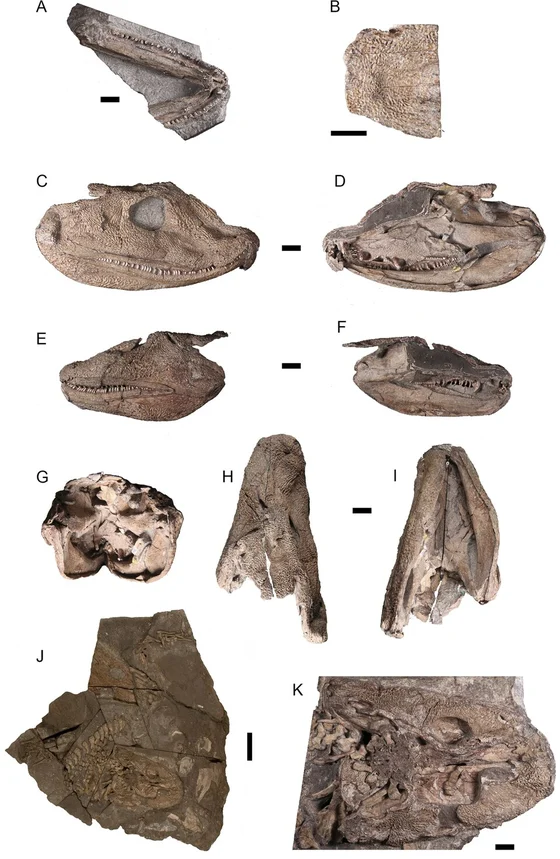
Dunkleosteus had a heavily armoured head and anterior body. Instead of rows of ordinary shark-like teeth, its jaws bore sharp cutting surfaces and fang-like projections formed from bony elements. Fossils from the Cleveland Shale of Ohio provide especially important examples, connecting the animal with ancient marine ecosystems that once occupied the region.
The preserved armour is much better known than the complete soft-bodied outline. Consequently, reconstructions of overall length and proportions have depended on comparisons and have changed as researchers test new methods. It is useful to distinguish the genus from its best-known species, Dunkleosteus terrelli. The animal's predatory role is supported by jaw anatomy, while precise performance, body dimensions and individual behaviour require additional inference.
Russell Engelman’s 2023 PeerJ study tested whether the mouth measurements of living sharks could reliably predict length in Dunkleosteus terrelli. It compared upper-jaw perimeter, mouth width and head length, using museum specimens, published measurements and more complete arthrodire relatives. This matters because a relationship that works within sharks need not transfer to a distantly related fish with a different skull. The study concerned the validity of a reconstruction method, rather than the discovery of a complete Dunkleosteus body.
A useful test was Coccosteus, an arthrodire whose body length could be checked against more complete remains. A shark-based upper-jaw equation predicted approximately 100.8 centimetres for an animal about 39.4 centimetres long. Mouth-width estimates also substantially exceeded its known length. By contrast, comparable methods worked more closely for the tested sharks. Engelman concluded that arthrodires generally had proportionally larger mouths, so transferring shark mouth-to-body relationships could exaggerate their size. Some comparisons depended on composite fossil reconstructions, scaled to comparable dimensions, because mouthparts and the remainder of the body were not always preserved together.
The study independently checked the head-to-body proportions implied by earlier Dunkleosteus estimates. Those reconstructions produced an unusually small head and extremely elongated trunk relative to the preserved armour. Many living fishes with comparably small relative heads are eel-like or have exceptionally long tails; the known armour did not supply corresponding evidence for such a body in Dunkleosteus. Head-length estimates favoured a shorter animal, although the author also noted that the short snout of arthrodires complicates that measurement. A narrow statistical interval therefore cannot compensate for using an unsuitable anatomical comparison.
Coccosteus itself was not treated as a perfect miniature Dunkleosteus. Its relatively flattened underside and inferred bottom-associated habits differ from the rounded thoracic armour of several marine arthrodires. These differences limit direct copying of the entire body outline from one genus to another. The strongest result is methodological: proposed proportions must agree with preserved anatomy and perform sensibly when tested on related fishes whose lengths are known. Precise total length, tail form and soft tissues remain reconstructed features.
Origins & earliest records
Dunkleosteus fossils occur in Late Devonian rocks, with Ohio material near the end of that period providing important specimens. The modern genus name and historical excavations concern taxonomic and museum history. A representative age near 360 million years cannot identify the exact evolutionary origin or duration of every included species.
Evidence & interpretation
Skulls and armour plates provide strong anatomical evidence for an arthrodire predator. The less complete body record makes total length more uncertain than head structure. Reconstructions and mechanical calculations use assumptions about missing anatomy, so spectacular size and bite claims should be attributed to particular studies rather than presented as direct measurements.
Selected bibliography
Documented works and useful reading. This is not a list of every appearance.
- 01
Dunkleosteus terrelli
Selected institutional scientific reading; not a complete bibliography.
- 02
Giant, swimming mouths: oral dimensions of extant sharks do not accurately predict body size in Dunkleosteus terrelli (Placodermi: Arthrodira)
Summary adapted under the article’s unrestricted CC Attribution grant. Complete main Methods, upper-jaw and head-length Results, and length-estimation Discussion read; supplementary computations not rerun.
Family, evolution & connections
Dunkleosteus in Jobbins’s 2024 majority-rule arthrodire tree
Seven-tip pruning of the newly computed Figure 4 50% majority-rule consensus: Coccosteus, both source-labeled Dunkleosteus tips, Gorgonichthys, Melanosteus, Amazichthys and Alienacanthus. Omitted taxa and branches are suppressed without creating ancestor claims.
Scroll sideways to see all branches. With a keyboard, focus the tree and use the arrow keys.
- Selected eubrachythoracid sample (Figure 4)
- Coccosteus
- Selected pachyosteomorphs
- Two source-labeled Dunkleosteus tips
- Selected selenosteids
- Gorgonichthys
- Retained three-way polytomy after omitted tips
- Melanosteus
- Amazichthys
- Alienacanthus
Morphological parsimony analysis used a 98-character starting matrix for 28 taxa plus six added taxa, eight ordered characters, PAUP heuristic search and seven equally most-parsimonious trees of 447 steps. Figure 4 reports majority-rule frequencies, not bootstrap probabilities; selected polytomy remains unresolved. The displayed 57 values are four-of-seven consensus frequencies, and Alienacanthus placement varies among the equally parsimonious trees; three instead group it with Selenosteus. This is a study-specific morphological hypothesis, not a definitive placoderm phylogeny. T/R labels remain as printed because this main-paper figure does not expand them; both links lead to the broad Dunkleosteus profile. Outgroup tips and other ingroup taxa omitted. The jaw silhouettes and geological strip below the tree are anatomical comparisons, not additional topology or direct ancestors; no dates or branch lengths reproduced.
Taxonomic classification
A hierarchy of classified groups, not a chain of direct ancestors.
- kingdomAnimalia
- phylumChordata
- familyDunkleosteidae
- genusDunkleosteus
Selected selenosteids in Jobbins et al. Figure 4
The 2024 morphology-based majority-rule tree places its two Dunkleosteus tips within a sampled branch sister to Selenosteidae. This is a branching hypothesis from seven equally parsimonious trees, not an assertion that any sampled genus directly descended from another.
Encyclopedia background
An additional attributed reference, separate from the editorial profile above.
Read the open encyclopedia overview
Dunkleosteus is an extinct genus of large arthrodire ("jointed-neck") fish that existed during the Late Devonian period, about 382–358 million years ago. It was a pelagic fish inhabiting open waters, and one of the first vertebrate apex predators of any ecosystem. Fossils of Dunkleosteus have been found in the United States, Canada, Poland, Belgium, Morocco, and Russia.
Dunkleosteus consists of ten species, some of which are among the largest placoderms ("plate-skinned") to have ever lived: D. terrelli, D. belgicus, D. denisoni, D. marsaisi, D. magnificus, D. missouriensis, D. newberryi, D. amblyodoratus, D. raveri, and D. tuderensis. However, the validity of several of these species is unclear. The largest and best known species is D. terrelli, the type species.
Since body shape is not known, various methods of estimation put the living total length of the largest known specimen of D. terrelli between 4.1 to 10 m (13 to 33 ft) long and its weight around 1–4 t (1.1–4.4 short tons). However, current evidence suggests length of less than 5 metres (16 ft) was more likely, with the most recent and extensive studies on the body shape and size of D. terrelli producing estimated lengths of approximately 3.4 metres (11 ft) for typical adults and 4.1 metres (13 ft) for exceptionally large individuals of this species. It has been suggested that Dunkleosteus could quickly open and close its jaw, possibly creating suction like modern-day suction feeders, and had an extremely high bite force, but both claims have recently been questioned.
Text from Wikipedia contributors, “Dunkleosteus”. CC BY-SA 4.0. Extracted introduction; formatting changed. Retrieved 5 October 2026. The source article may have changed since retrieval.
References
Sources supporting this profile. Linked pages have their own scope and editorial standards.
- MuseumDunkleosteus terrelliResearch access: 2026-10-05
- ResearchGiant, swimming mouths: oral dimensions of extant sharks do not accurately predict body size in Dunkleosteus terrelli (Placodermi: Arthrodira)Research access: 2026-10-05
Image credits
Reference illustrationDunkleosteus
Image associated with the exact linked encyclopedia article; consult credited file description for its interpretation.