Eurypterids
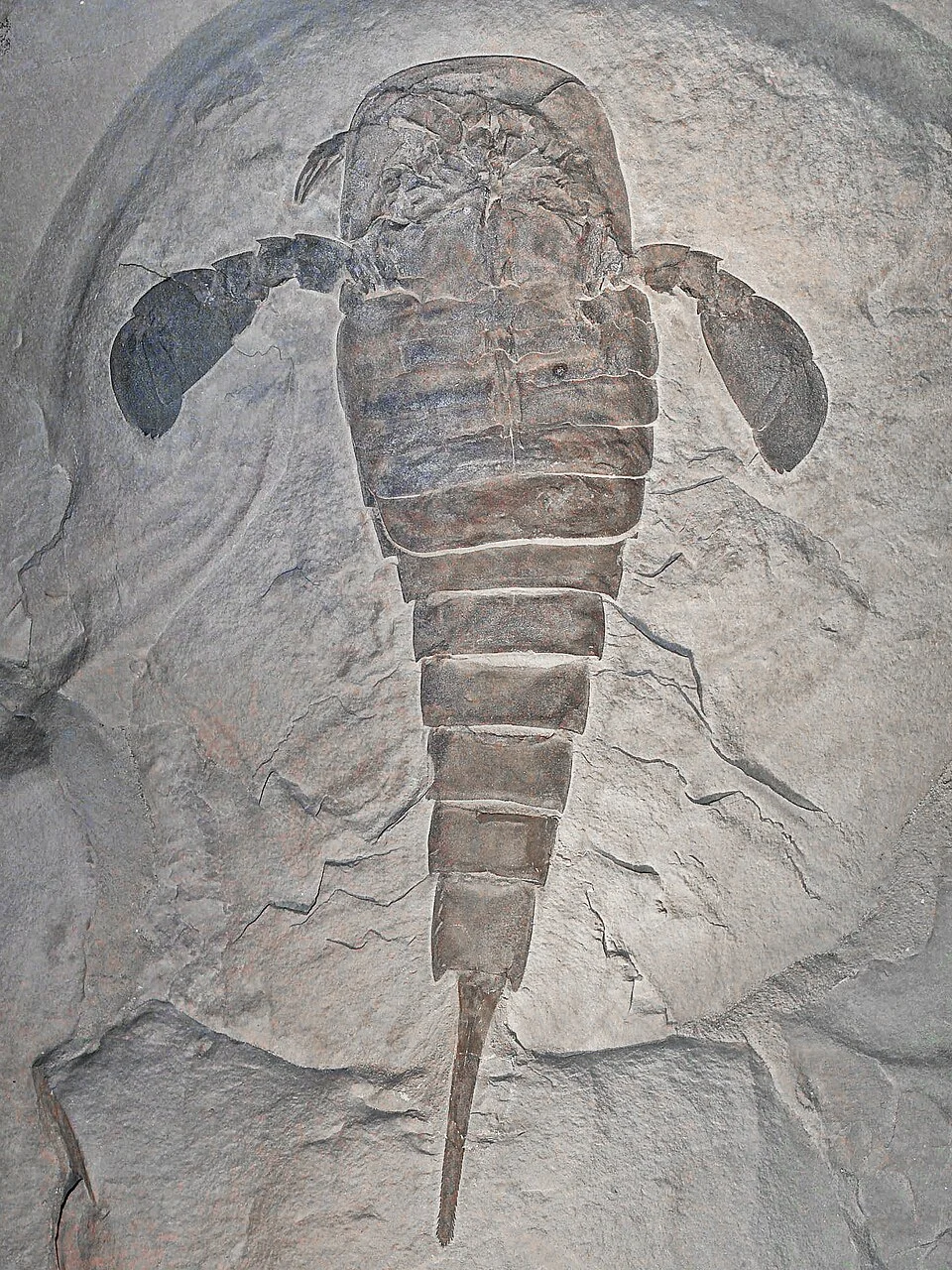
Image associated with the exact linked encyclopedia article; consult credited file description for its interpretation.
Overview
Eurypterids belong to the chelicerate branch of arthropods, alongside the ancestry of horseshoe crabs and arachnids. Their segmented bodies and paired appendages developed into diverse forms, including swimming paddles and formidable grasping structures. The common name sea scorpion is convenient, but it should not imply that every species lived in open seas or behaved like a modern scorpion.
Some pterygotid eurypterids grew exceptionally large and possessed structures suited to capturing prey. Other members were smaller and occupied different settings. Their fossils provide evidence for changing Paleozoic aquatic ecosystems, while anatomical comparisons test relationships within Chelicerata. The entire order eventually disappeared by the end of the Permian. A broad overview necessarily leaves many individual species and habitat differences outside its scope.
Exceptionally preserved eyes provide a detailed example of evidence within this diverse group. Schoenemann, Poschmann and Clarkson’s 2019 study examined material assigned to Jaekelopterus rhenaniae from the Jaeger Quarry near Frielingshausen in Germany. The material is held at the Geological Institute of the University of Cologne; illustrated specimens include GIK 186, 188 and 190. Their Lower Devonian age comes from the enclosing stratigraphic interval, described as Siegenian and possibly lowermost Emsian in the international framework. The approximately 400-million-year description is geological context, not a direct date of each preserved eye.
The researchers identified tapering cuticular structures beneath the visual surface, interpreted as lens cylinders or exocones. These resemble the optical structures of living horseshoe crabs more closely than the crystalline-cone arrangement in many crustacean eyes. They also described repeated rosette-like patterns beneath the lenses, with a dark central ring surrounding a brighter centre. These patterns were interpreted as remnants of sensory units, potentially including the central process of an eccentric cell comparable to that of horseshoe crabs. Fine individual microvilli were not preserved, making the cellular identities interpretations of fossil traces rather than complete observed nervous tissue.
In living horseshoe crabs, eccentric cells contribute to processing that enhances edges and contrasts. A similar function in Jaekelopterus is therefore plausible if the proposed structural identification is correct, but no electrical activity can be measured in the fossils. The study used optical microscopy, image stacking and scanning electron microscopy; it explicitly notes the lack of suitable material for further tomographic confirmation. Similarity may illuminate the early history of chelicerate vision, while relationships among eurypterids, arachnids and horseshoe crabs remain broader phylogenetic questions. Preserved moults usually cannot reveal internal sensory anatomy, and covered or poorly preserved eye surfaces further restrict sampling. This specific visual interpretation should not be extended automatically to every eurypterid species or used to make all members identical predators.
Origins & earliest records
Eurypterids have a Paleozoic fossil history and are particularly well represented in Silurian rocks. The timeline marker near 430 million years is a representative interval, not a claimed earliest origin. Scientific collections assembled from multiple regions document a group that survived for more than 200 million years before extinction.
Evidence & interpretation
Exoskeletons and preserved appendages establish body organisation and species differences. Comparisons of claws, eyes and paddles suggest predation and swimming in particular lineages. Fossil settings help reconstruct habitat, but transported remains and uneven preservation complicate interpretation. Maximum size estimates apply to selected species, not uniformly to the order.
Selected bibliography
Documented works and useful reading. This is not a list of every appearance.
- 01
Eurypterids, Giant Ancient Sea Scorpions
Selected institutional scientific reading; not a complete bibliography.
- 02
Insights into the 400 million-year-old eyes of giant sea scorpions (Eurypterida) suggest the structure of Palaeozoic compound eyes
Scientific Reports 9: 17797, 28 November. Complete Introduction/systematic-position discussion, Results, Discussion and Material and Methods; comparative-eye chapter partly read. CC BY 4.0.
Family, evolution & connections
Five sampled megalograptids in Lamsdell et al. (2015)
The Megalograptidae subtree of Figure 21, not a complete eurypterid or chelicerate tree.
Scroll sideways to see all branches. With a keyboard, focus the tree and use the arrow keys.
- Sampled Megalograptidae (bootstrap 74 / Bremer 3 / jackknife 88)
- Pentecopterus decorahensis
- Remaining sampled family (bootstrap 71 / Bremer 2 / jackknife 81)
- Echinognathus clevelandi
- Sampled Megalograptus (bootstrap 59 / Bremer 1 / jackknife 61)
- Megalograptus williamsae
- Terminal pair (bootstrap 42 / Bremer 1 / jackknife 44)
- Megalograptus ohioensis
- Megalograptus welchi
Pruning of the single most-parsimonious morphological tree; analysis length 475 steps, consistency index 0.429 and retention index 0.796. The family node shows bootstrap 74, Bremer 3 and jackknife 88; internal bootstrap values are 71,59 and 42 toward the terminal pair. These are study-specific hypotheses with weaker internal support, not a chronological ancestor chain. Arachnids were excluded; this figure cannot establish their sister relationship to eurypterids.
Taxonomic classification
A hierarchy of classified groups, not a chain of direct ancestors.
- kingdomAnimalia
- phylumArthropoda
- orderEurypterida
Encyclopedia background
An additional attributed reference, separate from the editorial profile above.
Read the open encyclopedia overview
Eurypterids, often informally called sea scorpions, are a group of extinct marine arthropods that form the order Eurypterida. The earliest known eurypterids date to the Tremadocian stage of the Ordovician period, 480 million years ago. The group is likely to have appeared first during the Late Cambrian period. With approximately 250 species, the Eurypterida is the most diverse Paleozoic chelicerate order. Following their appearance during the Ordovician, eurypterids became major components of marine faunas during the Silurian, from which the majority of eurypterid species have been described. The Silurian genus Eurypterus accounts for more than 90% of all known eurypterid specimens. Though the group continued to diversify during the subsequent Devonian period, the eurypterids were heavily affected by the Late Devonian extinction event. They declined in numbers and diversity during the Permian period, though their time of extinction remains contentious, argued to be either the early Middle Permian, or the Permian–Triassic extinction event 251.9 million years ago.
Although popularly called "sea scorpions", only the earliest eurypterids were marine; many later forms lived in brackish or fresh water, and they were not true scorpions. Some studies suggest that a dual respiratory system was present, which would have allowed for short periods of time in terrestrial environments. The name Eurypterida comes from Ancient Greek εὐρύς (eurús), meaning "wide, broad", and πτερόν (pterón), meaning "wing", referring to the pair of wide swimming appendages present in many members of the group.
The eurypterid order includes the largest known arthropods ever to have lived. The largest, Jaekelopterus, reached 2.5 meters (8.2 ft) in length. Eurypterids were not uniformly large and most species were less than 20 centimeters (8 in) long; the smallest eurypterid, Alkenopterus, was only 2.03 centimeters (0.80 in) long. Eurypterid fossils have been recovered from every continent. A majority of fossils are from fossil sites in North America and Europe because the group lived primarily in the waters around and within the ancient supercontinent of Laurasia. Only a handful of eurypterid groups spread beyond the confines of Euramerica and a few genera, such as Adelophthalmus and Pterygotus, achieved a cosmopolitan distribution with fossils being found worldwide.
Text from Wikipedia contributors, “Eurypterid”. CC BY-SA 4.0. Extracted introduction; formatting changed. Retrieved 5 October 2026. The source article may have changed since retrieval.
References
Sources supporting this profile. Linked pages have their own scope and editorial standards.
- MuseumEurypterids, Giant Ancient Sea ScorpionsResearch access: 2026-10-05
- ResearchInsights into the 400 million-year-old eyes of giant sea scorpions (Eurypterida) suggest the structure of Palaeozoic compound eyesResearch access: 2026-10-05
Image credits
Reference illustrationEurypterids
Image associated with the exact linked encyclopedia article; consult credited file description for its interpretation.