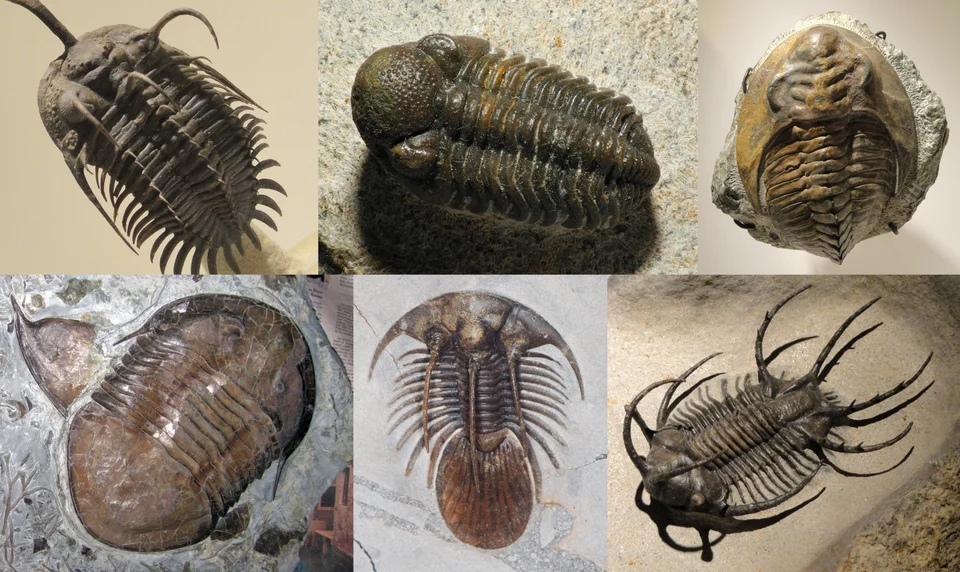
Trilobites
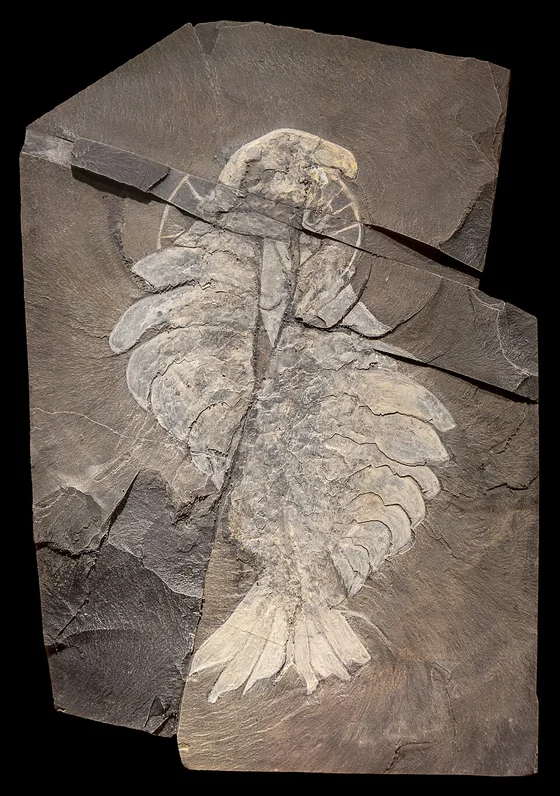
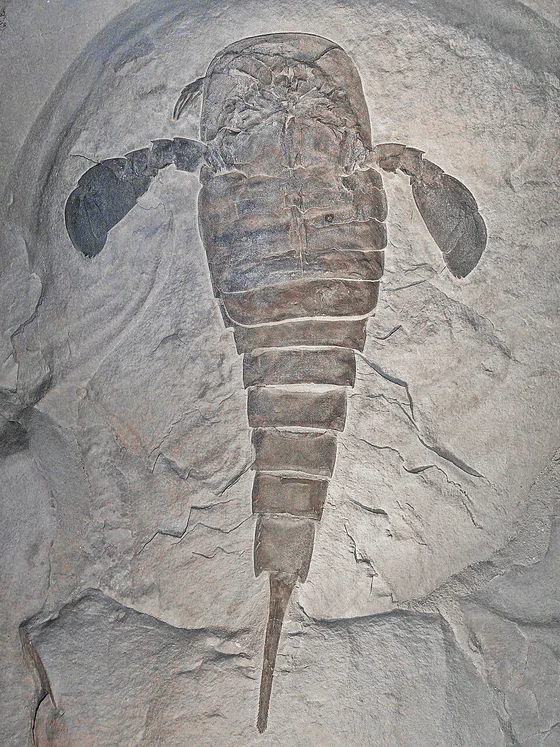
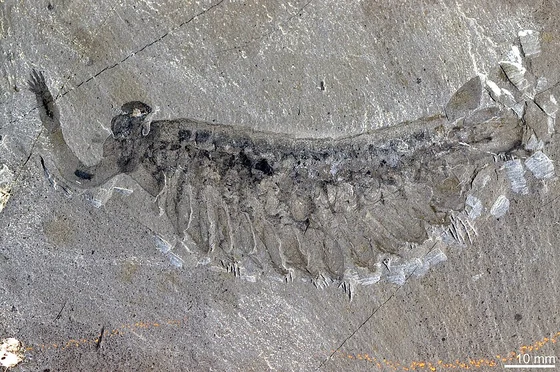
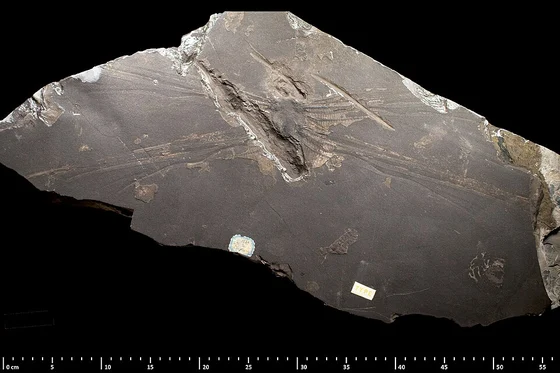
Image associated with the exact linked encyclopedia article; consult credited file description for its interpretation.
Overview
Trilobites occupied marine environments through much of the Paleozoic. Their bodies were divided into a head, articulated trunk and tail region, with three longitudinal lobes giving the group its name. Many species had compound eyes whose lenses incorporated calcite. The familiar fossil shell represents only part of the animal; limbs and other soft structures usually require exceptional preservation.
Thousands of species document changing shapes, habitats and communities across a long history. Because exoskeletons were shed during growth, some fossil accumulations contain moults rather than whole dead animals. Trilobites are useful for comparing rock ages and investigating evolution, but they were never one uniform ecological type. The final members disappeared at the end-Permian extinction, leaving no living trilobite species.
A source-specific example shows how discarded shells can inform behavioural hypotheses. Zong, Fan and Gong described the specimen HB2013-01 from the Upper Devonian Hongguleleng Formation of Xinjiang, China. An incomplete nautiloid shell contains Omegops cornelius remains: seven head shields, seven thoraces and four tail shields, including some intact eleven-segment thoraces. The nautiloid itself could not be identified to genus. The fossils came from storm-influenced limestone, so transport was an important competing explanation rather than something that could simply be assumed absent.
The authors compared the shell contents with fossils outside it. Surrounding limestone contains mixed fragments and other marine animals, whereas the chamber contains only Omegops, with relatively intact thoraces and differently oriented pieces. One head shield is separated and rotated beside an associated thorax and tail shield, matching a recognised phacopid moulting configuration. The study interprets the remains as discarded exoskeletons produced inside an empty shell rather than consumed prey or a random mixture washed into it. This inference depends on preservation and arrangement; the living animals were not observed.
The researchers proposed that several similarly sized trilobites used the chamber successively as a refuge while moulting. Similar dimensions favour multiple individuals over a single animal growing through seven successive moults. Limited space makes simultaneous moulting unlikely, but neither the interval between visits nor deliberate cooperation can be measured from the specimen. Suggestions that later visitors moved old shells aside or followed a safety cue remain reconstructions. The paper discusses predation, storms and competition as possible pressures encouraging shelter use, not established motives for each individual. Its approximately 365-million-year framing refers to Late Devonian geological context; collection from the conodont-correlated P. marginifera Zone provides stratigraphic evidence rather than a radiometric date for the shells. This local example does not establish one universal moulting strategy for the entire class.
Origins & earliest records
The first known trilobite body fossils appear around 520 million years ago in Cambrian rocks. Their ancestry must predate those occurrences, although the duration and character of that earlier history remain debated. Their eventual extinction at the end of the Permian ended a lineage lasting more than 250 million years.
Evidence & interpretation
Mineralised shells provide abundant taxonomic evidence, while rare fossils reveal limbs, guts and other soft structures. Growth stages and moults can be studied across populations. Fossil appearances vary with preservation and sampling, so the first known shell is a record boundary rather than a direct observation of the group's evolutionary beginning.
Selected bibliography
Documented works and useful reading. This is not a list of every appearance.
- 01
How trilobites conquered prehistoric oceans
Selected institutional scientific reading; not a complete bibliography.
- 02
Seven 365-Million-Year-Old Trilobites Moulting within a Nautiloid Conch
Scientific Reports 6: 34914, 5 October. Complete main Results, Discussion, conclusions, Geological setting and method, and textual captions; CC BY 4.0.
Family, evolution & connections
Six sampled trilobites — Du et al. 2024
Complete six-tip trilobite subtree in Figure 10 supplement 3a; other sampled arthropods omitted.
Scroll sideways to see all branches. With a keyboard, focus the tree and use the arrow keys.
- Eoredlichia / Olenellus pair
- Eoredlichia intermedia
- Olenellus getzi
- Remaining sampled trilobites
- Anacheirurus adserai
- Three sampled tips
- Olenoides serratus
- Cryptolithus / Triarthrus pair
- Cryptolithus tesselatus
- Triarthrus eatoni
MrBayes, 70 taxa and 100 morphological characters; 20 million generations, four chains, 25% burn-in. This unconstrained analysis treats Acanthomeridion ventral plates as non-homologous to trilobite cephalic features. This is one coding scenario. Constraining five trilobites changes Olenellus placement; other scenarios also differ. Both initial daughter clades have posterior probability 0.625. No dates, direct ancestors or universal trilobite classification are inferred.
Taxonomic classification
A hierarchy of classified groups, not a chain of direct ancestors.
- kingdomAnimalia
- phylumArthropoda
- classTrilobita
Olenellus getzi
Du et al.’s unconstrained non-homology scenario pairs Olenellus with Eoredlichia. Their constrained analyses instead place Olenellus outside the other sampled trilobites. Neither depiction identifies it as their direct ancestor.
Encyclopedia background
An additional attributed reference, separate from the editorial profile above.
Read the open encyclopedia overview
Trilobites (; meaning "three-lobed entities") are extinct marine arthropods that form the class Trilobita. One of the earliest groups of arthropods to appear in the fossil record, trilobites were among the most successful of all early animals, existing in oceans for almost 270 million years, with over 22,000 species having been described.
Because trilobites had wide diversity and an easily fossilized mineralised exoskeleton made of calcite, they left an extensive fossil record. The study of their fossils has facilitated important contributions to biostratigraphy, paleontology, evolutionary biology, and plate tectonics. Trilobites are placed within the clade Artiopoda, which includes many organisms that are morphologically similar to trilobites, but are largely unmineralised. The relationship of Artiopoda to other arthropods is uncertain.
Trilobites evolved into many ecological niches; some moved over the seabed as predators, scavengers, or filter feeders, and some swam, feeding on plankton. Some even crawled onto land. Most lifestyles expected of modern marine arthropods are seen in trilobites, with the possible exception of parasitism (where scientific debate continues). Some trilobites (particularly the family Olenidae) are even thought to have evolved a symbiotic relationship with sulfur-eating bacteria from which they derived food. The largest trilobites were more than 70 centimetres (28 in) long and may have weighed as much as 4.5 kilograms (9.9 lb).
The first appearance of trilobites in the fossil record defines the base of the Atdabanian/Cambrian Stage 3 time period of the Early Cambrian around 521 million years ago. Trilobites were already diverse and globally dispersed shortly after their origination, with trilobites reaching an apex of diversity during the late Cambrian–Ordovician, and remained diverse during the following Silurian and early Devonian. During the mid-late Devonian, their diversity strongly declined, being impacted by successive extinction events, including the Taghanic event, the Late Devonian mass extinction/Kellwasser event and the Hangenberg/end-Devonian mass extinction, wiping out most trilobite diversity and leaving Proetida as the only surviving order. Their diversity moderately recovered during the Early Carboniferous, before dropping to persistently low levels during the late Carboniferous and Permian periods, though they remained widespread until the end of their existence. The last trilobites disappeared in the end-Permian mass extinction event about 251.9 million years ago, by which time only a handful of species remained.
Text from Wikipedia contributors, “Trilobite”. CC BY-SA 4.0. Extracted introduction; formatting changed. Retrieved 5 October 2026. The source article may have changed since retrieval.
References
Sources supporting this profile. Linked pages have their own scope and editorial standards.
- MuseumHow trilobites conquered prehistoric oceansResearch access: 2026-10-05
- ResearchSeven 365-Million-Year-Old Trilobites Moulting within a Nautiloid ConchResearch access: 2026-10-05
Image credits
Reference illustrationTrilobites
Image associated with the exact linked encyclopedia article; consult credited file description for its interpretation.