Meganeura
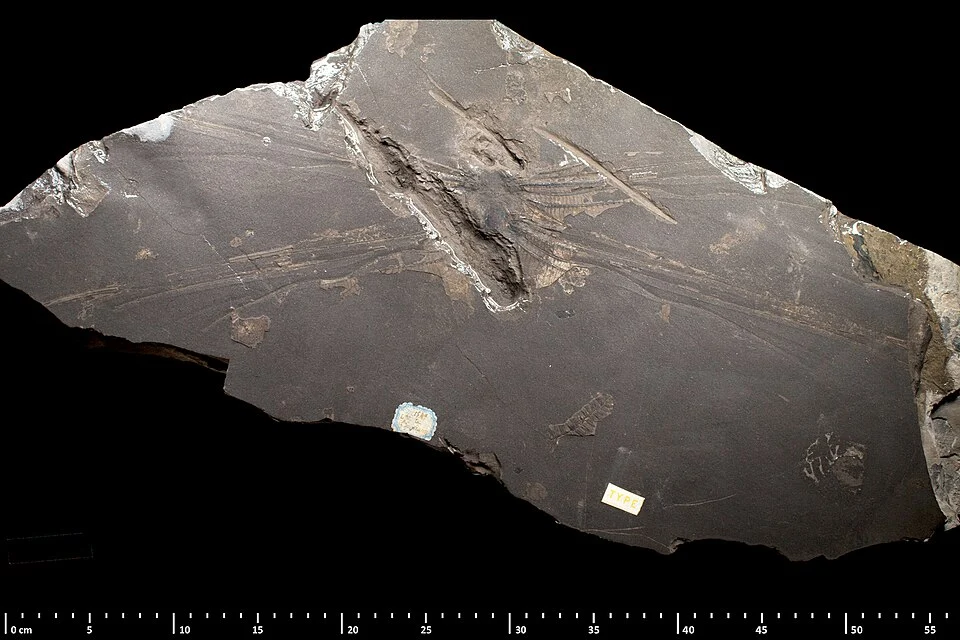
Image associated with the exact linked encyclopedia article; consult credited file description for its interpretation.
Overview
Meganeura is famous for wings that dwarf those of most living insects. The best-known material from Commentry in France preserves a spectacular example of late Carboniferous insect diversity. Its dragonfly-like appearance supports a familiar comparison, but the genus belongs to an extinct griffinfly lineage rather than to the modern dragonflies themselves.
Large size has prompted hypotheses about atmospheric oxygen and the absence of competing airborne vertebrate predators. These factors can be investigated through comparative physiology and the history of ecosystems, yet they should not become a single certain explanation for every giant insect. The fossils primarily record wing structure and body anatomy. Reconstructions of flight, hunting and sensory performance require further inference from those remains and comparisons with living relatives.
Jon Harrison and colleagues’ 2010 review explained a possible physiological link between oxygen and insect size. Living insects deliver oxygen through branching air tubes. The reviewed evidence included smaller growth under low oxygen and, in some species, increased size under elevated oxygen. Larger insects can also devote proportionally more space to that respiratory system. These observations make an oxygen effect plausible, but the authors stressed that sparse fossils and ecological alternatives prevented a definitive historical explanation. Laboratory responses in living species do not directly measure Meganeura physiology.
Matthew Clapham and Jered Karr examined more than 10,500 fossil insect wing lengths in a 2012 study. Their abstract reports a relationship between maximum size and atmospheric oxygen early in insect history, followed by a separation of those trends during the rise of birds. They proposed that predation or competition increasingly constrained large flying insects. This was a comparison across geological time and many insect groups, not direct evidence of a particular bird attacking Meganeura. It also cautions against explaining all changes in insect size through oxygen alone.
A. E. R. Cannell’s 2018 engineering analysis considered another constraint: heat generated during flight. Its abstract reports calculations involving lift, muscle power, cooling and air supply in giant griffinflies, using comparisons with living dragonflies. Denser air was proposed as a way to reconcile flight with heat removal. Those atmospheric and performance estimates depend on the assumed animal and model; they are not measurements from fossilized airways. The paper concerns giant Permian insects broadly, so its numerical estimates should not be assigned automatically to the Carboniferous species Meganeura monyi.
Origins & earliest records
Meganeura fossils from the Commentry coal basin date to the late Carboniferous, approximately 300 million years ago. Nineteenth-century collecting and description brought them into scientific study. Those historical events do not date the lineage's emergence, and a famous specimen's wingspan should not be treated as the size of every included species.
Evidence & interpretation
Wing impressions and other fossil structures establish an unusually large insect and permit comparison of venation. Fossil context constrains geological age. Higher oxygen and ecological opportunity are plausible explanations for gigantism, but the remains do not measure flight performance directly or isolate one universal cause of large size.
Selected bibliography
Documented works and useful reading. This is not a list of every appearance.
- 01
Meganeura monyi, libellule géante
Selected institutional scientific reading; not a complete bibliography.
- 02
Atmospheric oxygen level and the evolution of insect body size
Complete abstract, geological evidence, alternative explanations and Conclusions read; remaining physiological review sections not comprehensively assessed.
- 03
Environmental and biotic controls on the evolutionary history of insect body size
Complete public abstract and bibliographic record read; full article and dataset not read.
- 04
The engineering of the giant dragonflies of the Permian: revised body mass, power, air supply, thermoregulation and the role of air density
Complete public abstract and bibliographic record read; full engineering model not assessed.
Family, evolution & connections
Odonatopteran groups — Bechly 2001 hypothesis
The four group-level terminals of Figure 15.
Scroll sideways to see all branches. With a keyboard, focus the tree and use the arrow keys.
- Odonatoptera
- Geroptera / Eugeropteridae
- Neodonatoptera
- “Eomeganisoptera” / “Erasipteridae”
- Euodonatoptera
- Odonatoclada, including Odonata sensu stricto
Morphological synapomorphies interpreted through Hennigian systematics; Appendix supplies the character arguments. A historical group hypothesis, not a species-level Meganeura tree. GBIF supplies only Meganeura’s group membership, not topology. Geroptera monophyly is explicitly weak; “Eomeganisoptera” may be paraphyletic. Figure numbers 1–7 identify character groups, not support values. No dates, direct ancestors or statistical support are inferred. Mating-behaviour scenarios are separate hypotheses.
Taxonomic classification
A hierarchy of classified groups, not a chain of direct ancestors.
- kingdomAnimalia
- phylumArthropoda
- classInsecta
- orderMeganisoptera
- familyMeganeuridae
- genusMeganeura
Odonatoclada in Bechly’s 2001 group hypothesis
Figure 15 places Meganisoptera beside Odonatoclada within Euodonatoptera. This group-level morphological hypothesis does not make Meganeura a direct ancestor of living dragonflies. The appendix explicitly questions other groups’ monophyly.
Encyclopedia background
An additional attributed reference, separate from the editorial profile above.
Read the open encyclopedia overview
Meganeura (Ancient Greek: μέγα (large) + νευρόν (vein or nerve)) is a genus of extinct insects from the Late Carboniferous (about 300 million years ago). It is a member of the extinct order Meganisoptera (also known as griffenflies), which resemble dragonflies and damselflies (with dragonflies, damselflies, and meganisopterans being part of the broader group Odonatoptera). While various species of Meganeura have been named, only one is now considered valid, the type species, M. monyi.
Fossils of Meganeura were first discovered in Late Carboniferous (Stephanian) Coal Measures of Commentry, France, in 1880. In 1884, French paleontologist Charles Brongniart described the type specimen and assigned it to the genus Dictyoneura. The following year, he assigned it to a genus of its own, Meganeura, a name which refers to the network of veins on the insect's wings. Several specimens have been discovered since, though all are poorly preserved and some have been reassigned to other genera. All valid specimens of Meganeura are housed in the National Museum of Natural History in Paris. The genus belongs to the Meganeuridae, a family including other similarly giant dragonfly-like insects ranging from the Late Carboniferous to Middle Permian. Despite being the iconic "giant dragonfly", fossils of Meganeura are poorly preserved in comparison to most of its relatives.
With single wing length reaching 32 centimetres (13 in), a wingspan around 65–75 cm (2.13–2.46 ft), and mass estimates ranging from 17.8 g (0.039 lb) to 100–150 g (0.22–0.33 lb) M. monyi is one of the largest known flying insect species and is considerably larger than the biggest modern dragonfly, Petalura ingentissima. Based on other meganeurids, it would have had large compound eyes, which met along the midline, similar to some modern dragonflies. It was equipped with large spines on its tarsi (the end segments of its limbs), like those of modern odonatopterans, which would have been used for prey capture. Like other odonatopterans, meganeurids such as Meganeura were predatory, with their diet mainly consisting of other insects. Their size and wing anatomy means that they were not capable of the same kinds of abrupt direction changes as modern dragonflies, and they may have spent much of their time perching to properly oxygenate their tissues, as insects’ largely passive respiratory system diffuses oxygen to their tissues with difficulty at large body sizes.
Much debate exists regarding how Meganeura attained such a large body size, with hypotheses ranging from a correlation with the high oxygen content of the Late Carboniferous (though this is contradicted by the presence of giant meganisopterans in the Late Permian, after oxygen levels had dropped) to the absence of other big aerial predators. The extinction of meganisopterans as a whole and the absence of similarly large flying insects may correlate with the evolution of flying tetrapods such as pterosaurs.
Text from Wikipedia contributors, “Meganeura”. CC BY-SA 4.0. Extracted introduction; formatting changed. Retrieved 5 October 2026. The source article may have changed since retrieval.
References
Sources supporting this profile. Linked pages have their own scope and editorial standards.
- MuseumMeganeura monyi, libellule géanteResearch access: 2026-10-05
- ResearchHarrison and colleagues (2010)Research access: 2026-10-05
- ResearchClapham and Karr (2012)Research access: 2026-10-05
- ResearchCannell (2018)Research access: 2026-10-05
Image credits
Reference illustrationMeganeura
Image associated with the exact linked encyclopedia article; consult credited file description for its interpretation.