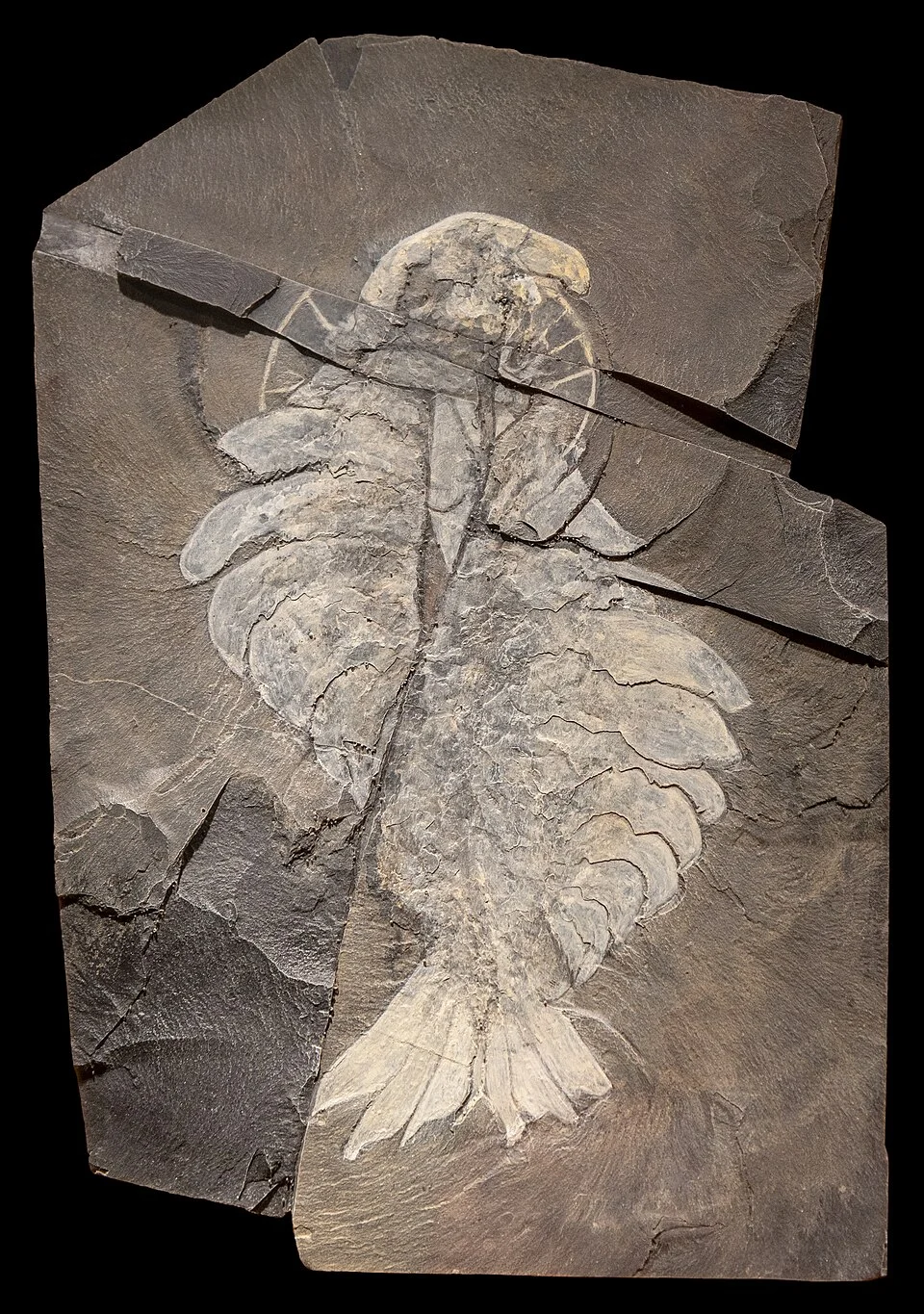
Anomalocaris
Image associated with the exact linked encyclopedia article; consult credited file description for its interpretation.
Overview
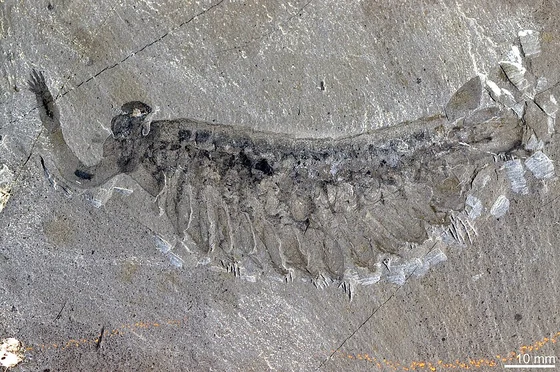
Anomalocaris combines a pair of jointed frontal appendages, a tooth-lined mouth and a body bordered by swimming flaps. Its anatomy places it among radiodonts, an extinct branch important for understanding early arthropod evolution. The Burgess Shale species Anomalocaris canadensis is the central example here; the genus should not stand for every superficially similar Cambrian predator.
The reconstruction has a notable history because isolated appendages and mouth parts were initially described as different organisms. Whole-body material revealed how these pieces fitted together. Large eyes and grasping structures support an active feeding role, but specific prey preferences and the mechanics of capturing food remain research questions. Its importance lies as much in that changing anatomical interpretation as in its reputation as a spectacular Cambrian hunter.
A 2023 study by Russell Bicknell and colleagues tested the frontal appendages of A. canadensis using models of joint movement, mechanical strain and water flow. The reconstruction combined several museum specimens preserved at different angles. Because the Burgess Shale fossils are flattened and provide insufficient density contrast for a complete micro-CT reconstruction, the researchers inferred the original three-dimensional proportions from the available anatomy. Whip spiders and whip scorpions supplied comparisons for grasping motion. These living analogues helped test function; they were not presented as descendants of Anomalocaris or as exact replicas of its anatomy.
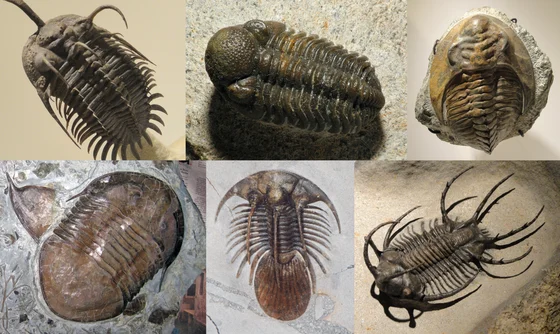
The appendage models could curl effectively, but their opposing spine tips did not completely close around a space. Mechanical simulations concentrated strain along the slender inward-projecting spines, supporting the interpretation that these structures handled soft prey more readily than they crushed mineralized shells. The authors consequently challenged the familiar attribution of trilobite injuries to A. canadensis. The conclusion concerns this species and these feeding structures: other radiodonts possessed different equipment and may have exploited different food sources. Damaged trilobites alone do not identify the animal responsible for an attack.
Water-flow simulations compared outstretched, intermediate and curled appendages. The outstretched position generated less drag at all three simulated inlet velocities, consistent with efficient pursuit in open water. Those velocities were modelling conditions, not measurements of a living animal’s speed. The analysis also excluded the contribution of the complete body to drag. Muscles and cuticle properties required assumptions based on living arthropods, so the authors interpreted relative strain patterns rather than treating absolute strain values as direct fossil measurements. Together, the results support an active hunter of mobile soft-bodied prey while keeping the model’s limits visible.
Origins & earliest records
The frontal appendage of Anomalocaris canadensis was described in 1892 before the complete animal was understood. Burgess Shale specimens represent Cambrian marine ecosystems approximately 505 million years old. The description date and fossil locality do not establish the genus' evolutionary origin or the geographic extent of every assigned species.
Evidence & interpretation
Exceptional fossils preserve appendages, mouths, eyes and swimming flaps, allowing parts once classified separately to be combined. Comparative anatomy and functional studies inform locomotion and feeding. Some species formerly assigned to Anomalocaris have been reassigned, so older reconstructions and general statements about its size or diet need taxonomic qualification.
Selected bibliography
Documented works and useful reading. This is not a list of every appearance.
- 01
Anomalocaris canadensis
Selected institutional scientific reading; not a complete bibliography.
- 02
Raptorial appendages of the Cambrian apex predator Anomalocaris canadensis are built for soft prey and speed
Complete main article and Methods read; actual Figure4 and source pages3,6,7 inspected. Supplementary simulations not independently rerun. Summary adapted under CC BY4.
Family, evolution & connections
Opabiniids in the 2022 Bayesian morphological tree
Figure 4a selected subtree; Hurdiidae and Deuteropoda collapsed, Amplectobeluidae and more distant branches pruned.
Scroll sideways to see all branches. With a keyboard, focus the tree and use the arrow keys.
- Selected stem-euarthropod branches (Figure 4a)
- Pambdelurion whittingtoni
- Opabiniids and remaining selected groups
- Opabiniidae (posterior support 0.68 / 0.69)
- Utaurora comosa
- Selected radiodonts and deuteropods
- Hurdiidae (collapsed)
- Selected anomalocaridids and deuteropods
- Selected Anomalocarididae
- Houcaris saron
- Deuteropoda (collapsed)
Bayesian consensus using the minimize-assumptions character treatment; key opabiniid support is 0.68, versus 0.69 under maximize-information treatment. Utaurora is known from one specimen with tentative proboscis evidence. Coding the proboscis uncertain reduces Bayesian support and collapses opabiniid monophyly in parsimony. Treespace contains alternative placements. Selected radiodont branching is this analysis, not a settled universal tree; fossils are not direct ancestors and no dates are shown.
Taxonomic classification
A hierarchy of classified groups, not a chain of direct ancestors.
- kingdomAnimalia
- phylumArthropoda
- familyAnomalocarididae
- genusAnomalocaris
Houcaris saron (Pates 2022 Figure 4a)
The selected Bayesian figure pairs Anomalocaris canadensis with Houcaris saron. This is a source-specific morphological topology, with other branches pruned in the local diagram.
Located primary passages
Specific passages supporting details in this entry, grouped by their published witness.
Primary source witness
Proceedings of the Royal Society B290:20230638; DOI10.1098/rspb.2023.0638
- Computational reconstructions support rapid swimming and capture of soft prey by Anomalocaris canadensis. Appendage strains make crushing mineralized prey unlikely, while an extended posture reduces modelled drag. These are biomechanical inferences with assumed muscles and cuticle properties; absolute strain values and whole-body drag are not established. Other radiodonts may have fed differently.
Sections2(d–e),3–5; methods assumptions and complete results/discussion/conclusion
Reading scope is limited to the identified sections. No uninspected primary sources, supplementary analysis or complete corpus claimed. No quotation added.
Encyclopedia background
An additional attributed reference, separate from the editorial profile above.
Read the open encyclopedia overview
Anomalocaris (from Ancient Greek ανώμαλος, meaning "anomalous", and καρίς, meaning "shrimp", with the intended meaning "unlike other shrimp") is an extinct genus of radiodont, an order of early-diverging stem-group marine arthropods. It is best known from the type species A. canadensis, found in the Stephen Formation (particularly the Burgess Shale) of British Columbia, Canada. The other named species A. daleyae is known from the somewhat older Emu Bay Shale of Australia. Other unnamed Anomalocaris species are known from China and the United States.
Like other radiodonts, Anomalocaris had swimming flaps running along its body, large compound eyes densely packed with lenses, and a single pair of segmented, frontal appendages, which in Anomalocaris were used to grasp prey. Estimated to reach 34.2–37.8 cm (13.5–14.9 in) long excluding the frontal appendages and tail fan, Anomalocaris is one of the largest animals of the Cambrian, and thought to be one of the earliest examples of an apex predator, though others have been found in older Cambrian lagerstätten deposits.
Anomalocaris was only known from its frontal appendages when it was first described in 1892, which were originally considered to be the body of a shrimp-like arthropod. Due to initially only being known from isolated body parts, Anomalocaris has a convoluted taxonomic history, being historically confused with the related radiodont genus Peytoia, with complete body specimens of Anomalocaris only being described in the late 20th century. It is the type genus of Anomalocarididae, a family which previously included all radiodonts but recently only Anomalocaris and a few closely related taxa.
Text from Wikipedia contributors, “Anomalocaris”. CC BY-SA 4.0. Extracted introduction; formatting changed. Retrieved 5 October 2026. The source article may have changed since retrieval.
References
Sources supporting this profile. Linked pages have their own scope and editorial standards.
- MuseumAnomalocaris canadensisResearch access: 2026-10-05
- Primary researchBicknell et al.2023: appendage mechanics and fluid dynamicsResearch access: 2026-10-05
- LicenceCreative Commons Attribution 4.0Research access: 2026-10-05
Image credits
Reference illustrationAnomalocaris
Image associated with the exact linked encyclopedia article; consult credited file description for its interpretation.