Opabinia
Image associated with the exact linked encyclopedia article; consult credited file description for its interpretation.
Overview
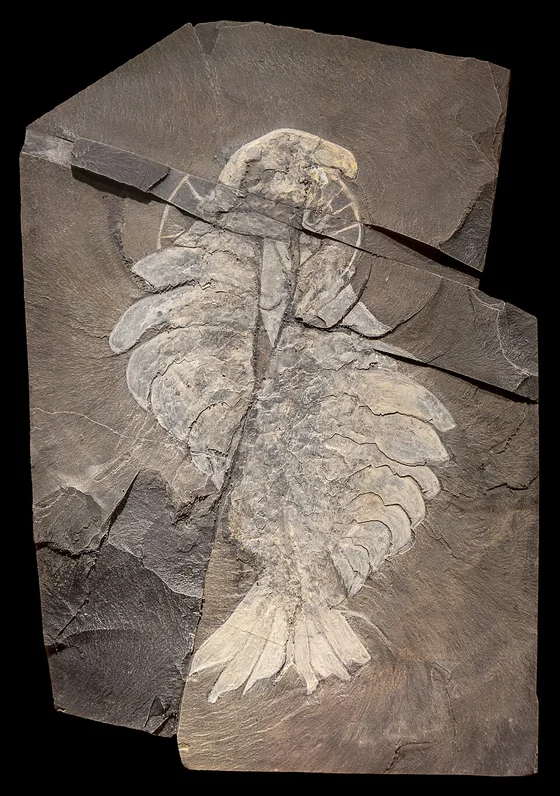
Opabinia is one of the most recognisable Burgess Shale animals. It had five eyes, a backward-facing mouth and a long flexible frontal structure ending in a grasping apparatus. Paired flaps along the body and a tail fan inform reconstructions of swimming. This combination initially made its relationship to familiar animals difficult to establish.
Later study placed it in debates about the early branches surrounding arthropods and radiodonts. Its proboscis probably moved food towards the mouth, but details of feeding are inferred from preserved structure. Some possible ventral features have been interpreted in different ways. Opabinia therefore illustrates how an unusual fossil becomes scientifically informative through close comparison, rather than through declaring every unfamiliar Cambrian body a separate animal phylum.
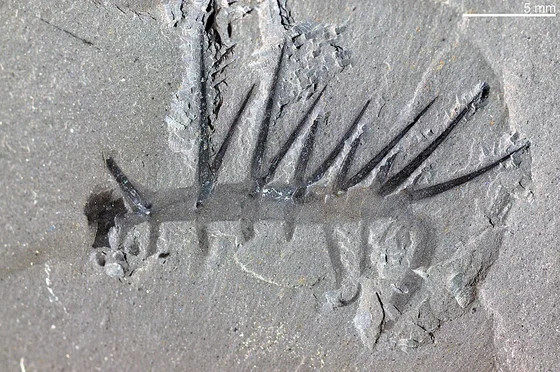
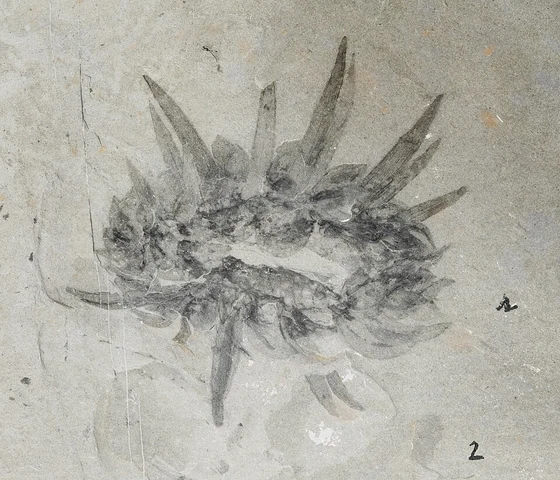
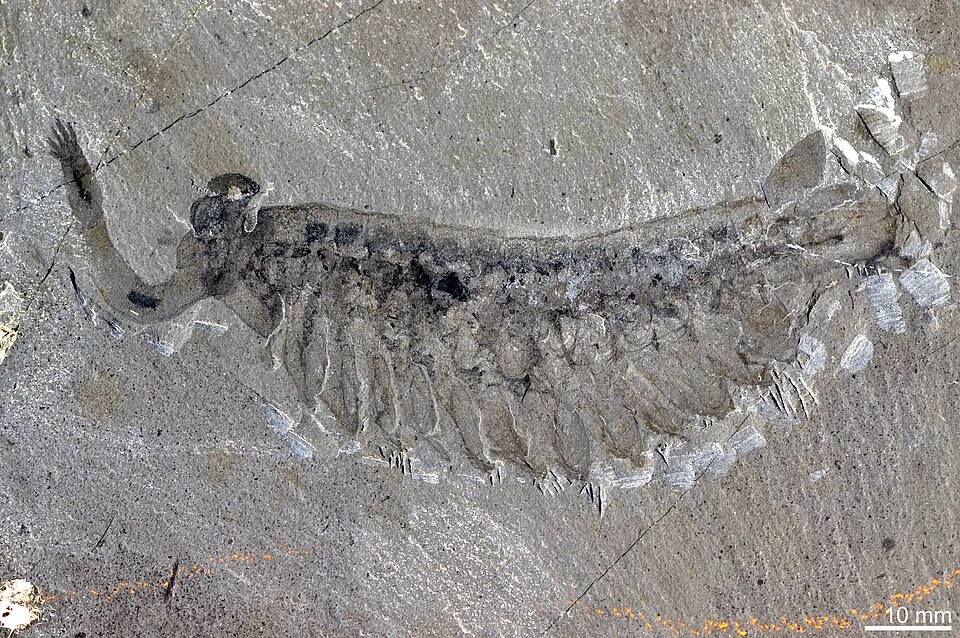
Stephen Pates and colleagues expanded the comparison in 2022 by redescribing a single Wheeler Formation specimen from Utah as Utaurora comosa. Earlier accounts had assigned that fossil to Anomalocaris. Its transverse trunk furrows, short paired tail structures and possible proboscis instead supported a relationship with Opabinia. The new interpretation did not make the two animals identical: Utaurora had at least seven pairs of long tail blades, whereas Opabinia had three pairs. Their filamentous structures also differed in distribution, extending across the trunk in Utaurora but associated with the flaps in Opabinia.
The study compared 125 anatomical characters across 43 fossil and 11 living taxa. Its main Bayesian and parsimony analyses grouped Utaurora with Opabinia, but support for that pairing was modest. Because the putative Utaurora proboscis is poorly preserved, the authors repeated the analysis with that character coded as uncertain. Bayesian analyses retained the pairing with weaker support; under parsimony, its placement became an unresolved branching relationship with deuteropods. The researchers also examined how alternative trees clustered in treespace, showing how much of the apparent uncertainty concerned genuinely competing placements.
For Opabinia itself, the comparison favoured an interpretation in which filamentous blades attached along the dorsal surfaces of the swimming flaps, rather than simply forming a fringe behind them. Possible ventral lobopod limbs remained unconfirmed. The broader branching order of opabiniids, radiodonts and other early arthropod relatives also varied between analytical methods. Such changes affect reconstructions of when jointed limbs and particular mouth arrangements evolved. A family tree therefore represents a stated analysis with uncertainty, rather than proof that one named fossil species was a direct ancestor of another.
Origins & earliest records
Charles Doolittle Walcott described Opabinia regalis in 1912, while a major redescription in 1975 transformed its reconstruction. Its Burgess Shale fossils are approximately 505 million years old. These research milestones concern discovery and interpretation, not a precise date for the evolutionary emergence of the lineage.
Evidence & interpretation
A limited collection of exceptionally preserved specimens shows the eyes, proboscis, body flaps and digestive region. Anatomical differences among interpretations affect its placement near early arthropods. Swimming and feeding proposals follow functional comparison; rare fossils and debated soft structures prevent a completely certain account of behaviour or ancestry.
Selected bibliography
Documented works and useful reading. This is not a list of every appearance.
- 01
Opabinia regalis
Selected institutional scientific reading; not a complete bibliography.
- 02
New opabiniid diversifies the weirdest wonders of the euarthropod stem group
Complete main article and Methods read from institutional PDF. Supplementary matrices and analyses not independently rerun; existing Figure4 tree retains its uncertainty. Summary adapted under CC BY4.
Family, evolution & connections
Opabiniids in the 2022 Bayesian morphological tree
Figure 4a selected subtree; Hurdiidae and Deuteropoda collapsed, Amplectobeluidae and more distant branches pruned.
Scroll sideways to see all branches. With a keyboard, focus the tree and use the arrow keys.
- Selected stem-euarthropod branches (Figure 4a)
- Pambdelurion whittingtoni
- Opabiniids and remaining selected groups
- Opabiniidae (posterior support 0.68 / 0.69)
- Utaurora comosa
- Selected radiodonts and deuteropods
- Hurdiidae (collapsed)
- Selected anomalocaridids and deuteropods
- Selected Anomalocarididae
- Houcaris saron
- Deuteropoda (collapsed)
Bayesian consensus using the minimize-assumptions character treatment; key opabiniid support is 0.68, versus 0.69 under maximize-information treatment. Utaurora is known from one specimen with tentative proboscis evidence. Coding the proboscis uncertain reduces Bayesian support and collapses opabiniid monophyly in parsimony. Treespace contains alternative placements. Selected radiodont branching is this analysis, not a settled universal tree; fossils are not direct ancestors and no dates are shown.
Taxonomic classification
A hierarchy of classified groups, not a chain of direct ancestors.
- kingdomAnimalia
- evolutionary placementArthropod stem group
- familyOpabiniidae
- genusOpabinia
Utaurora comosa (Pates 2022 sampled hypothesis)
The Bayesian consensus pairs Opabinia and Utaurora with limited posterior support. Uncertain proboscis coding changes support and the parsimony result; the fossils are not asserted to be direct ancestors.
Located primary passages
Specific passages supporting details in this entry, grouped by their published witness.
Primary source witness
Proceedings of the Royal SocietyB289:20212093; DOI10.1098/rspb.2021.2093
- A Utah fossil formerly identified with Anomalocaris is redescribed as Utaurora comosa and compared with Opabinia regalis. Shared trunk furrows and caudal structures support an opabiniid relationship, alongside a tentatively identified proboscis. Analyses explore alternative codings: Bayesian support persists when the proboscis is uncertain, while a parsimony result becomes unresolved. The paper expands family distribution; it does not make Utah specimens Opabinia regalis or establish every stem-arthropod branching order.
Systematics3; comparative Fig.2/p5; sensitivity6–7; discussion8/conclusion9
No uninspected supplementary datasets or original cited papers claimed; model inference distinguished from preserved observation.
Encyclopedia background
An additional attributed reference, separate from the editorial profile above.
Read the open encyclopedia overview
Opabinia regalis is an extinct stem group marine arthropod found in the Lagerstätte of the Burgess Shale (Middle Cambrian, 505 million years ago) of British Columbia. Opabinia was a soft-bodied animal, measuring up to 7 cm in body length, and had a segmented trunk with flaps along its sides and a fan-shaped tail. The head showed unusual features: 5 eyes, a mouth under the head and facing backwards, and a clawed proboscis that most likely passed food to its mouth. Opabinia lived on the seafloor, using the proboscis to seek out small, soft food. Fewer than twenty good specimens have been described; 3 specimens of Opabinia are known from the Greater Phyllopod bed, where they constitute less than 0.1% of the community.
When the first thorough examination of Opabinia in 1975 revealed its unusual features, it was thought to be unrelated to any known phylum, or perhaps a relative of arthropod and annelid ancestors. However, later studies since late 1990s consistently support its affinity as a member of basal arthropods, alongside the closely related radiodonts (Anomalocaris and relatives) and gilled lobopodians (Kerygmachela and Pambdelurion).
In the 1970s, there was an ongoing debate about whether multi-celled animals appeared suddenly during the Early Cambrian, in an event called the Cambrian explosion, or had arisen earlier but without leaving fossils. At first Opabinia was regarded as strong evidence for the "explosive" hypothesis. Later the discovery of a whole series of similar lobopodian animals, some with closer resemblances to arthropods, and the development of the idea of stem groups, suggested that the Early Cambrian was a time of relatively fast evolution, but one that could be understood without assuming any unique evolutionary processes.
Text from Wikipedia contributors, “Opabinia”. CC BY-SA 4.0. Extracted introduction; formatting changed. Retrieved 5 October 2026. The source article may have changed since retrieval.
References
Sources supporting this profile. Linked pages have their own scope and editorial standards.
- MuseumOpabinia regalisResearch access: 2026-10-05
- Primary researchPates et al.2022: opabiniid anatomy and competing phylogeniesResearch access: 2026-10-05
- LicenceCreative Commons Attribution 4.0Research access: 2026-10-05
Image credits
Reference illustrationOpabinia
Image associated with the exact linked encyclopedia article; consult credited file description for its interpretation.