Scott Hartman’s 2013 Pikaia gracilens reconstruction silhouette, showing a curved slender body and projections near one end
This simplified reconstruction by Scott Hartman was published in 2013. Its curved outline and small projections represent that interpretation of Pikaia gracilens, rather than an individual fossil specimen. It predates the 2024 anatomical reassessment and does not establish the animal’s dorsal–ventral orientation.
Overview
Pikaia was an elongate marine animal known from the Burgess Shale. Repeated body divisions and internal longitudinal structures have informed its interpretation as an early chordate. Chordates include vertebrates and several lineages without a bony backbone, so calling Pikaia a chordate does not automatically make it a fish or a direct human ancestor.
Its significance comes from the combination of features that illuminate early stages of this branch of animal evolution. Compression and soft-tissue preservation complicate the identification of particular internal structures. Researchers compare many specimens and living chordate anatomy rather than relying on one silhouette. A reconstruction can reasonably portray a small swimming animal while leaving precise anatomy, ecological habits and position within the chordate stem open to revision.
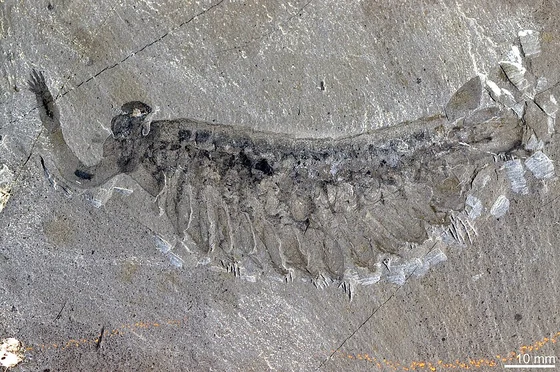
A 2024 reassessment by Giovanni Mussini and colleagues reversed the animal’s usual reconstructed orientation. They interpreted the structure previously called a dorsal organ as the digestive tract, and a supposed ventral blood vessel as the dorsal nerve cord. This brought the proposed anatomy into closer agreement with other chordates. Their evidence included connections between the longitudinal structure and the pharyngeal region, sediment filling comparable with the surrounding rock, and preserved carbon-rich margins. Several illustrated fossils retained enough detail to compare the interpretations across specimens. The new orientation is therefore an anatomical hypothesis supported by observations, rather than an arbitrary rotation of a drawing.
The study also interpreted regularly arranged body structures as muscle blocks with gently curved boundaries. Their extension toward the rear fin helped distinguish them from disorganized remains produced by decay. Branching appendages near the front were compared with external gills, but that identification remains an interpretation. Possible gonads were marked as uncertain, and a notochord could not be conclusively recognized. Failure to identify a soft organ in a compressed fossil is not proof that the living animal lacked it. Illustrations made before this reassessment may consequently show a different orientation or label the same structures differently.
The authors tested relationships using 102 taxa and 625 anatomical characters, including alternative scores for 25 characters. Their Bayesian analyses placed Pikaia on the chordate stem, outside the living chordate crown group. This is a branching relationship inferred from character comparisons, not a demonstration that Pikaia itself gave rise directly to vertebrates. Alternative interpretations of fossil structures, missing information and the selection of taxa matter to such analyses. The broader evolutionary scenario links changes in the pharyngeal region and body musculature, but it does not recover DNA from Pikaia or directly observe the sequence of ancestral populations. The 2024 paper dates the relevant Burgess Shale material to about 508 million years ago; the older museum account used approximately 505 million years.
Origins & earliest records
Charles Doolittle Walcott named Pikaia gracilens in 1911 from Burgess Shale material. The 2024 reassessment places the relevant deposits in the Wuliuan Stage, about 508 million years ago; the older museum account used approximately 505 million years. Geological dating, scientific naming and hypotheses about chordate origins are separate kinds of historical evidence.
Evidence & interpretation
Exceptional body fossils preserve serial divisions and longitudinal structures that support chordate comparisons. Distortion and alternative identifications of soft tissues influence interpretation. Phylogenetic placement is reconstructed by comparing combinations of characters; it cannot be demonstrated simply by placing an old, fish-shaped organism at the beginning of a linear family tree.
Selected bibliography
Documented works and useful reading. This is not a list of every appearance.
- 01
Pikaia gracilens
Selected institutional scientific reading; not a complete bibliography.
- 02
A new interpretation of Pikaia reveals the origins of the chordate body plan
Complete main Results, Discussion and STAR Methods read in the Oxford corrected proof; Figures1–2 inspected. Summary adapted under CC BY4. Supplementary analyses not rerun.
Family, evolution & connections
Pikaia in a selected 2023 Adams-consensus chordate tree
Basal Figure 3 branches; the two total-group vertebrate clades are collapsed. Pikaia, Tunicata and the remaining branch form a retained polytomy.
Scroll sideways to see all branches. With a keyboard, focus the tree and use the arrow keys.
- Selected Figure 3 branching
- Hemichordata
- Remaining sampled chordate branches
- Cephalochordata
- Unresolved three-way branch
- Tunicata
- Sampled vertebrate total group
- Haikouella
- Retained vertebrate polytomy
- Metaspriggina
- Haikouichthys / Myllokunmingia pair
- Haikouichthys
- Myllokunmingia
- Cyclostome total group (collapsed)
- Gnathostome total group (collapsed)
Adams consensus from parsimony analysis of 54 taxa and 167 morphological characters, with Hemichordata outgroup and the published backbone constraint. Adams consensus summarizes potentially unstable taxa; it does not imply that every displayed split is identically supported across all 1,951 shortest trees. The deep vertebrate polytomy is retained. A separate Bayesian analysis and different placements of Eriptychius are discussed in the paper. No dates or direct-ancestor identities are transferred.
Taxonomic classification
A hierarchy of classified groups, not a chain of direct ancestors.
Tunicata in the 2023 Adams consensus
Figure 3 retains Pikaia, Tunicata and the sampled vertebrate total group in a three-way polytomy. It does not resolve Pikaia as the tunicates’ exclusive sister lineage.
Located primary passages
Specific passages supporting details in this entry, grouped by their published witness.
Primary source witness
Current Biology2024, DOI10.1016/j.cub.2024.05.026; selected corrected proof labels1–10, not final2980–2989 pagination; online11June2024 verified on p8
- Re-examination interprets the former dorsal organ as gut and a supposed ventral blood vessel as a dorsal nerve cord, reversing the usual orientation of Pikaia. Fossil preservation and muscle configuration support placement near the chordate crown in the authors’ analysis. A notochord is not conclusively identified; failure to preserve one does not demonstrate its absence. The reconstructed stem relationship is an analytical result, not proof that a particular fossil was a direct ancestor.
Corrected-proof results1–6 and complete discussion6–8; nervous-system qualification3; Fig.4/7
Oxford catalogue calls file version of record, but the actual selected pages retain corrected-proof/in-press labels and provisional pagination; these actual labels are preserved. No original cited1911/2012 publication reading claimed.
Encyclopedia background
An additional attributed reference, separate from the editorial profile above.
Read the open encyclopedia overview
Pikaia gracilens is an extinct, primitive chordate marine animal known from the Middle Cambrian Burgess Shale of British Columbia. Described in 1911 by Charles Doolittle Walcott as an annelid, and in 1979 by Harry B. Whittington and Simon Conway Morris as a chordate, it became "the most famous early chordate fossil", or "famously known as the earliest described Cambrian chordate". It is estimated to have lived during the latter period of the Cambrian explosion. Since its initial discovery, more than a hundred specimens have been recovered.
The body structure resembles that of the lancelet and it swam perhaps much like an eel. A notochord and myomeres (segmented blocks of skeletal muscles) span the entire length of the body, and are considered the defining signatures of chordate characters. Its primitive nature is indicated by the body covering, a cuticle, which is characteristic of invertebrates and some protochordates. A reinterpretation in 2024 found evidence of the gut canal, dorsal nerve cord and myomeres, and suggested that the taxon was previously interpreted upside down.
The exact phylogenetic position is unclear, though recent studies suggest that it is likely a stem-chordate with crown group traits. Previously proposed affinities include those of cephalochordata, craniata, or a stem-chordate not closely related to any extant lineage. Popularly but incorrectly attributed as an ancestor of all vertebrates, or the oldest fish, or the oldest ancestor of humans, it is generally viewed as a basal chordate alongside other Cambrian chordates; it is a close relative of vertebrate ancestors but it is not an ancestor itself.
Text from Wikipedia contributors, “Pikaia”. CC BY-SA 4.0. Extracted introduction; formatting changed. Retrieved 5 October 2026. The source article may have changed since retrieval.
References
Sources supporting this profile. Linked pages have their own scope and editorial standards.
- MuseumPikaia gracilensResearch access: 2026-10-05
- Primary researchA new interpretation of Pikaia reveals the origins of the chordate body planResearch access: 2026-10-05
- LicenceCreative Commons Attribution 4.0Research access: 2026-10-05
Image credits
Scientific fossil reconstruction silhouetteScott Hartman’s 2013 Pikaia gracilens reconstruction silhouette, showing a curved slender body and projections near one end
This simplified reconstruction by Scott Hartman was published in 2013. Its curved outline and small projections represent that interpretation of Pikaia gracilens, rather than an individual fossil specimen. It predates the 2024 anatomical reassessment and does not establish the animal’s dorsal–ventral orientation.