Tiktaalik
Image associated with the exact linked encyclopedia article; consult credited file description for its interpretation.
Overview
Tiktaalik retained fish characteristics while possessing a mobile neck and fin structures useful for studying the transition towards limbed vertebrates. Fossils from Arctic Canada offer a combination of features absent from either a typical living fish or a modern land animal. The often-used term fishapod conveys that mixture, but is an informal description rather than a taxonomic category.
Its anatomy helps reconstruct changes that preceded fully developed limbs with digits. New imaging has revealed further details of the ribs and pelvic region. The evolutionary transition was branching, with related organisms following different ecological paths, including strongly aquatic ones. Tiktaalik therefore supplies evidence for an important set of transformations; it is not established as the individual ancestor from which all terrestrial vertebrates descended.
Stewart and colleagues' 2024 CT study of holotype NUFV 108 revealed differentiated ribs near the reconstructed pelvis. Their shape supports an inferred ligament connection, not an observed bony joint. The posterior-facing hip socket limits proposed terrestrial propulsion; aquatic propping or paddling remains plausible. The restoration combines repositioned and mirrored bones with pectoral-fin material from NUFV 110, rather than reproducing one intact skeleton.
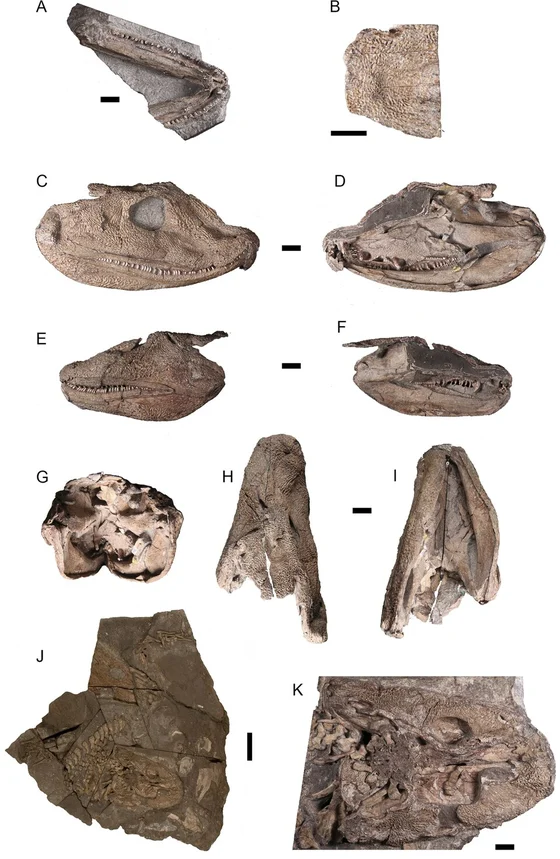
Lemberg, Daeschler and Shubin examined Tiktaalik's feeding system in 2021. CT sections showed tightly integrated skull-roof bones alongside looser overlapping contacts between cheek and roof. They reconstructed distinct functional units, allowing a consolidated skull to retain lateral movement of the cheek and palate. Fossil joint shape provides evidence for mobility, not a filmed feeding event.
Comparison with alligator gar and ornate bichir supported a combination of biting and aquatic suction. A digitally restored holotype was animated using gar-derived motion, rather than measured Tiktaalik behaviour. Unpreserved soft tissues constrain the inference: the modeled expansion likely approaches an extreme, and residual fossil distortion remains. The result challenges a simple replacement of suction by biting during the transition toward limbs, without demonstrating terrestrial feeding or making living analogues direct ancestors.
Origins & earliest records
Tiktaalik roseae fossils were discovered in 2004 in rocks approximately 375 million years old on Ellesmere Island in Nunavut. Its publication and naming marked scientific recognition of an already ancient animal. The locality's age dates preserved occurrence; it does not establish the first fish-to-tetrapod transformation or a universal direct ancestral relationship.
Evidence & interpretation
Skeletal fossils, prepared fin bones and micro-CT imaging reveal anatomical combinations linking lobe-finned fishes with limbed vertebrates. Functional interpretations test how those structures supported movement or feeding. Missing tissues and uncertain behaviour limit the reconstruction, while related fossils demonstrate that the transition included several branches rather than a single march onto land.
Selected bibliography
Documented works and useful reading. This is not a list of every appearance.
- 01
How a change in the hips led to the evolution of walking
Selected institutional scientific reading; not a complete bibliography.
- 02
The axial skeleton of Tiktaalik roseae
PNAS 121, e2316106121; main Results, Discussion and Methods. CC BY-NC-ND 4.0.
- 03
The feeding system of Tiktaalik roseae: an intermediate between suction feeding and biting
PNAS 118:e2016421118. CT/joint Results and complete main Methods read; remaining synthesis partly read. CC BY-NC-ND 4.0. No supplementary files, pixels or model rerun.
Family, evolution & connections
Selected early tetrapod relatives in Swartz’s 2012 morphology analysis
Figure 4 subtree beginning at Tinirau, with the sampled Carboniferous groups collapsed into one terminal; basal fish groups are omitted.
Scroll sideways to see all branches. With a keyboard, focus the tree and use the arrow keys.
- Selected Tinirau and elpistostegalian subtree
- Remaining sampled branches
- Platycephalichthys
- Sampled elpistostegalians
- Panderichthys
- Other sampled elpistostegalians
- Tiktaalik / Elpistostege pair
- Elpistostege
- Remaining sampled digited taxa
- Elginerpeton
- Ventastega and remaining sampled taxa
- Ventastega
- Acanthostega and remaining sampled taxa
- Ichthyostega and sampled Carboniferous groups
- Ichthyostega
- Sampled Carboniferous groups (collapsed)
Single most-parsimonious tree from 46 taxa and 204 equally weighted, unordered morphological characters; Bayesian analysis supplies additional node support. This transfers branching only, omitting geological ages, ghost-range calibration and character transformations. The Tiktaalik / Elpistostege pair has Bremer support 1; other short supported branches are also study-specific. Fossil tips are not arranged as direct ancestors of the subsequent tips. The collapsed Carboniferous terminal contains multiple sampled groups, not one organism.
Taxonomic classification
A hierarchy of classified groups, not a chain of direct ancestors.
- kingdomAnimalia
- phylumChordata
- familyElpistostegidae
- genusTiktaalik
Elpistostege
Swartz’s Figure 4 pairs Tiktaalik with Elpistostege, with Bremer support 1. This is a branching hypothesis from a particular morphological matrix, not proof that either fossil genus directly produced the other.
Located primary passages
Specific passages supporting details in this entry, grouped by their published witness.
Primary source witness
PNAS121:e2316106121(2024),DOI10.1073/pnas.2316106121.
- CT anatomy supports inferred pelvic stabilization through ligaments, without observed bony articulation. Proposed aquatic paddling, propping and walking remain distinct from unsupported terrestrial walking. Reconstruction uses mirrored and scaled elements.
Introduction/results1–2; discussion5–7; methods opening8; original7 checked.
Not full paper; movies, supplementary appendix and raw data uninspected.
Encyclopedia background
An additional attributed reference, separate from the editorial profile above.
Read the open encyclopedia overview
Tiktaalik (; Inuktitut: ᑎᒃᑖᓕᒃ [tiktaːlik]) is a monospecific genus of extinct sarcopterygian (lobe-finned fish) from the late Devonian Period, about 375 Mya (million years ago), having many features similar to those of tetrapods (four-legged animals). Tiktaalik is estimated to have had a total length of 1.25–2.75 metres (4.1–9.0 ft) on the basis of various specimens.
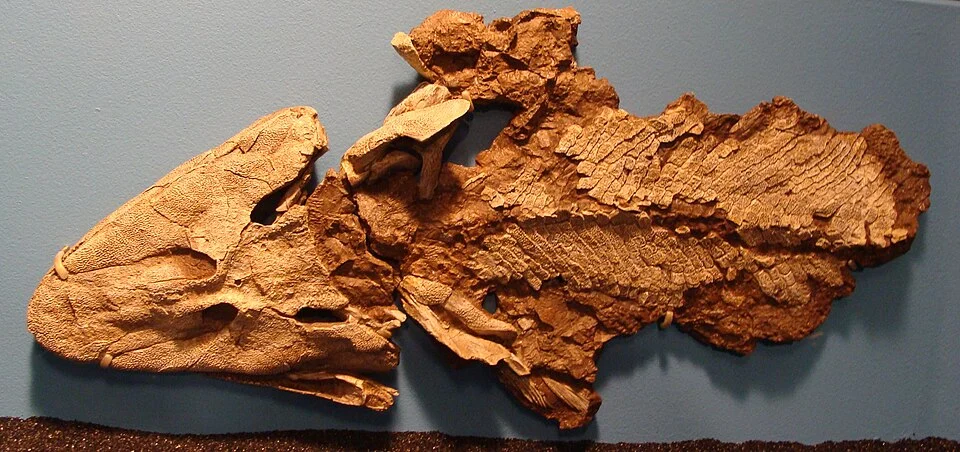
Unearthed in Arctic Canada, Tiktaalik is a non-tetrapod member of Osteichthyes (bony fish), complete with scales and gills—but it has a triangular, flattened head and unusual, cleaver-shaped fins. Its fins have thin ray bones for paddling like most fish, but they also have sturdy interior bones that would have allowed Tiktaalik to prop itself up in shallow water and use its limbs for support as most four-legged animals do. Those fins and other mixed characteristics mark Tiktaalik as a crucial transition fossil, a link in evolution from swimming fish to four-legged vertebrates. This and similar animals might be the common ancestors of all vertebrate terrestrial fauna.
The first Tiktaalik fossils were found in 2004 on Ellesmere Island in Nunavut, Canada. The discovery, made by Edward B. Daeschler of the Academy of Natural Sciences, Neil H. Shubin from the University of Chicago, and Harvard University Professor Farish A. Jenkins Jr., was published in the April 6, 2006 issue of Nature and quickly recognized as a transitional form. Tiktaalik has subsequently become one of the most widely known fossils of the fish-tetrapod transition, along with Acanthostega and Ichthyostega from Greenland.
Text from Wikipedia contributors, “Tiktaalik”. CC BY-SA 4.0. Extracted introduction; formatting changed. Retrieved 5 October 2026. The source article may have changed since retrieval.
References
Sources supporting this profile. Linked pages have their own scope and editorial standards.
- ResearchHow a change in the hips led to the evolution of walkingResearch access: 2026-10-05
- ResearchStewart 2024 axial skeletonResearch access: 2026-10-05
- ResearchLemberg and colleagues, feeding systemResearch access: 2026-10-06
Image credits
Reference illustrationTiktaalik
Image associated with the exact linked encyclopedia article; consult credited file description for its interpretation.