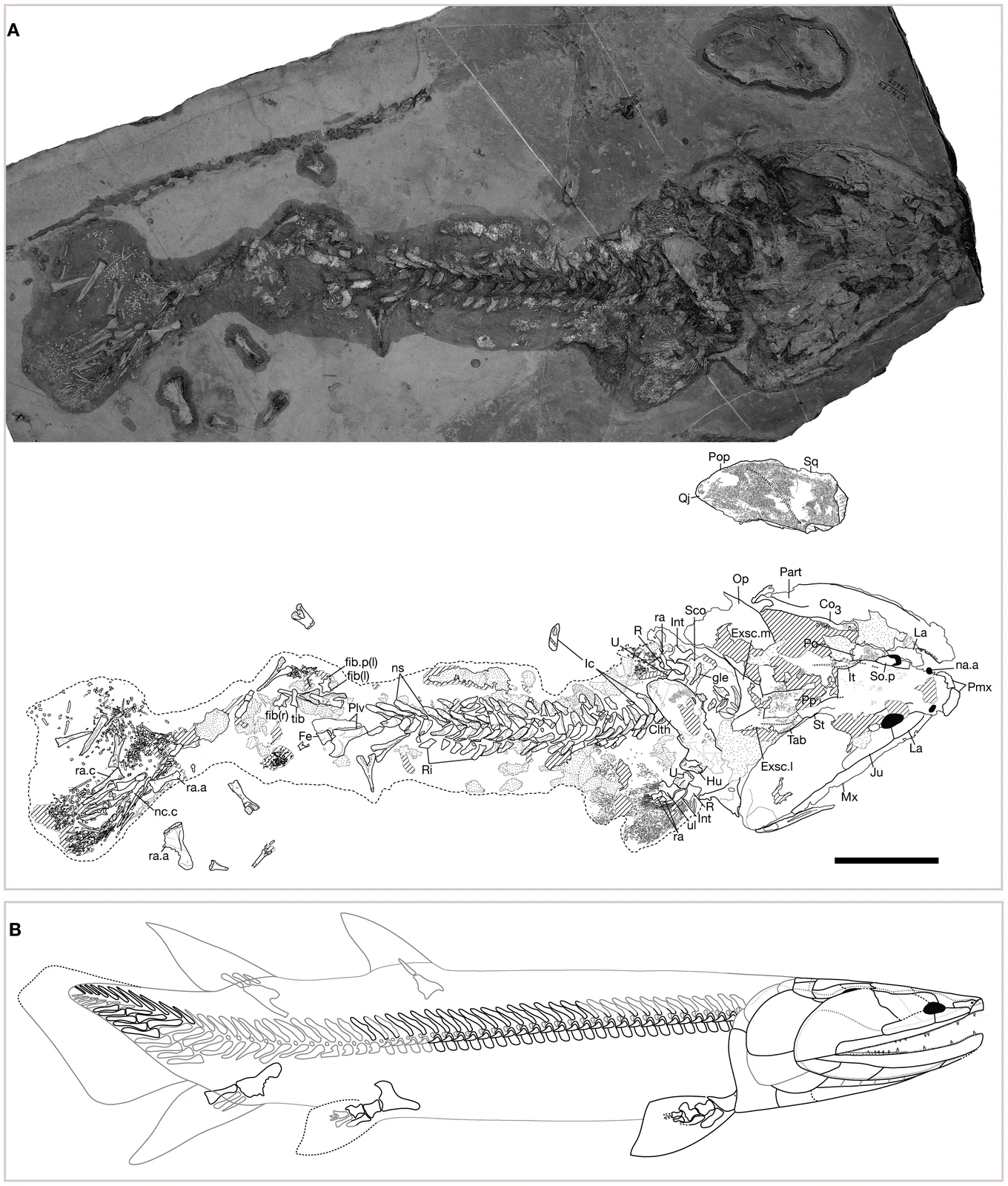
Tinirau clackae holotype UCMP 118605 with interpretive drawing and reconstructed skeleton, Brian Swartz 2012 figure 2
The upper panel photographs holotype UCMP 118605 beside an interpretive drawing; the lower panel reconstructs the animal’s skeleton. Swartz distinguishes preserved elements in black, inferred margins with dashed black lines, and hypothesized elements in gray. The photograph is fossil evidence; the completed outline includes interpretation rather than a directly observed living animal.
Overview
Tinirau clackae is a fossil lobe-finned vertebrate described by Brian Swartz in 2012 from six specimens at Red Hill I in northeastern Nevada. The holotype, UCMP 118605, preserves skull and postcranial material; a second specimen also retains some associated body and appendicular bones. These remains combine features familiar from earlier tetrapodomorph fishes with characters shared by forms closer to limbed vertebrates. The combination is the important evidence: the study does not identify Tinirau as a demonstrated direct ancestor of living tetrapods.
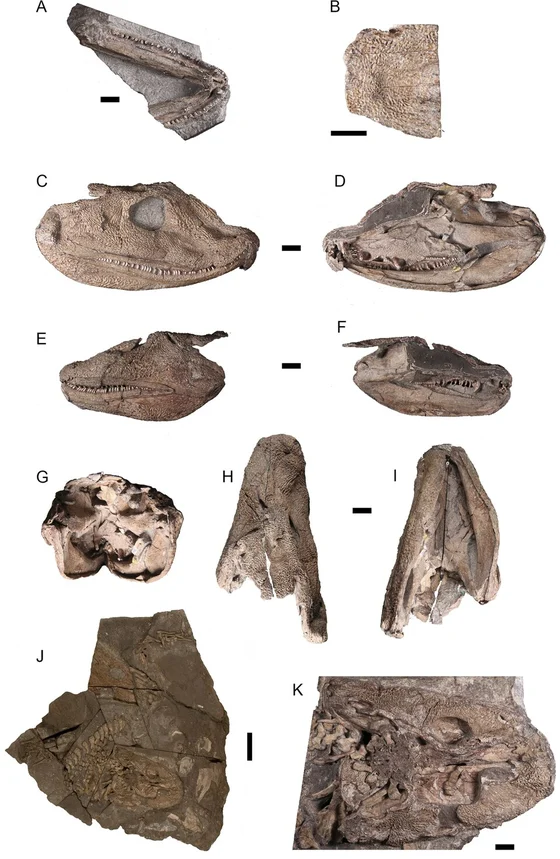
The skull includes a fused cheek plate and, in larger specimens interpreted as later growth stages, fusion across the anterior skull roof. Lower-jaw anatomy includes dentary fangs and an elongated posterior coronoid bone bearing one fang pair followed by a row of smaller teeth. Other features remain more fishlike: external nostrils lie on the face, the body bears rounded scales, and the preserved gill-cover region does not demonstrate a separate physical neck. Several poorly exposed or missing structures, including the precise contribution of one bone to the eye socket, are reconstructed rather than directly seen.
The shoulder socket is elongated compared with that of some earlier relatives, while the pectoral fin retains a more traditional arrangement of fin bones. In the pelvic appendage, the fibula has a reduced posterior process resembling the condition in Panderichthys. This distribution suggests that different parts of the appendages changed at different times. The main skeleton is twisted in preservation, and portions of the pelvic fin are disassociated. An anal-fin support is preserved, whereas dorsal fins are hypothesized despite the absence of their supporting radials; a complete restoration therefore contains both fossil evidence and inferred elements.
The fossils came from limestone and muddy sediment beds assigned through conodont biostratigraphy to the late Givetian, rather than an individual fossil radiometric date. Associated fauna and regional sedimentology support a marine setting, interpreted as the outer continental shelf. In the study's analysis of 46 taxa and 204 morphological characters, Tinirau branches just outside Platycephalichthys and elpistostegalians, beyond tristichopterids. Similar characters also evolved independently elsewhere in these fishes, making a simple ladder of progressively modern ancestors misleading. Swartz additionally discusses alternative makers of older trackways, so neither the fossil nor the analysis supplies an unambiguous date for the first digits.
Origins & earliest records
Named by Brian Swartz in 2012 from UCMP locality V74084, Red Hill I, Simpson Park Mountains, Eureka County, Nevada. Conodont correlation places the fossil-bearing beds in the lower Klapperina disparilis zone, late Givetian. The species name honors Jenny Clack.
Evidence & interpretation
Holotype UCMP 118605 and five additional specimens underpin the original diagnosis. Main-article anatomical comparisons, preservation descriptions and the 46-taxon, 204-character phylogenetic analysis distinguish observed structures from reconstructions. The branching hypothesis does not establish a direct ancestral relationship.
Selected bibliography
Documented works and useful reading. This is not a list of every appearance.
- 01
A Marine Stem-Tetrapod from the Devonian of Western North America
PLOS ONE 7(3): e33683, published 20 March; complete main geological framework, systematics, comparative anatomy, discussion and Methods. Original description; CC Attribution.
Family, evolution & connections
Selected early tetrapod relatives in Swartz’s 2012 morphology analysis
Figure 4 subtree beginning at Tinirau, with the sampled Carboniferous groups collapsed into one terminal; basal fish groups are omitted.
Scroll sideways to see all branches. With a keyboard, focus the tree and use the arrow keys.
- Selected Tinirau and elpistostegalian subtree
- Remaining sampled branches
- Platycephalichthys
- Sampled elpistostegalians
- Panderichthys
- Other sampled elpistostegalians
- Tiktaalik / Elpistostege pair
- Elpistostege
- Remaining sampled digited taxa
- Elginerpeton
- Ventastega and remaining sampled taxa
- Ventastega
- Acanthostega and remaining sampled taxa
- Ichthyostega and sampled Carboniferous groups
- Ichthyostega
- Sampled Carboniferous groups (collapsed)
Single most-parsimonious tree from 46 taxa and 204 equally weighted, unordered morphological characters; Bayesian analysis supplies additional node support. This transfers branching only, omitting geological ages, ghost-range calibration and character transformations. The Tiktaalik / Elpistostege pair has Bremer support 1; other short supported branches are also study-specific. Fossil tips are not arranged as direct ancestors of the subsequent tips. The collapsed Carboniferous terminal contains multiple sampled groups, not one organism.
Taxonomic classification
A hierarchy of classified groups, not a chain of direct ancestors.
- classSarcopterygii
- cladeTetrapodomorpha
- genusTinirau
- speciesTinirau clackae
References
Sources supporting this profile. Linked pages have their own scope and editorial standards.
- ResearchSwartz 2012: original description of Tinirau clackaeResearch access: 2026-10-05
Image credits
Scientific fossil specimen and reconstruction figureTinirau clackae holotype UCMP 118605 with interpretive drawing and reconstructed skeleton, Brian Swartz 2012 figure 2
The upper panel photographs holotype UCMP 118605 beside an interpretive drawing; the lower panel reconstructs the animal’s skeleton. Swartz distinguishes preserved elements in black, inferred margins with dashed black lines, and hypothesized elements in gray. The photograph is fossil evidence; the completed outline includes interpretation rather than a directly observed living animal.