Hallucigenia
Image associated with the exact linked encyclopedia article; consult credited file description for its interpretation.
Overview
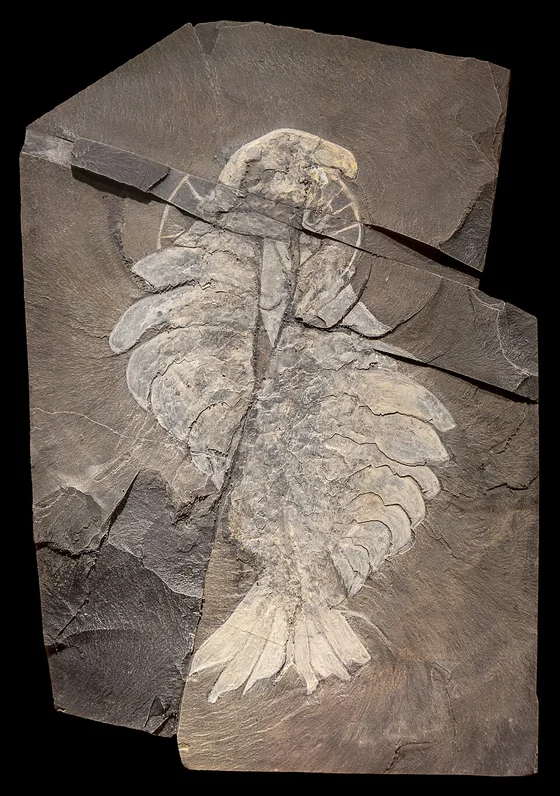
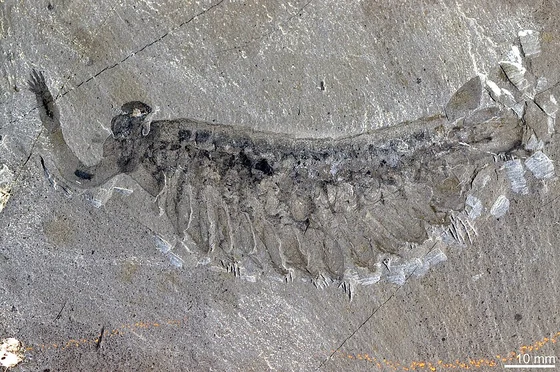
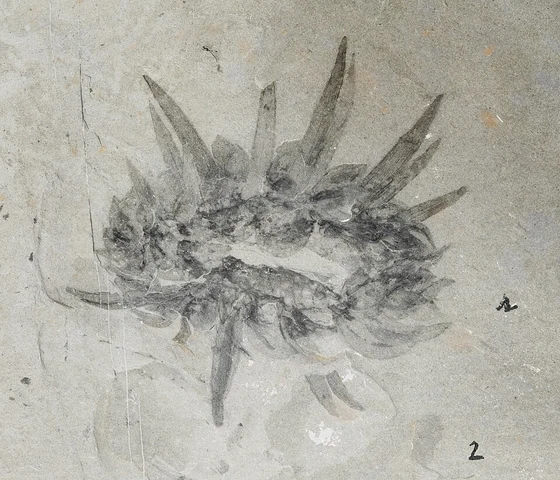
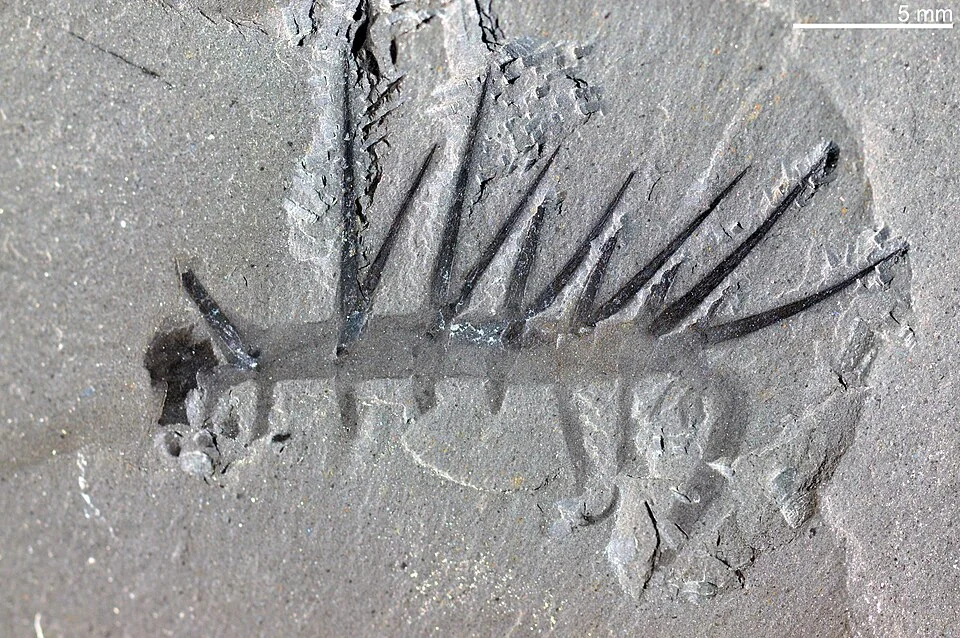
Hallucigenia had an elongate soft body, paired spines and slender walking appendages. Its fossils became famous through a reconstruction that reversed the animal's upper and lower surfaces. Subsequent specimens and closer examination showed that the soft appendages were legs and the rigid projections belonged on the back.
The correction made Hallucigenia useful in understanding lobopodians and the ancestry surrounding velvet worms and arthropods. New anatomical observations have also clarified its head region. This is a case where scientific confidence varies by feature: the general orientation is much more secure than a detailed account of diet or daily movement. A fossil reconstruction should show that history without suggesting that the animal itself was an evolutionary mistake or an impossible creature.
Smith and Caron’s 2015 microscopic study identified simple eyes, radial mouth elements and backward-pointing foregut teeth in H. sparsa. The posterior dark stain was interpreted as expelled decay fluid. These observations refined its orientation and feeding anatomy, while proposed ancestral mouthpart homologies remained evolutionary inferences.
A later analysis by Jean-Bernard Caron and Cédric Aria compared 59 anatomical characters across 38 taxa in 2017. Their Bayesian and parsimony analyses recovered different arrangements of the earliest panarthropod branches, but both separated hallucigeniids and luolishaniids from the lineage containing living velvet worms. This differed from earlier studies placing Hallucigenia within the onychophoran stem group. Several basal relationships had weak support. The disagreement reflects choices about character interpretation, missing information and analytical method; it does not erase the fossil evidence for individual legs, spines or mouth structures.
The 2017 study also considered how limbs might have functioned. Long soft appendages with relatively large claws, particularly the forward-pointing rear claws and truncated hind end, could have helped Hallucigenia anchor or climb on a substrate. Its thin anterior appendages could reach the mouth, but whether they mainly sensed surroundings or manipulated food remained uncertain. The authors proposed suspension feeding for early lobopodians while distinguishing hallucigeniid tentacles from the more elaborate sieving structures of luolishaniids. These are anatomical arguments about possible ecology, not preserved observations of a meal or a demonstration that every lobopodian fed in the same way.
Comparisons of body form placed hallucigeniids, luolishaniids and onychophoran-like animals in distinct regions of the study’s morphological space. The results suggested substantial variety within both extinct groups, rather than treating unusual Cambrian forms as unsuccessful experiments. The authors also stressed that scarce fossils and poorly known taxa limited comparisons of diversity. This helps separate three questions often conflated in reconstructions: what anatomy is preserved, which evolutionary relationships best fit a particular dataset, and what ways of life those structures might have supported.
Origins & earliest records
The Burgess Shale material represents Cambrian marine life about 505 million years ago. Hallucigenia's scientific interpretation developed through successive descriptions and revised orientation of its body. An illustration's publication date is not an evolutionary date, and recognition of a better anatomy does not establish the first occurrence of the lineage.
Evidence & interpretation
Compressed fossils preserve spines and soft appendages in different degrees of completeness. Comparison with related lobopodians resolved the original orientation problem and informs possible relationships to velvet worms. The fossil record supplies anatomy more directly than behaviour; specific feeding habits remain less secure than the presence of legs and dorsal spines.
Selected bibliography
Documented works and useful reading. This is not a list of every appearance.
- 01
Hallucigenia sparsa
Selected institutional scientific reading; not a complete bibliography.
- 02
Hallucigenia’s head and the pharyngeal armature of early ecdysozoans
Main manuscript and Methods read; no supplementary-data reanalysis.
- 03
Cambrian suspension-feeding lobopodians and the early radiation of panarthropods
Complete published Methods, phylogenetic and disparity Results, Discussion and Conclusions read. Selected Hallucigeniidae diagnosis also inspected. Other species description and supplements not newly read in full. Summary adapted under CC BY4.
Family, evolution & connections
Five sampled hallucigeniids in the 2017 Bayesian morphological tree
The five blue-shaded Hallucigeniidae tips in Figure 4, pruned from 38 sampled taxa; Microdictyon is excluded because the authors leave its membership unresolved.
Scroll sideways to see all branches. With a keyboard, focus the tree and use the arrow keys.
- Selected hallucigeniids (Figure 4 Bayesian result)
- Carbotubulus
- Other sampled hallucigeniids
- Remaining sampled hallucigeniids
- Hallucigenia hongmeia
- Cardiodictyon / H. fortis pair
- Cardiodictyon
- Hallucigenia fortis
Bayesian Mkv analysis of 59 morphological characters, gamma-distributed character rates and 20% burn-in. Only branching is transferred. Internal posterior support is low (29, 39 and 55 percent in the figure). Cardiodictyon nests among named Hallucigenia species in this result; genus membership is not imposed as a branching constraint. The paper also presents a conflicting parsimony topology. Fossil tips are sampled relatives, not asserted direct ancestors.
Taxonomic classification
A hierarchy of classified groups, not a chain of direct ancestors.
- kingdomAnimalia
- familyHallucigeniidae
- genusHallucigenia
Cardiodictyon (2017 sampled Bayesian topology)
Figure 4 places Cardiodictyon beside H. fortis, within the sampled hallucigeniids. Weak internal support and a conflicting parsimony result make this a study-specific hypothesis, not a direct-ancestor claim.
Located primary passages
Specific passages supporting details in this entry, grouped by their published witness.
Primary source witness
Accepted manuscript; Nature523:75–78,2015.
- Preserved structures are interpreted as eyes, radial mouth elements and foregut teeth. Proposed ancestral ecdysozoan homology is an inference; hindgut differentiation remains unresolved.
Supplementary data not read; no replication or universal anatomy claim.
Encyclopedia background
An additional attributed reference, separate from the editorial profile above.
Read the open encyclopedia overview
Hallucigenia is a genus of lobopodian known from Cambrian-aged fossils in Burgess Shale-type deposits in Canada (Burgess Shale) and China, and from isolated spines around the world. The generic name reflects the type species' unusual appearance and eccentric history of study; when it was erected as a genus, H. sparsa was reconstructed as an enigmatic animal upside down and back to front. Lobopodians are a grade of Paleozoic panarthropods from which the velvet worms, water bears, and arthropods arose.
Text from Wikipedia contributors, “Hallucigenia”. CC BY-SA 4.0. Extracted introduction; formatting changed. Retrieved 5 October 2026. The source article may have changed since retrieval.
References
Sources supporting this profile. Linked pages have their own scope and editorial standards.
- MuseumHallucigenia sparsaResearch access: 2026-10-05
- Primary researchSmith and Caron2015Research access: 2026-10-05
- Primary researchCaron and Aria2017: alternative relationships and ecologyResearch access: 2026-10-05
- LicenceCreative Commons Attribution 4.0 for Caron and Aria2017Research access: 2026-10-05
Image credits
Reference illustrationHallucigenia
Image associated with the exact linked encyclopedia article; consult credited file description for its interpretation.