Wiwaxia
Image associated with the exact linked encyclopedia article; consult credited file description for its interpretation.
Overview
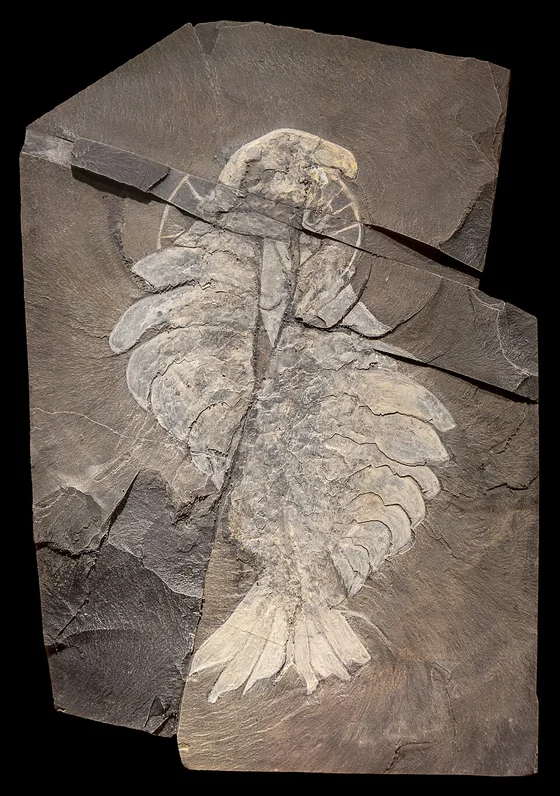
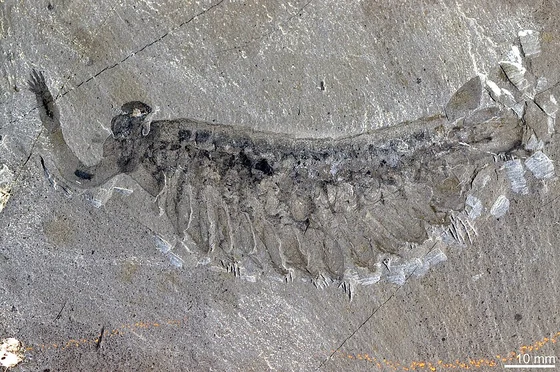
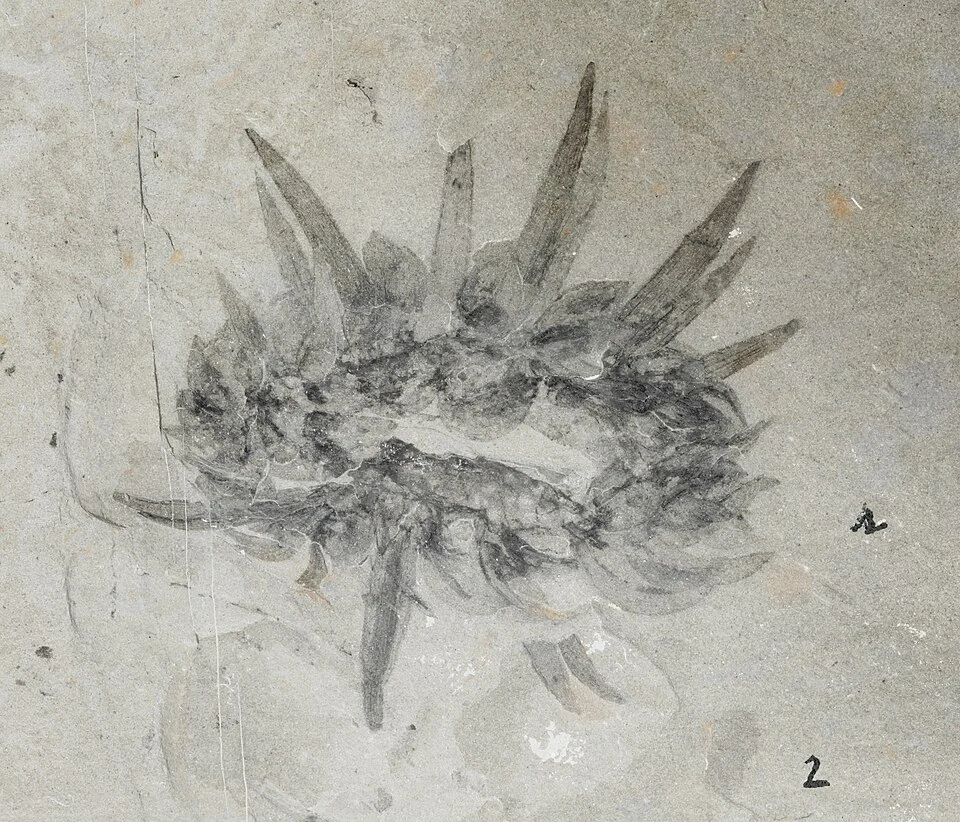
Wiwaxia had a body protected by overlapping hard elements, with prominent spines in larger specimens. Exceptional Burgess Shale preservation allows researchers to examine these elements in relation to its soft anatomy. The result is an animal that combines recognisable protective structures with a body organisation difficult to match exactly to familiar living groups.
Anatomical comparisons have placed Wiwaxia in discussions of early molluscan and annelid relationships. Its feeding apparatus is particularly informative, although different features can support different interpretations. Size variation helps researchers investigate growth and the development of the covering. The genus is valuable as evidence of early animal experimentation in structure, but that phrase should not be read as a claim that evolution had a goal or that every reconstruction is settled.
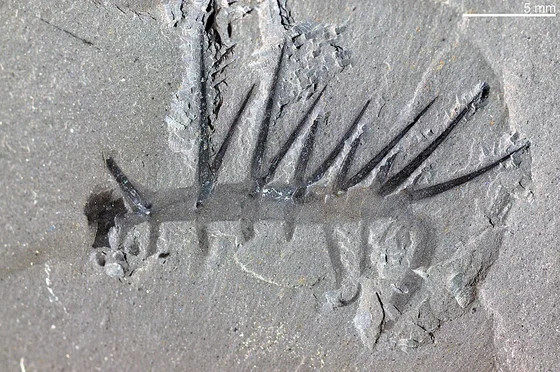
Zhang, Smith and Shu’s 2015 study added five articulated specimens from the Chengjiang deposits of China. They named the material Wiwaxia papilio, with ELI-W001 as the holotype and four additional specimens deposited at Northwest University. The fossils were only five to eight millimetres long and lacked dorsal spines. Comparison with similarly small W. corrugata specimens suggested that they represented juveniles, rather than establishing that all adults of the new species were spineless. Species-level differences were identified in the ribbing and proportions of the protective elements.
The articulated arrangement helped reconsider the whole covering, or scleritome. The authors interpreted nine transverse rows, including the foremost row, whose elements varied from curved lateral forms to more rounded dorsal forms. Bundles appeared associated with projections of soft tissue, with comparisons to Burgess Shale specimens supporting connective links across rows. This contrasts with a reconstruction that treats the front covering as a separate, structurally different zone. Two Chinese specimens preserved mouthparts bearing two or three tooth rows, although preservation did not resolve the details of every small tooth.
These features contributed to a difficult evolutionary comparison. The serial covering resembles aspects of annelid armature, while the mouthparts and unarmoured underside invite comparison with molluscs. Neither resemblance securely assigns the animal to a living subgroup. The paper considered positions on the molluscan stem, the annelid stem or the stem leading to both, each implying different histories of inherited and transformed characters. These are alternative phylogenetic interpretations, not demonstrated direct descent from Wiwaxia to a named living species.
The authors also noted a contrast between abundant small specimens in several shallow-water deposits and larger individuals in deeper-water assemblages. They discussed possible migration or differences in survival, but the fossil distribution does not directly record either behaviour. Preservation and uneven sampling remain relevant. A 2023 publisher correction restored a supplementary dataset omitted from the original publication; it did not replace the main anatomical account. The restored dataset has not been independently reanalysed here.
Origins & earliest records
Wiwaxia is known from Cambrian deposits, with the Burgess Shale species Wiwaxia corrugata providing a central example approximately 505 million years old. Its scientific description and reassessment belong to research history. Preserved local occurrences establish minimum evidence for its existence, rather than a complete account of its evolutionary origin.
Evidence & interpretation
Body fossils preserve protective elements and, in some specimens, details associated with feeding. Isolated elements broaden comparisons but can be difficult to attribute. Differences in preservation and competing anatomical interpretations affect evolutionary placement, so the relationships inferred for Wiwaxia should remain more qualified than the visible presence of scales and spines. Articulated Chengjiang specimens and Burgess Shale comparisons support the covering reconstruction; juvenility, deep homology and habitat-linked distributions remain interpretations.
Selected bibliography
Documented works and useful reading. This is not a list of every appearance.
- 01
Wiwaxia corrugata
Selected institutional scientific reading; not a complete bibliography.
- 02
New reconstruction of the Wiwaxia scleritome, with data from Chengjiang juveniles
Scientific Reports 5: 14810, 7 October. Complete main description, Material and Methods, Discussion and captions. CC BY 4.0. Publisher correction, 4 December 2023, DOI 10.1038/s41598-023-48303-1, restores an omitted dataset.
Family, evolution & connections
One of three Wiwaxia placement hypotheses (2015, Figure 6a)
Figure 6a only: the stem-mollusc hypothesis. The paper also explicitly illustrates competing stem-annelid and stem-Mollusca-plus-Annelida placements.
Scroll sideways to see all branches. With a keyboard, focus the tree and use the arrow keys.
- Conditional hypothesis: Figure 6a
- Annelida (collapsed)
- Molluscan stem and crown in this hypothesis
- Remaining selected branch
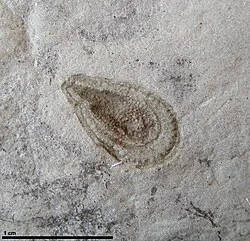
- Odontogriphus
- Mollusca
- Aculifera (collapsed)
- Conchifera (collapsed)
Morphological character interpretation, not a statistical consensus or a resolved species tree. The authors say the affinity remains unresolved and requires more early lophotrochozoan evidence. Odontogriphus and Wiwaxia are terminal branches, not literal ancestors. No support values or dates are supplied. The December 2023 correction restores omitted supplementary data, without changing this figure.
Taxonomic classification
A hierarchy of classified groups, not a chain of direct ancestors.
Encyclopedia background
An additional attributed reference, separate from the editorial profile above.
Read the open encyclopedia overview
Wiwaxia is a genus of prehistoric soft-bodied animals that were covered in carbonaceous scales and spines that protected it from predators. Wiwaxia fossils—mainly isolated scales, but sometimes complete, articulated fossils—are known from early Cambrian and middle Cambrian fossil deposits across the globe. The living animal would have measured up to 5 centimetres (2 in) when fully grown, although a range of juvenile specimens are known, the smallest being 2 millimetres (0.08 in) long.
Wiwaxia's affinity has been a matter of debate, causing researchers to be long split between two possibilities. On the one hand, its rows of scales looked superficially similar to certain scale worms (annelids); conversely, its mouthparts and general morphology suggested a relationship to the shell-less molluscs. More recently, evidence for a molluscan affinity has been accumulating, based on new details of Wiwaxia's mouthparts, scales, and growth history. The name derives from Wiwaxy Peak in British Columbia.
The proposed clade Halwaxiida contains Wiwaxia as well as several similar Cambrian animals.
Text from Wikipedia contributors, “Wiwaxia”. CC BY-SA 4.0. Extracted introduction; formatting changed. Retrieved 5 October 2026. The source article may have changed since retrieval.
References
Sources supporting this profile. Linked pages have their own scope and editorial standards.
- MuseumWiwaxia corrugataResearch access: 2026-10-05
- ResearchChengjiang juveniles and scleritome reconstructionResearch access: 2026-10-05
- ResearchPublisher correction restoring supplementary datasetResearch access: 2026-10-05
Image credits
Reference illustrationWiwaxia
Image associated with the exact linked encyclopedia article; consult credited file description for its interpretation.