Kimberella
Image associated with the exact linked encyclopedia article; consult credited file description for its interpretation.
Overview
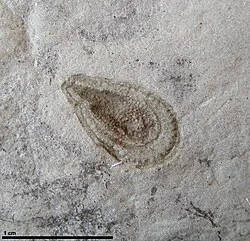
Kimberella had an oval body and inhabited marine seafloors before the Cambrian. Fossils are associated with feeding traces interpreted as grazing on microbial mats. Its apparent movement and feeding organisation make it useful for investigating how early animals interacted with the resource-rich surfaces of Ediacaran seas.
A mollusc-like interpretation follows from several anatomical and behavioural comparisons, but no single resemblance proves it belonged to the modern molluscan crown group. Chemical research on one White Sea specimen found patterns interpreted as evidence of digestion. This adds a different line of inquiry to the body and trace fossils. Alternative sources for chemical signals and disagreements over grazing mechanics keep the reconstruction open to refinement rather than turning it into a complete portrait.
Interpretations changed as new fossils became available. The public abstract of Mikhail Fedonkin and Benjamin Waggoner’s 1997 study describes more than 35 White Sea specimens that challenged an earlier jellyfish reconstruction. They instead proposed a bottom-dwelling, bilaterally symmetrical animal with a non-mineralized protective covering resembling a single shell. The comparison strengthened a mollusc-like interpretation without identifying Kimberella as a member of a particular living molluscan class. This account uses the abstract; the subscription article was not fully read.
Andrey Ivantsov’s 2017 account describes a proposed retractable head, a broad foot-like underside and longitudinal and transverse muscle bands. He interpreted surface markings as traces of small protective elements, possibly mineralized but lost during fossilization. This differs from the non-mineralized covering proposed in 1997. His comparison of body impressions with Kimberichnus scrape traces supports a reconstruction in which a toothed head scratched microbial mats as the body extended and contracted. Those teeth and movements are interpretations of preserved marks, not directly observed feeding. Repeated ridges also do not establish true body segmentation. The proposed connection with molluscan relatives remains a hypothesis about affinity.
The public abstract of Ilya Bobrovskiy and colleagues’ 2022 study interprets molecules from Kimberella and the tube-like Calyptrina as evidence for internal digestion of green algae and bacteria. It compares their sterol processing with living invertebrates. This provides a chemical line of evidence alongside body and scrape fossils; it does not by itself identify every food species, preserve a complete digestive system or settle the animal’s ancestry.
Origins & earliest records
Kimberella is recorded in late Ediacaran deposits, including fossils from Russia's White Sea region dated near 558 million years old. That age measures a preserved occurrence. It does not establish when the lineage evolved, and the modern scientific description is a separate event in the history of investigation.
Evidence & interpretation
Body fossils, nearby scrape-like traces and chemical differences between a specimen and surrounding sediment support mobility and feeding interpretations. The association of a trace with its maker can be uncertain. Molecular evidence suggests digestion but does not preserve the whole organ, and molluscan affinity remains a reasoned comparison rather than an unquestionable identification.
Selected bibliography
Documented works and useful reading. This is not a list of every appearance.
- 01
Evidence of the world's oldest meal may have been discovered
Selected institutional scientific reading; not a complete bibliography.
- 02
The Late Precambrian fossil Kimberella is a mollusc-like bilaterian organism
Complete public abstract and bibliographic record read; subscription article not read.
- 03
The most probable Eumetazoa among late Precambrian macrofossils
Complete Kimberella section and Figure2 caption read; actual printed130 figure inspected. Other taxa not comprehensively assessed.
- 04
Guts, gut contents, and feeding strategies of Ediacaran animals
Complete public abstract and bibliographic record read; full main article not assessed.
- 05
New Data on Kimberella, the Vendian Mollusc-like Organism (White Sea Region, Russia): Paleoecological and Evolutionary Implications
Undated five-page author-hosted manuscript; exact relationship to final2007 Geological Society paper not verified
Family, evolution & connections
Taxonomic classification
A hierarchy of classified groups, not a chain of direct ancestors.
- kingdomAnimalia
- genusKimberella
Located primary passages
Specific passages supporting details in this entry, grouped by their published witness.
New Data on Kimberella, the Vendian Mollusc-like Organism (White Sea Region, Russia): Paleoecological and Evolutionary Implications
Undated five-page author-hosted manuscript; exact relationship to final2007 Geological Society paper not verified
- This manuscript interprets White Sea fossils as a complex mollusc-like animal and associates fan-shaped scratches with feeding. A retractable feeding organ is proposed, with alternative interpretations acknowledged. The identity of circumpodial structures remains uncertain. Its report of over700 specimens and undated format must not be silently substituted for the later published paper.
Complete manuscript1–5; anatomy and trace interpretations2–4
Reading scope is limited to the identified sections. No uninspected primary sources, supplementary analysis or complete corpus claimed. No quotation added.
Encyclopedia background
An additional attributed reference, separate from the editorial profile above.
Read the open encyclopedia overview
Kimberella is an extinct genus of marine bilaterian known only from rocks of the Ediacaran period. The slug-like organism fed by scratching the microbial surface on which it dwelt in a manner similar to the gastropods, although its affinity with this group is contentious.
Specimens were first found in Australia's Ediacara Hills, but recent research has concentrated on the numerous finds near the White Sea in Russia, which cover an interval of time from 555 to 558 million years ago. As with many fossils from this time, its evolutionary relationships to other organisms are hotly debated. Paleontologists initially classified Kimberella as a type of cubozoan, but, since 1997, features of its anatomy and its association with scratch marks resembling those made by a radula have been interpreted as signs that it may have been a mollusc. Although some paleontologists dispute its classification as a mollusc, it is generally accepted as being at least a bilaterian.
The classification of Kimberella is important for the scientific understanding of the Cambrian explosion; if it was a mollusc, or at least a protostome, this would mean that the two dominant Nephrozoan lineages would have diverged significantly before 555 million years ago, and if it was at least bilaterian, its age would indicate that animals were diversifying well before the start of the Cambrian.
Text from Wikipedia contributors, “Kimberella”. CC BY-SA 4.0. Extracted introduction; formatting changed. Retrieved 5 October 2026. The source article may have changed since retrieval.
References
Sources supporting this profile. Linked pages have their own scope and editorial standards.
- MuseumEvidence of the world's oldest meal may have been discoveredResearch access: 2026-10-05
- Primary researchThe Late Precambrian fossil Kimberella is a mollusc-like bilaterian organismResearch access: 2026-10-05
- Primary researchThe most probable Eumetazoa among late Precambrian macrofossilsResearch access: 2026-10-05
- Primary researchGuts, gut contents, and feeding strategies of Ediacaran animalsResearch access: 2026-10-05
Image credits
Reference illustrationKimberella
Image associated with the exact linked encyclopedia article; consult credited file description for its interpretation.