Dickinsonia
Image associated with the exact linked encyclopedia article; consult credited file description for its interpretation.
Overview
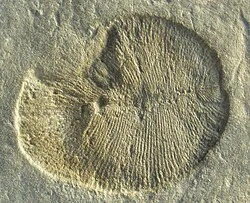
Dickinsonia fossils show an oval body with repeated units arranged along its length. They occur as impressions in ancient marine sediments, offering a view of large soft-bodied life before the Cambrian. Its appearance has encouraged comparisons with very different living groups, but a familiar-looking outline is insufficient to establish ancestry or identify its feeding mechanism.
In 2018, researchers analysed steroids preserved with Dickinsonia fossils. The reported chemical pattern supported an animal interpretation. Such molecules add evidence beyond the body impressions, but they do not reveal a complete digestive system or settle the organism’s precise evolutionary position.
Growth provides evidence beyond a resemblance to any living animal. Scott Evans, Mary Droser and James Gehling examined 988 specimens of Dickinsonia costata for their 2017 study. Different preservation requirements produced different measurement sets: 538 complete, undeformed specimens for length and width, 194 for counts of repeated body units, and 94 for detailed measurements of those units. These are not 988 equally complete measurements. Very small units could fall below the resolution of the surrounding sediment grains, making some counts minimum estimates.
The specimens retained a relatively consistent oval outline as they increased in size, while the number of units varied substantially between similarly sized individuals. Growth involved both enlargement and the addition of units, with their changing proportions helping maintain the body outline. The authors cautioned that unit count was not a dependable measure of age. Nor does a repeated unit automatically correspond to a segment in an earthworm or arthropod. Their preferred interpretation placed Dickinsonia among extinct animal lineages with regulated development, but the growth data did not reveal its genes, demonstrate a through-gut or settle its exact position among living animal groups.
Christopher Mulligan and David Gold revisited the coprostane signal in 2025. They proposed that Dickinsonia could have accumulated the compound while feeding on microbial mats, rather than acquiring it only during decay. Their survey included 115 metagenomes but did not confirm the tested coprostanol-producing enzyme in the sampled invertebrate microbiomes. The dietary explanation remains a hypothesis: contamination could not be excluded, and chemical enrichment does not directly preserve an organ or demonstrate the complete feeding mechanism.
Origins & earliest records
Dickinsonia is known from late Ediacaran rocks, including material from the White Sea region and Australia. A representative age near 558 million years dates fossil-bearing deposits, not the beginning of the genus. Scientific naming and later biomarker studies are historical research events separated from its geological existence.
Evidence & interpretation
Body impressions reveal repeated units and growth patterns, while associated traces and chemical biomarkers offer different tests of animal affinity. Steroid evidence requires careful comparison with surrounding sediment and possible contamination. An animal interpretation is well supported, but detailed physiology and placement within the animal tree remain more uncertain.
Selected bibliography
Documented works and useful reading. This is not a list of every appearance.
- 01
Ancient steroids establish the Ediacaran fossil Dickinsonia as one of the earliest animals
Selected institutional scientific reading; not a complete bibliography.
- 02
Highly regulated growth and development of the Ediacara macrofossil Dickinsonia costata
Complete Methods and Results/Discussion read. Original summary adapted under CC BY4; measurements and supplementary analyses not rerun.
- 03
A Reassessment of the Coprostane Biomarker in the Ediacaran With Implications for Dickinsonia
Complete abstract and selected Discussion passages read; full Methods not assessed. Brief factual account; CC BY-NC-ND4 does not grant adaptation rights.
Family, evolution & connections
Taxonomic classification
A hierarchy of classified groups, not a chain of direct ancestors.
- kingdomAnimalia
- familyDickinsoniidae
- genusDickinsonia
Located primary passages
Specific passages supporting details in this entry, grouped by their published witness.
Primary source witness
- Cholesteroids support animal affinity; precise modern phylum remains unassigned.
Supplements/cited papers unread.
Encyclopedia background
An additional attributed reference, separate from the editorial profile above.
Read the open encyclopedia overview
Dickinsonia is a genus of extinct organism that lived during the late Ediacaran period in what is now Australia, China, Russia, Canada and Ukraine. It had a round, approximately bilaterally symmetric body with multiple segments running along it. It could range from a few millimeters to over a meter in length, and likely lived in shallow waters, feeding on the microbial mats that dominated the seascape at the time.
As a member of the Ediacaran biota, its relationships to other organisms has been heavily debated. It was initially proposed to be a jellyfish, and over the years has been claimed to be a land-dwelling lichen, a placozoan, or even a giant protist. Currently, the most popular interpretation is that it was a seafloor-dwelling animal, perhaps a primitive stem group bilaterian, although this is still contentious. Among other Ediacaran organisms, it shares a close resemblance to other segmented forms like Vendia, Yorgia, and Spriggina, and has been proposed to be a member of the phylum Proarticulata or alternatively the morphogroup Dickinsoniomorpha. It is disputed whether the segments of Dickinsonia are bilaterally symmetric across the midline, or are offset from each other via glide reflection, or possibly both.
Text from Wikipedia contributors, “Dickinsonia”. CC BY-SA 4.0. Extracted introduction; formatting changed. Retrieved 5 October 2026. The source article may have changed since retrieval.
References
Sources supporting this profile. Linked pages have their own scope and editorial standards.
- ResearchAncient steroids establish the Ediacaran fossil Dickinsonia as one of the earliest animalsResearch access: 2026-10-05
- Primary researchHighly regulated growth and development of the Ediacara macrofossil Dickinsonia costataResearch access: 2026-10-05
- Primary researchA Reassessment of the Coprostane Biomarker in the Ediacaran With Implications for DickinsoniaResearch access: 2026-10-05
- LicenceCreative Commons Attribution 4.0Research access: 2026-10-05
Image credits
Reference illustrationDickinsonia
Image associated with the exact linked encyclopedia article; consult credited file description for its interpretation.