Charnia
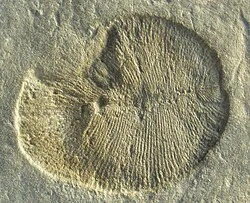
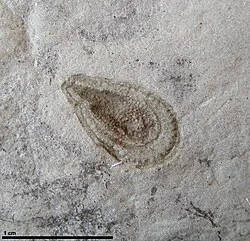
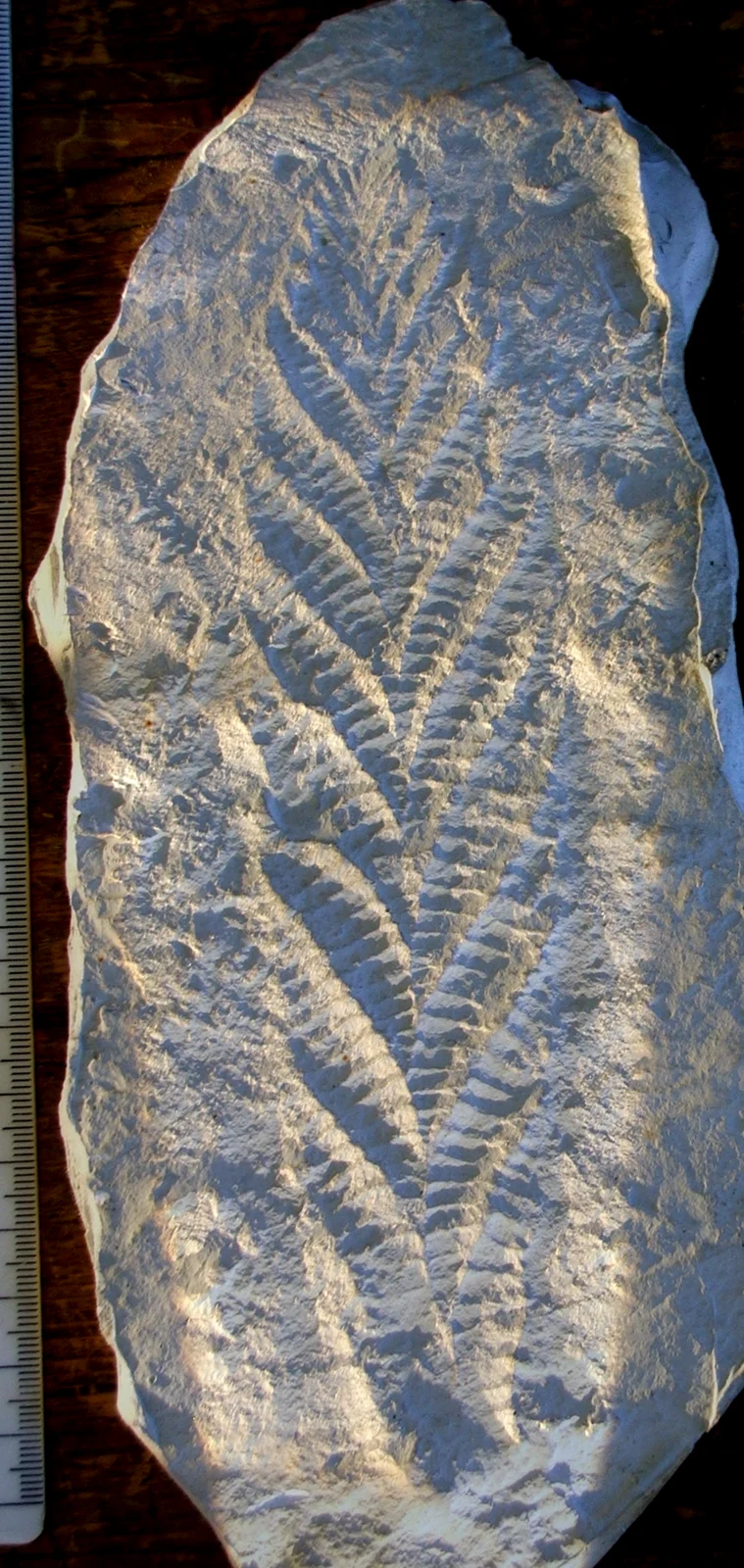
Image associated with the exact linked encyclopedia article; consult credited file description for its interpretation.
Overview
Charnia fossils resemble tapering fronds made from successively branching units. Their resemblance to leaves is misleading: these marine organisms belong to the Ediacaran rangeomorph assemblage and are interpreted within early animal evolution. Preserved impressions record the arrangement of the body, but rarely supply the internal anatomy that would settle every aspect of its biology.
The genus became important in establishing substantial life in rocks older than the Cambrian. Research on its growth patterns tests how new units were added and how the organism changed shape during development. These comparisons support an animal relationship without making Charnia a modern coral or sea pen. Its feeding and broader ecological function still require inference from form, habitat and comparisons among related fossils.
Frances Dunn and colleagues investigated Charnia masoni in 2021 using three-dimensional fossil preservation, growth comparisons and an analysis of anatomical relationships. X-ray tomography of five Russian specimens showed branches filling the width of the frond, without a separate internal stalk between them. Adjacent branches appeared connected near their bases. Fine and coarse sediment layers continued between branches, supporting the interpretation that sediment could circulate through linked spaces after death. This is evidence about how the body was organized and fossilized; the infilling sediment is not preserved food or living tissue.
The researchers also compared six English specimens from one bedding surface, ranging from approximately 2.7 centimetres to more than 45 centimetres long. Small individuals had fewer and smaller branches. Most specimens nevertheless had similarly sized branches at the tip, suggesting that new units were added there while older branches expanded. The largest specimen had larger tip branches, consistent with slowing the production of new units and placing greater emphasis on enlarging existing ones. This developmental sequence was reconstructed from different fossils, not observed by following one living individual through time.
Their growth analysis assumed that members of the species followed broadly comparable developmental patterns and that the measured branches did not shrink during life. Comparing specimens from the same surface helped limit environmental differences, although preservation and variation still constrain the result. The inferred architecture also differed from the familiar picture of leaves attached to a central plant stem: in Charnia, successive large branches derived from preceding branches. The study distinguished that organization from the different branching arrangements of other rangeomorphs.
An anatomical character analysis placed Charnia on the stem leading to living eumetazoans, outside the sampled living groups themselves. That position was retained under several alternative arrangements of those groups. It does not make Charnia a demonstrated direct ancestor or a modern sea pen. The authors found no compelling fossil evidence for muscles or a nervous system. Feeding remained uncertain: interconnected internal spaces might be compatible with moving water by cilia, but the necessary openings were not demonstrated. Absorbing dissolved nutrients was another discussed explanation, with its own physical difficulties.
Origins & earliest records
Charnia became scientifically prominent through specimens from Charnwood Forest in England, although related rangeomorph fossils occur elsewhere. Its fossils predate the Cambrian; the representative timeline date is approximate. The recognition and naming of the genus concern scientific history rather than the first evolutionary appearance of rangeomorphs.
Evidence & interpretation
Repeated branching patterns, population samples and developmental comparisons provide evidence for rangeomorph structure and affinity. Sedimentary context constrains its marine habitat. Soft-body impressions do not preserve every organ, so proposed nutrition and exact animal-tree placement should be treated as reconstructions rather than directly observed features of a living species.
Selected bibliography
Documented works and useful reading. This is not a list of every appearance.
- 01
Charnia masoni
Selected institutional scientific reading; not a complete bibliography.
- 02
The developmental biology of Charnia and the eumetazoan affinity of the Ediacaran rangeomorphs
Science Advances7(30):eabe0291,23July2021; DOI10.1126/sciadv.abe0291
Family, evolution & connections
Charnia in the 2021 unconstrained morphological analysis
Figure 6A with sampled living groups collapsed; other Ediacaran organisms are not positioned here.
Scroll sideways to see all branches. With a keyboard, focus the tree and use the arrow keys.
- Sampled opisthokont groups (Figure 6A)
- Choanoflagellata (outgroup)
- Sampled Metazoa
- Porifera (collapsed)
- Placozoa and remaining sampled groups
- Placozoa
- Charnia and crown Eumetazoa
- Crown Eumetazoa (unresolved in panel A)
- Ctenophora (collapsed)
- Cnidaria (collapsed)
- Bilateria (collapsed)
Bayesian morphological analysis in MrBayes 3.2.6; Figure 6 caption specifies 41 taxa and 182 characters. The unconstrained majority-consensus topology is shown. Charnia is a stem-group relative, not a demonstrated direct ancestor. Ctenophora, Cnidaria and Bilateria remain a three-way polytomy in panel A. Panels B–D impose competing living-group constraints and retain its stem placement; they are not merged here. Character homology and incomplete fossil anatomy limit inference. No dates shown.
Taxonomic classification
A hierarchy of classified groups, not a chain of direct ancestors.
- kingdomAnimalia
- familyCharniidae
- genusCharnia
Sampled crown Eumetazoa (Dunn 2021 morphological hypothesis)
Dunn and colleagues recover Charnia beside crown Eumetazoa. Their unconstrained tree leaves the three living groups unresolved; this is a morphological hypothesis, not direct ancestry.
Located primary passages
Specific passages supporting details in this entry, grouped by their published witness.
Primary source witness
Science Advances7(30):eabe0291,23July2021; DOI10.1126/sciadv.abe0291
- Tomographic anatomy and comparison of developmental patterns support internally connected branching structures. The authors’ character analysis places Charnia outside living eumetazoan groups, while accounting for uncertainty about their relationships. They find no compelling direct evidence for muscles or a nervous system; feeding openings might escape preservation. Its animal affinity is therefore an analytical interpretation, not identification as a modern sea pen.
No complete paper or uninspected supplementary/cited sources claimed; anatomical observation distinguished from functional/phylogenetic inference.
Encyclopedia background
An additional attributed reference, separate from the editorial profile above.
Read the open encyclopedia overview
Charnia is an extinct genus of frond-like lifeforms belonging to the Ediacaran biota with segmented, leaf-like ridges branching alternately to the right and left from a zig-zag medial suture (thus exhibiting glide reflection, or opposite isometry). The genus Charnia was named after Charnwood Forest in Leicestershire, England, where the first fossilised specimen was found, and is thus pronounced ; the first species of Charnia described, Charnia masoni, was named after Roger Mason, a schoolboy who was believed to have initially discovered it. Charnia is significant because it was the first Precambrian fossil to be recognized as such.
The living organism grew on the sea floor, 570 to 550 million years ago, and is believed to have fed on nutrients in the water. Despite Charnia's fern-like appearance, it is not a photosynthetic plant or alga because the nature of the fossil beds where specimens have been found implies that it originally lived in deep water, well below the photic zone where photosynthesis can occur.
Text from Wikipedia contributors, “Charnia”. CC BY-SA 4.0. Extracted introduction; formatting changed. Retrieved 5 October 2026. The source article may have changed since retrieval.
References
Sources supporting this profile. Linked pages have their own scope and editorial standards.
- ResearchCharnia masoniResearch access: 2026-10-05
- ResearchThe developmental biology of Charnia and the eumetazoan affinity of the Ediacaran rangeomorphsResearch access: 2026-10-05
Image credits
Reference illustrationCharnia
Image associated with the exact linked encyclopedia article; consult credited file description for its interpretation.