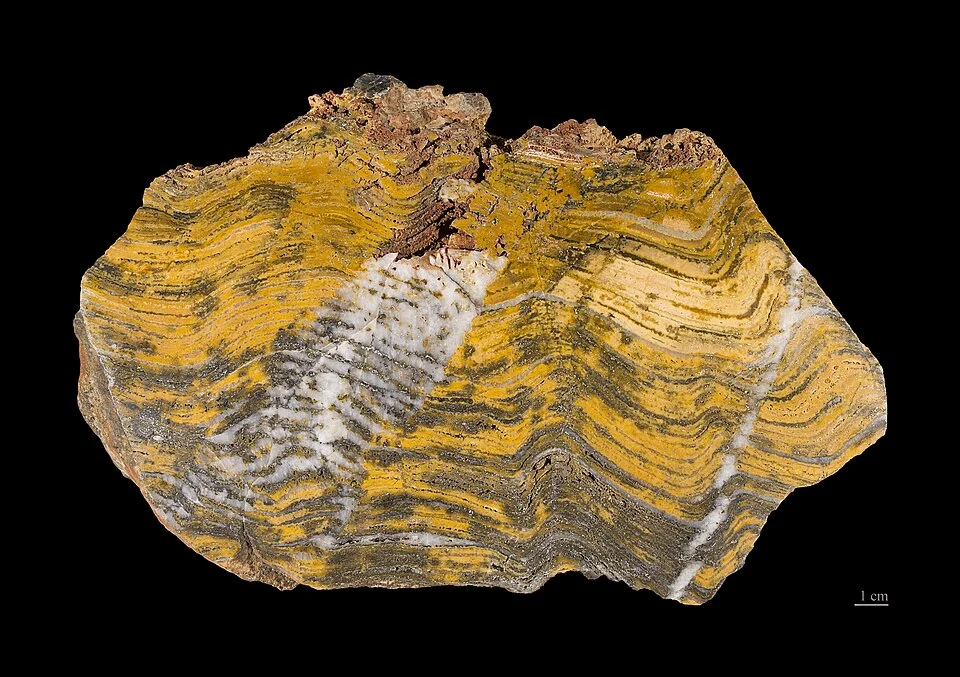
Stromatolite Stromatolites are formed over the years by mats (1-10 mm in thickness) of microorganisms (cynobacteria among others) found in shallow, mainly marine waters. The microorganisms precipitate mineral particles, which makes the mat to thicken, but only the upper part survives. Most stromatolites display characteristically layered structures. Only the layers are visible to the naked eye. Stage : Paleoarchean from -3 600 à -3 200 Ma (million years ago). Locality: Strelley Pool Chert (SPC
Illustration associated with the linked encyclopedia article. Refer to the file record for the subject and interpretation.
Overview
A stromatolite records a community interacting with its environment. Microbial mats can trap sediment, encourage mineral precipitation and build repeated layers, sometimes forming domes or columns. Modern examples help explain how comparable structures developed in ancient settings. Different microbes can contribute, so a stromatolite cannot automatically be identified as a particular cyanobacterial species.
Specimens from Western Australia's Dresser Formation, about 3.48 billion years old, are important evidence for early life. Their interpretation depends on geological context and growth textures rather than a recognisable animal-like body. Some layered rocks can develop without biology. This makes comparison of several independent features essential, especially when researchers use ancient terrestrial examples to investigate possible signs of life elsewhere.
Hickman-Lewis and colleagues combined thin sections with laboratory and synchrotron tomography to examine Dresser material in two and three dimensions. They describe layers thickening over dome crests, sediments overlapping those domes, and upright pillar-like fabrics resembling microbial palisades. Their biological interpretation rests on this combination of structures and geological context, rather than one visually suggestive shape.
The study interprets these particular samples as forming in a shallow lagoon receiving seawater and hydrothermal fluids. Other Dresser horizons have been interpreted as terrestrial hot-spring deposits, so the setting is not uniform across the formation. Later oxidation replaced earlier minerals with hematite while retaining fine structures; missing original organic matter therefore limits, but does not erase, the evidence. Comparison with Mars concerns methods for evaluating possible biosignatures and does not establish life on Mars.
The team combined optical microscopy, mineral identification, trace-element measurements and laboratory and synchrotron X-ray tomography. This made it possible to follow structures in three dimensions instead of judging a single cut surface. The samples contain hematite, barite and quartz, with fine wavy layers, domes and pillar-like fabrics. Some layers thicken toward the tops of domes, while surrounding sediment laps against the growing structures. These details provide the evidence for a community repeatedly growing in interaction with accumulating sediment.
No preserved original organic matter was required for this particular argument. The authors interpret the aligned pillar-like fabric as the mineral replacement of microbial palisades, and the combined geometry as difficult to explain by static inorganic precipitation alone. Shallow-water conditions and growth toward a resource support their interpretation of light-using communities. This does not identify a named microbial species or establish oxygen-producing photosynthesis: light use and oxygen production are separate claims. The strength of the case lies in the combination of context and structures, not in one dome-shaped rock.
Preservation has substantially changed the material. The study reconstructs early silicification followed by later mineral alteration, including oxidative weathering that converted iron-bearing material to hematite. The replacement can preserve biological fabric while losing original organic chemistry. The authors therefore distinguish a structure’s retained shape from chemical signals that no longer report its original formation. Irregular voids are interpreted in relation to decay or drying rather than automatically labelled living gas bubbles.
Origins & earliest records
The Dresser Formation contains some of the oldest widely discussed stromatolite evidence, about 3.48 billion years old. This dates preserved structures rather than life's origin or the first microbial species. Modern stromatolites also form today, making the term a structural category spanning enormous geological time. The selected Dresser study appeared online4 November2022 and in Geology51(1),33–38 in2023. These bibliographic dates are kept distinct from the rocks’ approximate3.48-billion-year age.
Evidence & interpretation
High-resolution imaging reveals domed layering and fine structures consistent with microbial growth in Dresser samples. Researchers found no preserved microfossils or organic material in the studied specimens. The biological interpretation rests on converging structural and geological evidence, with abiotic alternatives assessed rather than excluded by appearance alone. The primary paper distinguishes fine-layer thickening, sediment onlap and three-dimensional palisade-like fabrics from later mineral replacement. Its inferred shallow lagoon applies to the examined lower Dresser horizons, not every stromatolite locality. The evidence does not identify one microbial species or prove oxygen production.
Selected bibliography
Documented works and useful reading. This is not a list of every appearance.
- 01
Earth’s oldest stromatolites help in the search for ancient life on Mars
Selected institutional scientific reading; not a complete bibliography.
- 02
Advanced two- and three-dimensional insights into Earth’s oldest stromatolites (ca. 3.5 Ga): Prospects for the search for life on Mars
Geology 51(1), 33–38; first published online 4 November 2022. Methods, microstructures and preservation of selected Dresser samples. Complete main text and captions newly read; original pages34/36 and figures1/3 viewed in Glasgow-hosted version of record. Expanded account is an attributed paraphrase of the CC-BY paper: https://creativecommons.org/licenses/by/4.0/. Supplement not independently analysed.
Family & connections
A source-supported family tree or inspiration record has not yet been compiled for this profile. Related reading below indicates a connection in subject matter, not a proven lineage or creative influence.
Look for a taxonomic record and classified relativesEncyclopedia background
An additional attributed reference, separate from the editorial profile above.
Read the open encyclopedia overview
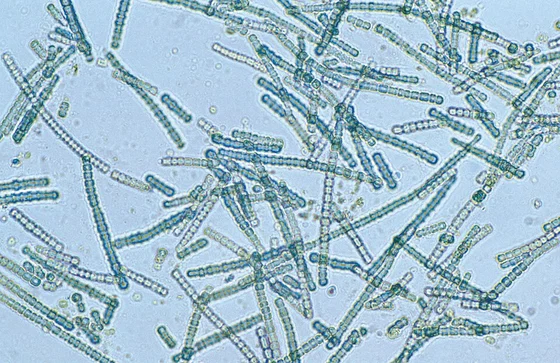
Stromatolites ( stroh-MAT-ə-lytes, strə-) or stromatoliths (from Ancient Greek στρῶμα (strôma), GEN στρώματος (strṓmatos) 'layer, stratum' and λίθος (líthos) 'rock') are layered sedimentary formations (microbialite) that are formed mainly by photosynthetic microorganisms such as cyanobacteria, sulfate-reducing bacteria, and Pseudomonadota (formerly proteobacteria). These microorganisms produce adhesive compounds that cement sand and other rocky materials to form mineralized "microbial mats". In turn, these mats build up layer by layer, growing gradually over time.
This process generates the characteristic lamination of stromatolites, a feature that is hard to interpret in terms of its temporal and environmental significance. Different styles of stromatolite lamination have been described, which can be studied through microscopic and mathematical methods. A stromatolite may grow to a meter or more. Fossilized stromatolites provide important records of some of the most ancient life. As of the Holocene, living forms are rare.
Text from Wikipedia contributors, “Stromatolite”. CC BY-SA 4.0. Extracted introduction; formatting changed. Retrieved 5 October 2026. The source article may have changed since retrieval.
References
Sources supporting this profile. Linked pages have their own scope and editorial standards.
- MuseumEarth’s oldest stromatolites help in the search for ancient life on MarsResearch access: 2026-10-05
- ResearchHickman-Lewis et al. — Dresser stromatolite primary studyResearch access: 2026-10-05
- ResearchUniversity of Trieste repository — full primary-study PDFResearch access: 2026-10-05
- Primary geological study; CC BYHickman-Lewis et al., Dresser stromatolites primary study, version of recordResearch access: 2026-10-05
Image credits
Reference imageStromatolite Stromatolites are formed over the years by mats (1-10 mm in thickness) of microorganisms (cynobacteria among others) found in shallow, mainly marine waters. The microorganisms precipitate mineral particles, which makes the mat to thicken, but only the upper part survives. Most stromatolites display characteristically layered structures. Only the layers are visible to the naked eye. Stage : Paleoarchean from -3 600 à -3 200 Ma (million years ago). Locality: Strelley Pool Chert (SPC
Illustration associated with the linked encyclopedia article. Refer to the file record for the subject and interpretation.