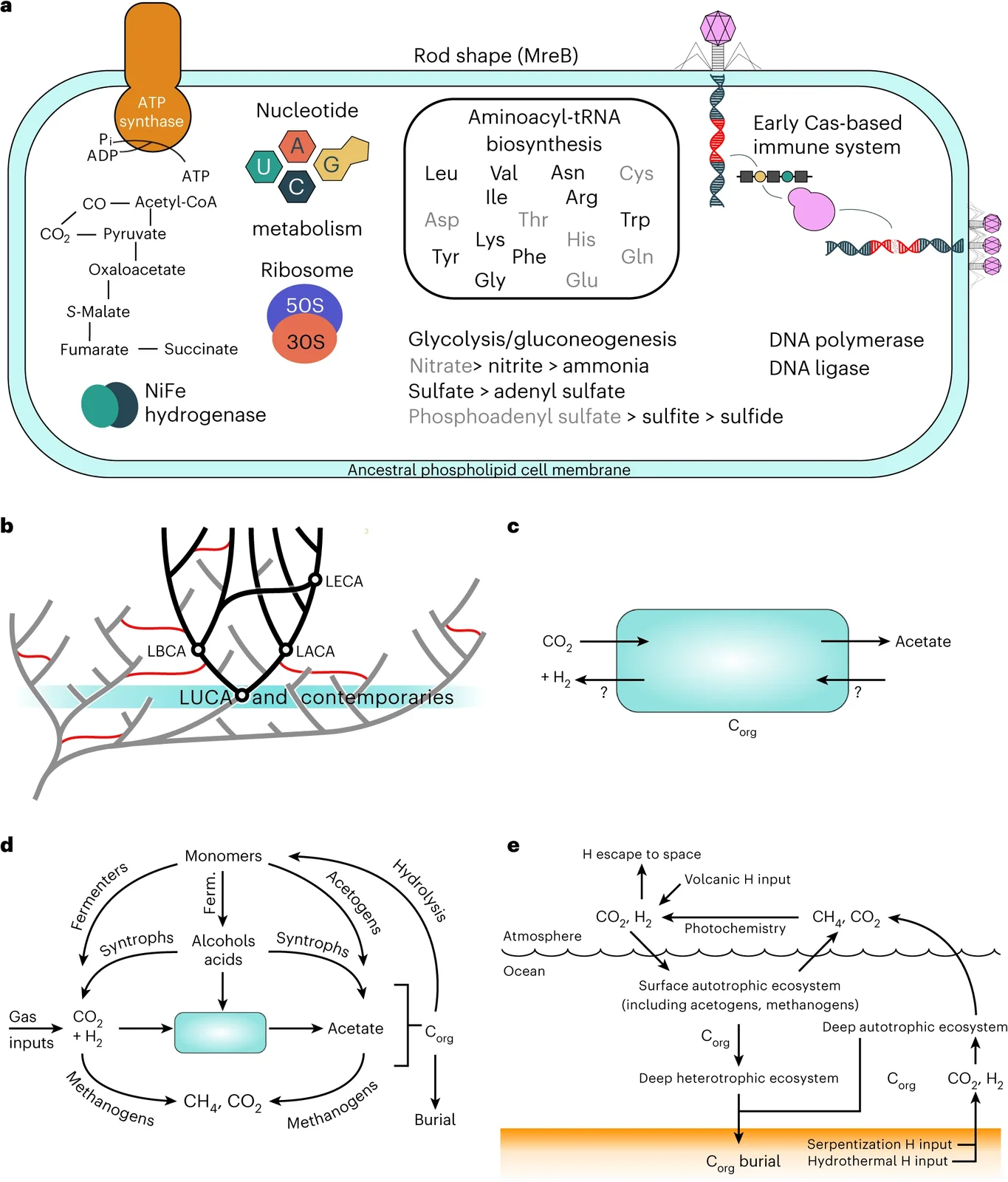
Moody and coauthors’ hypothetical reconstruction of LUCA’s cellular features, ancestry and ecosystem, 2024
This 2024 model connects inferred cellular functions with LUCA’s ancestry and possible ecosystem. Black and grey labels distinguish different confidence thresholds for reconstructed gene content. The cell shape, metabolic exchanges and early-Earth settings are hypotheses from the authors’ analysis, rather than photographs, fossils or a definitive account of LUCA’s appearance. The published figure is reproduced unchanged.
Overview
Living cells share deep molecular features, including related protein-making machinery, a nearly universal genetic code and the use of ATP in energy transfer. LUCA names the ancestral population or lineage reconstructed from these connections. It belongs to a branching history in which earlier organisms and extinct branches could already have existed. The concept therefore addresses common ancestry rather than the chemical beginning of life.
Gene loss, horizontal transfer and uncertain evolutionary rates complicate reconstruction. Weiss and colleagues in 2016 screened 6.1 million protein-coding genes and identified 355 families meeting their criteria for inheritance from LUCA. Their reconstruction favoured an oxygen-free, hydrogen-dependent organism fixing carbon dioxide and nitrogen in a hot, geochemically active setting. These conclusions come from phylogenetic comparisons and inferred protein functions; the 355 families are not a complete recovered genome. The publicly accessible abstract supports this account; the full subscription article was not inspected here.
Moody and colleagues in 2024 used ancient gene duplications and fossil and isotope calibrations to estimate an age near 4.2 billion years, within the Hadean. Their independent-rate analysis gave 4.09–4.32 billion years; the autocorrelated model gave 4.18–4.33 billion years. The authors also compared 700 bacterial and archaeal genomes while modelling gene duplication, transfer and loss. They inferred a genome around 2.75 million base pairs encoding roughly 2,657 proteins, with considerable uncertainty, and proposed an anaerobic acetogen living within an ecosystem. These are study-specific reconstructions, not measurements of a surviving specimen or a date for life’s beginning.
The dating method uses five pairs of gene families whose duplication is inferred to precede LUCA. Repeated copies of the same later divergence constrain one another’s dates. Fossil calibration choices and assumptions about evolutionary rates remain essential, despite tests with different genes and clocks. A minor numerical difference also occurs within the publication: its independent-rate results paragraph gives an upper limit of 4.32 billion years, whereas the abstract and Figure1 give 4.33. The preceding account follows the results paragraph rather than silently merging the two.
In this reconstruction LUCA could grow without oxygen and use a carbon-fixation pathway associated with acetogenesis, producing acetate. The study finds no support for photosynthesis and does not reconstruct a modern methane-producing organism. Some inferred Cas-family proteins suggest an early defence system, but several components of a complete modern CRISPR system are absent. Likewise, a cellular membrane is supported more securely than its precise chemical composition. The evidence therefore supports a developed cellular organism under the authors’ model without specifying every feature of a modern bacterium or archaeon.
The ecological argument is also an inference. An organism using hydrogen and carbon dioxide would produce substances that other microbes could use; organisms exchanging these products could form a small ecosystem. The authors discuss possible deep-water, surface-water and hydrothermal settings without uniquely identifying LUCA’s home. Other contemporary lineages could have left no living descendants, so they cannot simply be recovered as named branches from modern genomes. A family tree for LUCA consequently represents an inferred common node in surviving cellular ancestry, not a photograph of the earliest community or a list of all life that then existed.
Origins & earliest records
LUCA has no formal fossil discovery date because it is reconstructed from relationships among living organisms. Its name describes a position in evolutionary history. Published ages vary with molecular-clock assumptions; an estimated date for this ancestor cannot establish when life first originated on Earth. Moody et al. published their explicitly dated reconstruction on 12 July 2024; the September issue is a publication date, not an ancient discovery horizon.
Evidence & interpretation
Shared molecular systems support common cellular ancestry, while comparisons of gene families constrain possible ancestral capabilities. They do not provide a preserved LUCA specimen. Ancient gene exchange and subsequent loss can mimic ancestral inheritance, so proposed metabolism, habitat and genome size require explicit methodological qualifications. In the 2024 study, five pairs of pre-LUCA gene duplicates constrain molecular dating, while a 700-genome analysis reconstructs gene content with transfer and loss explicitly modelled. Probabilistic gene totals, metabolic pathways and ecological scenarios are different levels of inference; none is a sequenced fossil genome.
Additional images
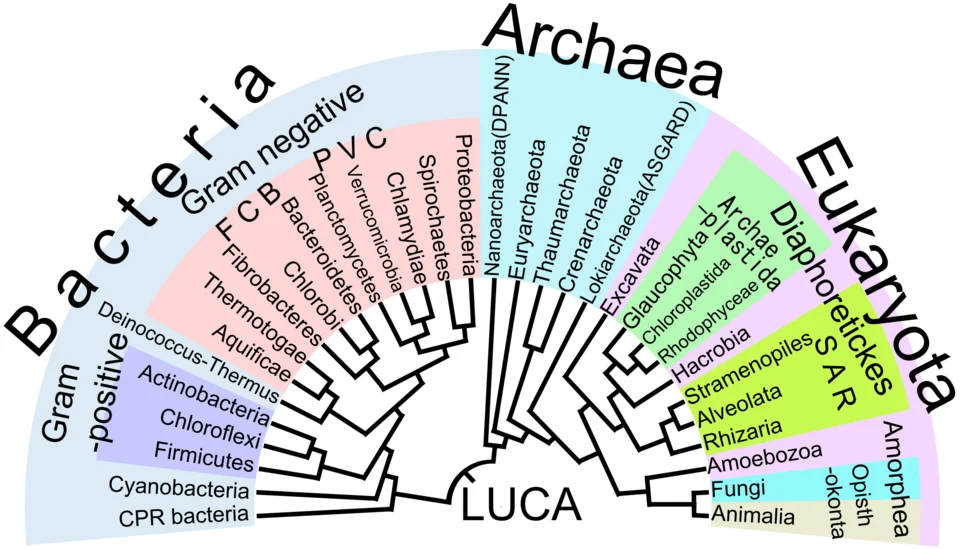 View larger
 Phylogenetic Tree of Life
Illustration associated with the linked encyclopedia article. Refer to the file record for the subject and interpretation.
Selected bibliography
Documented works and useful reading. This is not a list of every appearance.
- 01
The nature of the last universal common ancestor and its impact on the early Earth system
Published online 12 July 2024; Nature Ecology & Evolution 8, 1654–1666. Dating, gene-family reconciliation and ecosystem reconstruction; explicit model dependence. Main argument and relevant methods newly read; supplementary datasets and published code not independently rerun. Expanded account paraphrases this CC BY4.0 article with attribution: https://creativecommons.org/licenses/by/4.0/.
- 02
The physiology and habitat of the last universal common ancestor
Nature Microbiology 1, article 16116. Public abstract inspected; full subscription article not inspected.
Family & connections
A source-supported family tree or inspiration record has not yet been compiled for this profile. Related reading below indicates a connection in subject matter, not a proven lineage or creative influence.
Look for a taxonomic record and classified relativesEncyclopedia background
An additional attributed reference, separate from the editorial profile above.
Read the open encyclopedia overview
The last universal common ancestor (LUCA) is the hypothesized latest common ancestral population of single-celled organisms from which all subsequent life forms descend under the three-domain system of Bacteria, Archaea, and Eukarya. Most studies suggest that the LUCA existed by 3.5 billion years ago, and possibly as early as 4.3 billion years ago or earlier. The nature of this point or stage of divergence remains a topic of research.
All earlier forms of life preceding this divergence and all extant organisms are generally thought to share common ancestry. On the basis of a formal statistical test, this theory of a universal common ancestry (UCA) is supported in preference to competing multiple-ancestry hypotheses. The first universal common ancestor (FUCA) is a hypothetical non-cellular ancestor to LUCA and other now-extinct sister lineages.
Whether the genesis of viruses falls before or after the LUCA—as well as the diversity of extant viruses and their hosts—remains a subject of investigation as part of the virus world hypothesis.
With no discovered fossil evidence of LUCA, it may precede the earliest known life forms. However, the detailed biochemical similarity of all current...
Text from Wikipedia contributors, “Last universal common ancestor”. CC BY-SA 4.0. Extracted introduction; formatting changed. Retrieved 5 October 2026. The source article may have changed since retrieval.
References
Sources supporting this profile. Linked pages have their own scope and editorial standards.
- Primary phylogenomic study; CC BY 4.0The nature of the last universal common ancestor and its impact on the early Earth systemResearch access: 2026-10-05
- ResearchWeiss et al. 2016 — public research abstractResearch access: 2026-10-05
- ResearchMoody et al. 2024 — author institutional repository PDFResearch access: 2026-10-05
Image credits
Scientific hypothesis diagramMoody and coauthors’ hypothetical reconstruction of LUCA’s cellular features, ancestry and ecosystem, 2024
This 2024 model connects inferred cellular functions with LUCA’s ancestry and possible ecosystem. Black and grey labels distinguish different confidence thresholds for reconstructed gene content. The cell shape, metabolic exchanges and early-Earth settings are hypotheses from the authors’ analysis, rather than photographs, fossils or a definitive account of LUCA’s appearance. The published figure is reproduced unchanged.
Further credits appear with each additional image.