Pteranodon
Image associated with the exact linked encyclopedia article; consult credited file description for its interpretation.
Overview
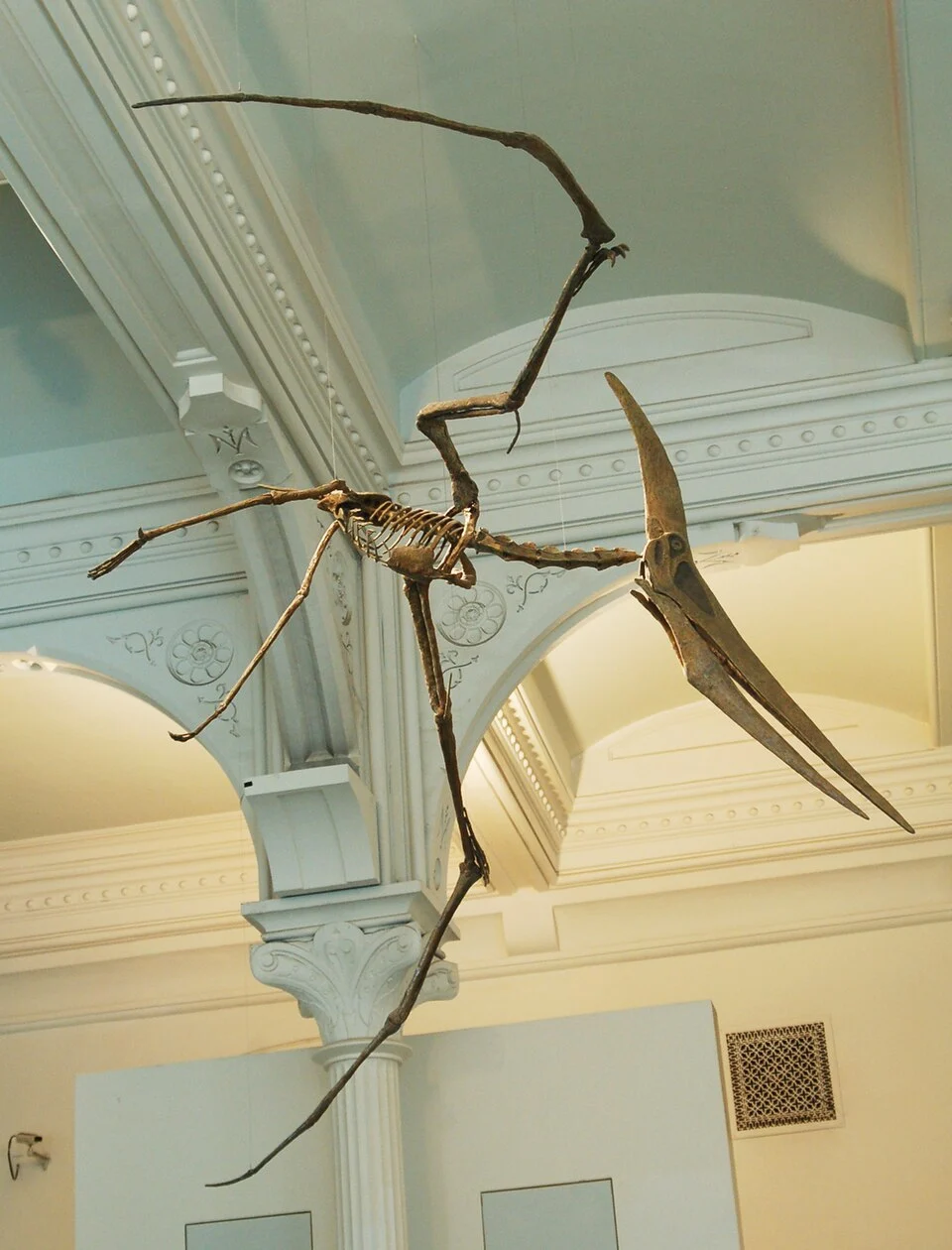
Pteranodon had long wings supported by an elongated fourth finger, a toothless beak and a striking backward-projecting crest. It was a pterosaur, an evolutionary branch distinct from both birds and dinosaurs. Fossils from western Kansas record an environment that was once part of the Western Interior Seaway rather than the dry landscape visible today.
Fish-eating and extensive flight over water are supported by its anatomy and fossil context. The style of launching, landing and feeding involves functional reconstruction rather than direct observation. Size and crest shape varied, and distinguishing species or sexes can require broader fossil comparisons. Pteranodon is important as an example of reptilian powered flight, but the wings of pterosaurs, birds and bats were constructed differently despite serving a comparable general function.
A specimen discussed by Hone, Witton and Habib in 2018 documents an unusual encounter with another animal. LACM 50926, displayed at the Natural History Museum of Los Angeles County, includes a series of neck vertebrae closely associated with a tooth identified as belonging to the shark Cretoxyrhina mantelli. Museum notes record collection from the Niobrara Chalk of Kansas in 1965, with a likely Santonian stratigraphic age. The authors retained Pteranodon sp. rather than confidently assigning a species because diagnostic skull material was not securely associated with the vertebrae.
The display is a composite assembled from more than one individual, with reconstructed parts replacing missing bones. The three connected neck vertebrae were considered a secure individual association, whereas their continuity with other mounted elements could not be assumed. The shark tooth lay in intimate contact with the fourth cervical vertebra but did not penetrate its outer bone surface. This matters: a dramatic illustration of a tooth-driven attack should not be mistaken for an observed puncture wound. Measurements and anatomical inspection were also constrained by the enclosing display case.
The authors favoured a biting interaction over accidental association because the tooth’s position was complex and close, comparable feeding traces were known from the formation, and chance transport seemed less plausible in the depositional setting. They did not identify other unequivocal bite marks on the displayed material. A small circular hole was considered more likely damage from preparation or an earlier mount, while damaged neural spines could have several causes. The fossil thus offers evidence of a probable feeding interaction without fixing the complete sequence of events.
Crucially, the study could not distinguish an attack on a living pterosaur from scavenging a floating carcass. Both were considered plausible: Pteranodon’s inferred marine foraging could place it within reach of sharks, while a low-density carcass might remain afloat. The accompanying life reconstruction deliberately portrays a speculative predatory scene. This example adds a locality-specific ecological link, while the rarity of such associations and the fragility of pterosaur bones limit broader conclusions about how often these encounters occurred.
Origins & earliest records
Important Pteranodon fossils were collected in Kansas during nineteenth-century expeditions, and the genus became widely recognised through subsequent study. The representative age near 85 million years refers to Late Cretaceous marine deposits. Collection and naming dates are historical events, separate from the origin of pterosaurs or the first appearance of this genus.
Evidence & interpretation
Wing bones, skulls and marine sedimentary context constrain anatomy and habitat. Comparisons and mechanical models suggest soaring and fish feeding. Missing soft tissues complicate exact flight reconstructions, while incomplete skulls can obscure crest variation. The presence of large wings does not independently prove one particular takeoff technique or habitual feeding depth. LACM 50926 supports a probable shark feeding interaction, while its composite mount, absent diagnostic skull association and lack of diagnostic predation-versus-scavenging evidence constrain interpretation.
Selected bibliography
Documented works and useful reading. This is not a list of every appearance.
- 01
Pterosaur: Pteranodon
Selected institutional scientific reading; not a complete bibliography.
- 02
Evidence for the Cretaceous shark Cretoxyrhina mantelli feeding on the pterosaur Pteranodon from the Niobrara Formation
PeerJ 6: e6031, 14 December. Complete main report, specimen Methods, taxonomic discussion and captions. CC BY 4.0.
Family, evolution & connections
Pteranodon’s sampled clade in the 2013 combined morphological analysis
Nine terminal taxa in the Pteranodon-containing clade of Figure 11B; other sampled pterosaurs and outgroups omitted.
Scroll sideways to see all branches. With a keyboard, focus the tree and use the arrow keys.
- Selected Pteranodon-containing clade (Figure 11B)
- Remaining sampled clade (three unresolved branches)
- Ludodactylus / Guidraco pair
- Ludodactylus sibbicki
- Guidraco venator
- Nurhachius / Istiodactylus pair
- Nurhachius ignaciobritoi
- Istiodactylus latidens
- Tropeognathus and sampled Anhanguera
- Tropeognathus mesembrinus
- Sampled Anhanguera (unresolved)
- Anhanguera blittersdorffi
- Anhanguera piscator
- Anhanguera santanae
Pruned branching topology from the strict consensus of 12 equally parsimonious trees in the recoded Wang dataset plus 23 pelvic characters (129 characters in total). Unresolved nodes retain multiple children. This is one 2013 morphological analysis, not a current consensus for all pterosaurs. Figure 11A’s pelvis-only matrix has much poorer resolution and does not recover this same resolved subtree. Species labels follow the paper’s historical identifications. No branch lengths, dates or direct ancestors are inferred; the three Anhanguera tips remain an unresolved group.
Pteranodon and sampled relatives — Wu et al. 2017
Complete nine-terminal clade below node 224 in S3 Figure; the surrounding pterosaur tree is omitted.
Scroll sideways to see all branches. With a keyboard, focus the tree and use the arrow keys.
- Selected nine-tip clade — node 224; bootstrap 7
- Node 223; bootstrap 47
- Pteranodon sternbergi
- Pteranodon longiceps
- Ornithostoma sedgwicki
- Node 225; bootstrap 5
- Alamodactylus byrdi
- Node 226; bootstrap 11
- Cretornis hlavaci
- Node 229; bootstrap 13
- Muzquizopteryx coahuilensis
- Nyctosaurus group — node 228; bootstrap 10
- Nyctosaurus lamegoi
- Node 227; bootstrap 49
- Nyctosaurus nanus
- Nyctosaurus gracilis
TNT 1.5, 271 equally weighted morphological characters, continuous characters rescaled to unity; 2,000 random-addition replicates. A single most-parsimonious tree is shown. Labels identify nodes and S1 Table bootstrap percentages. Support is weak: the selected clade has bootstrap and jackknife 7%. Missing Bremer scores are not zero. Historical Pteranodon sternbergi naming is retained as printed. No branch lengths, dates or direct ancestors are inferred.
Taxonomic classification
A hierarchy of classified groups, not a chain of direct ancestors.
- kingdomAnimalia
- phylumChordata
- cladePterosauria
- genusPteranodon
Remaining sampled ornithocheirid-like clade (Naish et al. 2013)
Figure 11B places Pteranodon longiceps beside the sampled clade containing Ludodactylus, Guidraco, Nurhachius, Istiodactylus, Tropeognathus and Anhanguera. The pelvis-only analysis is much less resolved; neither diagram establishes a named fossil as another’s direct ancestor.
Nyctosaurus and other sampled pteranodontoids
Wu and colleagues group the sampled Pteranodon pair with Ornithostoma and a clade including Nyctosaurus. The combined branch has only 7% bootstrap support; this is a study-specific hypothesis, not direct ancestry.
Encyclopedia background
An additional attributed reference, separate from the editorial profile above.
Read the open encyclopedia overview
Pteranodon (; from Ancient Greek pteron 'wing', an- 'without', and odon 'tooth') is a genus of pterosaur that included some of the largest known flying reptiles, with P. longiceps having a wingspan of over 6 m (20 ft). They lived during the late Cretaceous geological period of North America in present-day Kansas, Nebraska, Wyoming, South Dakota and Alabama. More fossil specimens of Pteranodon have been found than any other pterosaur, with about 1,200 specimens known to science, many of them well preserved with nearly complete skulls and articulated skeletons. It was an important part of the animal community in the Western Interior Seaway.
When the first fossils of Pteranodon were found, they were assigned to toothed pterosaur genera, which includes Ornithocheirus and Pterodactylus. In 1876, Othniel Charles Marsh recognised it as a genus of its own, making particular note of its complete lack of teeth, which at the time was unique among pterosaurs. Over the decades, multiple species would be assigned to Pteranodon, though today, only two are recognised: P. longiceps, the type species, and P. sternbergi. A third species, P. maiseyi, may also exist. Some researchers have suggested the latter two as a genus of their own, Geosternbergia, though this is the subject of some debate. Another genus split from Pteranodon, Dawndraco, may be synonymous with Geosternbergia if that genus is valid, or with Pteranodon if it is not.
Pteranodon is part of the family Pteranodontidae, part of the clade Pteranodontia, which also includes nyctosaurids. Pteranodontians form a larger clade, Pteranodontoidea, alongside ornithocheiromorphs, and that clade falls under the suborder Pterodactyloidea. While not dinosaurs, pterosaurs such as Pteranodon form a clade closely related to dinosaurs as both fall within the clade Avemetatarsalia.
Two distinct morphs of Pteranodon specimen have been found, that are thought to represent males and females. Male and female Pteranodon differed in size and crest shape. Males attained wingspans of 5.6–7.6 m (18–25 ft); females were smaller, averaging 3.8 m (12 ft). The crests of males were far larger than those of females. In P. longiceps, they were long and backswept, whereas in P. sternbergi, they were tall and upright. Females also had wider pelvises than males.
Text from Wikipedia contributors, “Pteranodon”. CC BY-SA 4.0. Extracted introduction; formatting changed. Retrieved 5 October 2026. The source article may have changed since retrieval.
References
Sources supporting this profile. Linked pages have their own scope and editorial standards.
- MuseumPterosaur: PteranodonResearch access: 2026-10-05
- ResearchNiobrara pterosaur and shark associationResearch access: 2026-10-05
Image credits
Reference illustrationPteranodon
Image associated with the exact linked encyclopedia article; consult credited file description for its interpretation.