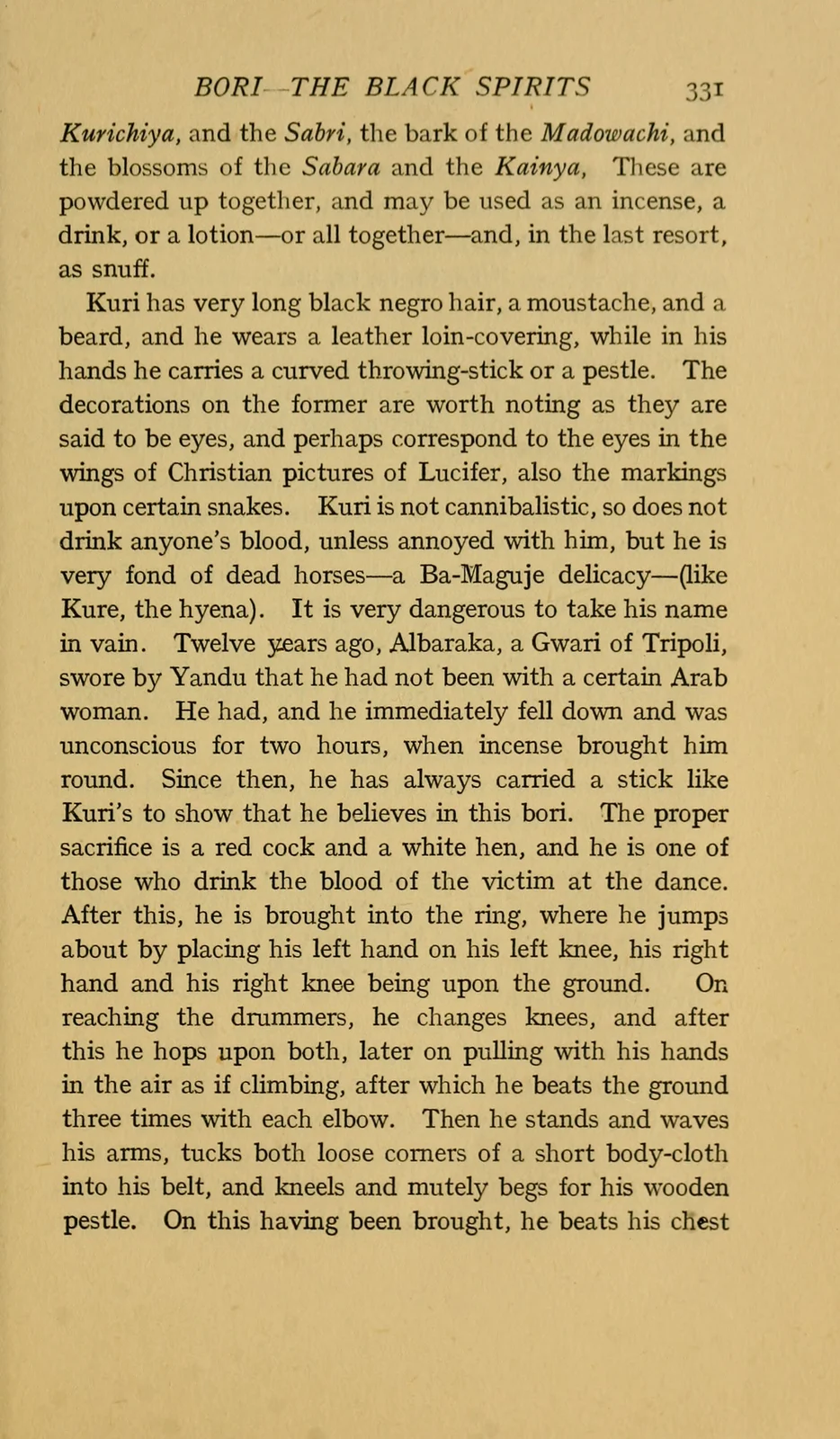
Kuri,1914 historical printed text witness, page331; documentary source-page facsimile
Documentary text facsimile naming Kuri and describing ritual/narrative attributes; not a photograph of a spirit or creature artwork. Colonial observer terminology and interpretations belong to the original1914 text.
Overview
Kuri, also given the names Yerko and Yandu, is represented in Tremearne’s account with long black hair, moustache and beard, a leather loin covering, and a curved throwing stick or pestle. The throwing stick has decorations interpreted locally as eyes; the collector’s further comparisons are speculative. The chapter identifies him as the husband of Doguwa, Risana and others, associates him with boxing and protective charms, and warns against invoking his name falsely. A reported Tripoli incident concerns Albaraka, who afterward carried a matching stick to show adherence.
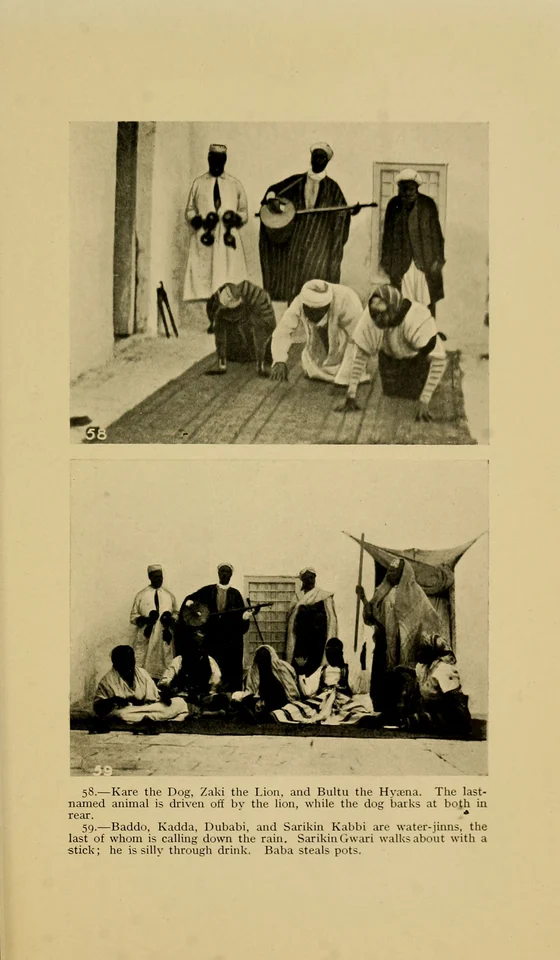
The dance supplies a detailed bodily enactment: the mount alternates knees, hops on both, makes climbing motions, strikes the ground with each elbow and requests the wooden pestle. He strikes chest, head and sides with it before another circuit and a final sneeze. These actions belong to the performer’s representation, not evidence of an independent spirit body. The translated song calls on a roaring, hairy figure with weapons and asks access to Doguwa.
An earlier collected tale gives a sharply different setting. In The Boy Who Cheated Death, a wealthy youth is challenged to enter Rago's house, where yesterday's visitor is killed as the next guest's meal. Tremearne's note explicitly interprets Rago as both ram and Terrible One and identifies this figure with Kuri, described there as ram-headed or he-goat-headed. The young man is welcomed and eats while his horse waits with him inside. Before another visitor can arrive and make him the next victim, Rago's wife opens a back door and lets him ride away. The host discovers the escape only after a new guest appears and pursues the fugitive, calling for him to stop. The rider refuses and reaches home; Rago then concedes his fortune and says that only God will kill him. This is the collector's stated identification across two witnesses, with a predatory household episode alongside the later possession performance, rather than one uniform depicted form.
Origins & earliest records
Tremearne’s historical collection combines accounts and ritual observations in Hausa-associated North African communities and northern Nigeria. Its evolutionary and comparative origin theories are not adopted.
Records & interpretation
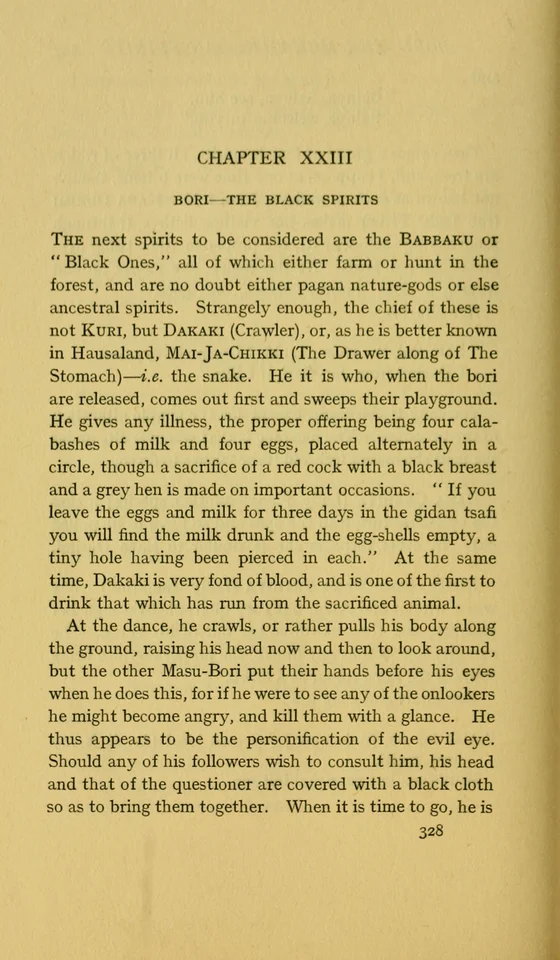
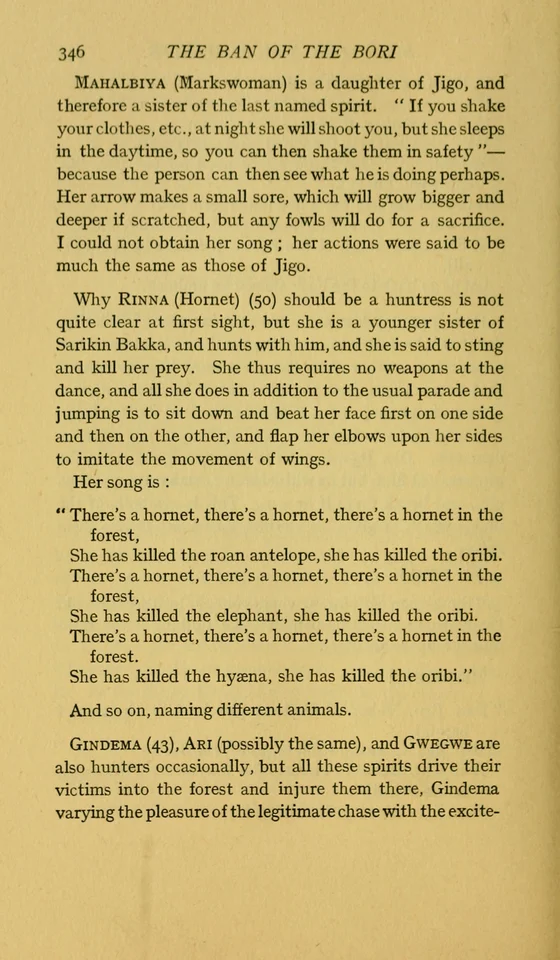
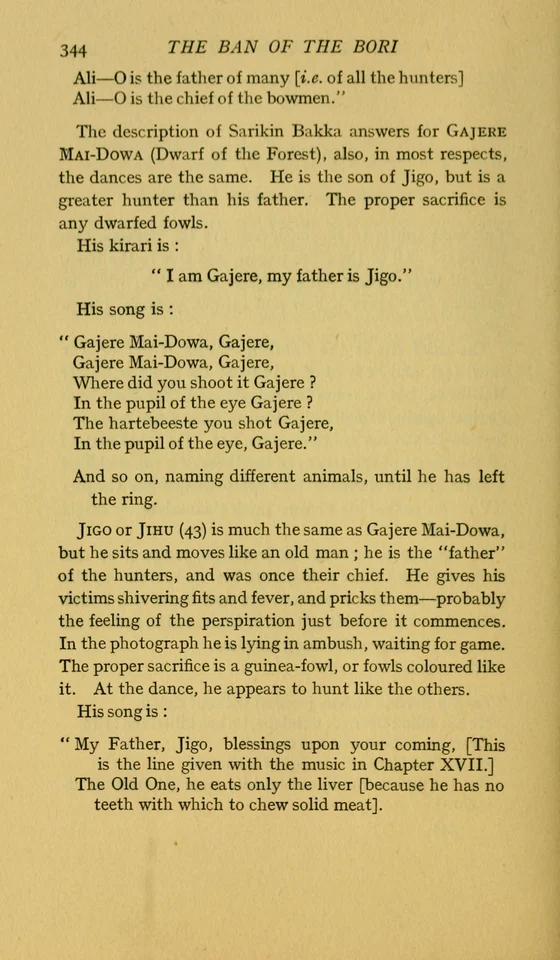
The Ban of the Bori, pp 330–332. Ritual movements describe human mounts representing spirits; translated songs and attributed powers are evidence of this recorded representation, not proof of medical causation or uniform contemporary community practice. The 1913 Rago episode and note XCVI.5 add an explicit collector identification, distinguished from the 1914 possession enactment.
Selected bibliography
Documented works and useful reading. This is not a list of every appearance.
- 01
The Ban of the Bori
Selected witness pp 330–332; colonial collection with uneven narrator attribution.
- 02
Hausa Superstitions and Customs
Second edition; tale 96 Rago episode pp. 444-446; note XCVI.5 p. 515 identifies Rago with Kuri.
Family, evolution & connections
Attributed sons of Kuri and the forest Doguwa aspect
Tremearne’s distinct informant qualifications in the 1914 notices, pp. 316–318.
Scroll sideways to see all branches. With a keyboard, focus the tree and use the arrow keys.
- Kuri + Uwar-Dowa / Doguwa Na Daji (reported parents; version qualified)
Mai-Aska is a son of Kuri/Uwar-Dowa according to some; Sambo is a younger son of Kuri/Doguwa Na Daji according to most. Joint root groups two named parents. The labels preserve different attribution strengths. Some instead call Sambo the forest aspect’s husband; this contradictory marital version is recorded separately in prose, not drawn simultaneously as descent. The two son reports do not independently state full brotherhood or a shared universal pantheon. House and forest aspects are not silently interchangeable. This is textual religious genealogy, not biological evolution.
Doguwa
The Doguwa notice calls both house and bush aspects wives of Kuri. It also records other attributed husbands for particular manifestations; this is one reported marital witness, not a resolved, universal genealogy.
Risana
The Kuri notice names Risana among his wives, while Doguwa’s song calls Doguwa the first-married head wife. Neither reference states children of Risana or authorizes a complete household reconstruction.
References
Sources supporting this profile. Linked pages have their own scope and editorial standards.
- Historical ritual observation and translated songsThe Ban of the Bori — KuriResearch access: 2026-10-05
- Collected primary narrative with comparative identificationTremearne 1913 Rago episode and Kuri identificationResearch access: 2026-10-05
Image credits
Historical text facsimileKuri,1914 historical printed text witness, page331; documentary source-page facsimile
Documentary text facsimile naming Kuri and describing ritual/narrative attributes; not a photograph of a spirit or creature artwork. Colonial observer terminology and interpretations belong to the original1914 text.